

Accept reality and deal with it in the right way. Co-Founder @Aurum8880 The posts are for informational purposes, NFA.
Italia
Joined May 2021
- Tweets14.9K
- Following976
- Followers1.4K
- Likes49.9K



Pinned Tweet
"Who will own the value created by machines in an automated, decentralized world?"
A new ecosystem is emerging, redefining value beyond money.
It’s about shared value, freedom, and empowerment.
@peaq is leading the way.
(Estimated reading time: 30 minutes)
Ready to dive deep?
The EUDR is entering its decisive phase.
This is where ethereum:0x51cb253744189f11241becb29bedd3f1b5384fdb will make the difference.
Because the true value lies in connecting agricultural data—that is where the value of digital agriculture lies.
There are now less than 6 weeks to go.
It is on this convergence of regulation, digital infrastructure, and demand for services that the long-term thesis on Dimitra is built.

ѕтєνєη retweeted

An OEM partner sending another $1M worth of robots to your lab says something about the work happening behind the scenes for @Auki
Building a robotics product is one thing but getting manufacturers to trust your technology enough to put more of their hardware into your hands is another.
More robots mean more opportunities to test integrations, improve deployment workflows and work across different robotic platforms.
Real opportunity for $AUKI is making deployment easier for many different robots in real world environments.


ѕтєνєη retweeted

The biggest name in voice AI buys its data from a DePIN project.
Most people still haven't noticed 👀
In case you missed it: @silencioNetwork is one of @ElevenLabs ' voice data suppliers. In the clip below the team explains why this matters.
And ElevenLabs isn't the only one. Silencio also works with other big names in AI, including a Tier 1 AI lab and billion-dollar AI companies, still under NDA.
The latest numbers:
▪️ ~$100K in Q1, ~$300K in Q2, ~$640K in Q3
▪️ $1.04M received in 2026 so far
▪️ Every client has ordered again
▪️ 2026 on track to close above $2M, according to the team
▪️ $1M milestone crossed, base:0x6bd83abc39391af1e24826e90237c4bd3468b5d2 buybacks activated for Q4
3.4 billion people still can’t talk to AI in their own language. That data can’t be scraped, it has to be recorded by real people.
That’s where DePIN fits perfectly imho: 2.5M+ contributors in 185+ countries recording on their own phones and getting paid for it.
When robots become a commodity, whoever controls the infrastructure will capture the value.
base:0xf9569cfb8fd265e91aa478d86ae8c78b8af55df4 ’s strategy focuses on a resource that is set to become central to robotics 👇
collaboration between machines and environments.
The world’s smartest robot might have an economic problem...
Imagine that tomorrow a company manages to develop a robot equipped with general artificial intelligence, capable of learning and performing any human task.
The cost of hardware continues to fall.
AI models are becoming more efficient.
Robotic capabilities are gradually spreading among competing manufacturers.
Yet, to turn that robot into a commercial service, infrastructure, maintenance, insurance, software integration, logistics, and access to information about the surrounding environment will still be needed.
The real economic opportunity may lie precisely in the resources that enable artificial intelligence to operate in the physical world.
But let’s take a closer look at this argument...
Squeezing margins will change the Economics of Robotics 📌
@Auki first belief concerns the competitive evolution of the sector: hardware and artificial intelligence will progressively trend toward ever-shrinking margins.
The economic logic is that of commoditization.
When multiple manufacturers are able to offer similar capabilities, competition puts pressure on prices and shifts part of the value toward complementary services, distribution, and infrastructure.
In his presentation, Auki cites a 90% reduction in the prices of robots designed for hotels and restaurants over a five-year period.
If robotic intelligence becomes progressively more accessible, the competitive advantage could lie in the ability to deploy, coordinate, and keep millions of devices operational.
Value will shift toward those who make the work of machines economically sustainable.
Robots and Environments Will Become Reusable Infrastructure 📌
The second belief presented by Nils Pihl is particularly relevant to Auki’s business model.
A robot and the environment in which it operates can become shared resources, usable by different applications and operators.
Consider a supermarket that has already digitized its spaces, identified its shelves, and built a spatial representation of its products.
This infrastructure can support inventory management, navigation, monitoring, and, over time, robotic automation.
The economic value stems from the ability to spread the initial costs across multiple services.
An investment in digitizing the store could therefore generate benefits through subsequent applications, increasing the return on the existing infrastructure.
Auki aims to position itself precisely at this level, through its protocol and the applications developed around it.
The vision is that of a reusable spatial infrastructure, in which different devices can share references, information, and operational capabilities.
Each new compatible device could increase the economic utility of already digitized environments.
Collaboration will retain its value even with nearly free Intelligence 📌
The third belief completes the strategy.
Even if we imagine a future in which artificial intelligence has an extremely low marginal cost, information about the physical world and the resources needed to utilize it would remain economically significant.
A robot might be perfectly capable of recognizing a product, but knowing its location in advance would allow it to complete the task more quickly.
Two devices might have equivalent computational capabilities, but sharing an up-to-date map would help avoid redundant operations.
The value of collaboration stems from savings in time, energy, and computational capacity.
This is one of the most interesting insights of the Auki strategy.
The history of technology shows just how important it can be to control the infrastructure that enables an entire industry to grow.
Robotics could follow a similar trajectory.
As manufacturers develop increasingly capable machines, the need arises to digitize environments, coordinate devices, and make their operations economically sustainable.
Auki is working to build this foundation through a well-defined strategy.
That’s why the race for robotics could be won before the robots even arrive.
🤖 Made with AI

The next financial infrastructure could start with a farm plot.
A geolocated plot of land.
A documented harvest.
A shipment linked to its producers.
Every verifiable piece of information helps build a supply chain that is more transparent and potentially more accessible to international markets.
The EUDR is accelerating demand for these capabilities. The financial sector may represent another area of application.
@dimitratech is developing the tools to connect these processes, while ethereum:0x51cb253744189f11241becb29bedd3f1b5384fdb serves as the utility component of its Protocol.
Agriculture’s next major asset could be the measurable trust embedded in its data.
And the evolution of this infrastructure will be one of the key factors to watch in the long-term thesis on ethereum:0x51cb253744189f11241becb29bedd3f1b5384fdb.
The Internet is about to welcome a new category of users.
And there will be billions of machines. $AUKI
Imagine a robot entering a supermarket to retrieve a product. It could spend several minutes scanning the shelves, consuming energy and computational power, or it could purchase the exact coordinates of the item directly from the store for just a few cents.
Ten cents to save time, battery life, and operational resources.
A seemingly insignificant interaction that introduces an economic model completely different from the one we’re used to.
When machines start using the Internet, value will gradually shift from human attention to immediate access to information.
This is the vision that @Auki explored in its recent update to the community.
ѕтєνєη retweeted

We're about to come back ⌛

It’s been almost exactly one year since the ethereum:0x4a220e6096b25eadb88358cb44068a3248254675 report was published on @Aurum8880 .
What do you think about releasing a new report, this time a vertical one on @FusionLayer25 ? 👀
Let us know in the comments 👇
Privacy is becoming a structural requirement of tokenized finance ethereum:0x5f64ab1544d28732f0a24f4713c2c8ec0da089f0
The tokenization of financial assets is entering a phase in which the characteristics of the infrastructure matter just as much as those of the product.
A bank that issues tokenized funds must be able to identify authorized investors, enforce jurisdictional restrictions, protect commercial information, and ensure the verifiability of transactions.
The Bank for International Settlements (BIS), in its 2026 Annual Economic Report, highlights that the public visibility of transactions can create confidentiality issues in financial markets. The report also recognizes the importance of permissioned systems and mechanisms that limit data sharing to relevant parties.
As early as 2023, the BIS had identified the protection of trade secrets and the segregation of information among participants as central elements in the design of unified ledgers.
The message for RWA infrastructure developers is significant.
Institutional privacy must be designed in tandem with authorization systems, governance, and audit procedures.
The next level of on-chain finance requires selective transparency.
This is precisely the architectural direction chosen by @Memento_Bc .

The world’s next major database could emerge from farm fields
A pineapple grown in the heart of Suriname can tell us much more than just its origin.
It can hold information about the soil in which it grew, the farming practices used, the harvesting process, and the journey that will take it to international markets.
For an indigenous community, this information can represent a new economic opportunity: making the value of their work visible and verifiable.
This is where blockchain finds one of its most practical applications: transforming the history of an agricultural product into verifiable digital assets.
On November 13, 2026, Jon Trask, CEO of ethereum:0x51cb253744189f11241becb29bedd3f1b5384fdb , is scheduled to speak at the FAO’s e-Agriculture Forum to discuss this very transformation, using the experience of Surinamese pineapple farmers as a case study.

ѕтєνєη retweeted

Online advertising works by remembering. base:0xf9569cfb8fd265e91aa478d86ae8c78b8af55df4
Profiles build with every visit, growing more valuable the longer that history runs.
@Auki 's model for machines paying for data skips that build-up.
Machines pay a few cents to ask where one item is.
They get an answer, and nothing else follows.
Many small local maps, instead of one global one, changes where that kind of profile could even form.
Each question lives and dies on its own
With no bigger file for it to join.
The new economy of agricultural traceability stems from European regulations.
That is why agriculture’s next competitive advantage will be the ability to demonstrate
Product quality opens the door to negotiations. The quality of the data can determine how easily those negotiations turn into a contract. ethereum:0x51cb253744189f11241becb29bedd3f1b5384fdb

EUDR compliance is just the ticket to play. It won't guarantee your buyer contracts. 🚨
If your cooperative relies on scattered paper records, your EU market access and trade finance are at immediate risk.
Join our Nov 19 executive briefing to defend your revenue.
🕚 11:00 CET | 13:00 Nairobi | 17:00 Jakarta
👇 Secure your spot here: dimitra.io/webinars/due-dili…
#EUDR #Cooperatives #SupplyChainRisk #AgTech

The future of Physical AI lies in intelligent spaces.
The advances presented by base:0xf9569cfb8fd265e91aa478d86ae8c78b8af55df4 point to a clear direction.
"Robots that share what they see."
Environments that maintain a shared spatial memory.
Sensors and devices that collaborate through an interoperable protocol.
Auki’s potential lies precisely in its ability to transform these capabilities into an infrastructure that can be used by different robots within real-world environments.
Imagine a warehouse where every robot benefits from the observations of the others. A supermarket that continuously updates its digital twin. A building where different devices collaborate through a shared spatial representation.
This is the vision that Auki is striving to bring to life.
The next leap in robotics could come from machines’ ability to share a single understanding of the physical world.
And if smart spaces become an essential component of Physical AI, the infrastructure connecting them could take on a strategic role.

Smarter spaces create smarter robots.
That's @Auki 's thesis and here are a few recent updates 👇
▪️ One Galbot pointed at a cart it couldn't see. A second Galbot could see the cart and through collaborative perception the first one still knew where it was.
▪️ Two robots sent point clouds to a third peer, which merged them into one scene. Both robots then used that scene live to avoid collisions.
▪️ Many retailers want to recognize products from images but have no product photos. @CactusXR already scans the store, so the idea is to create those images along the way.
▪️ Auki also went to Securitas Day 2026, a corporate security event on AI and robotics. It sees its self-hosted digital twin as of special interest for security use cases that put privacy first.
Auki is building where physical AI will actually be used: real spaces. Curious what comes next 🦾

A market driven by regulatory requirements that open the door to significant opportunities for ethereum:0x51cb253744189f11241becb29bedd3f1b5384fdb
The scale of the opportunity becomes clear when considering the scope of the regulation.
The EUDR covers seven main categories of raw materials:
-cattle
-cocoa
-coffee
-palm oil
-rubber
-soy
-and timber..
According to the European Commission, agricultural expansion is the main driver of global deforestation, with approximately 10 million hectares of forest lost each year.
The regulation requires relevant operators to demonstrate that products comply with deforestation-free criteria and applicable laws in the country of production.
For operators responsible for the first placing on the European market, this involves collecting verifiable information and, where required, submitting due diligence statements.
The 2025 legislative amendments have also simplified the obligations for various downstream operators, placing greater responsibility for due diligence on the first operator.
From an economic perspective, this scenario creates structural demand for data collection, agricultural mapping, and traceability platforms.
The ability to integrate these capabilities into business processes is one of the main growth drivers for providers such as @dimitratech .

The EUDR countdown is turning agricultural traceability into an economic necessity
December 30 is fast approaching.
Supply chains must be ready.
There are less than two months left until a deadline that could redefine how some of the most important international agricultural supply chains operate.
Every year, millions of metric tons of coffee, cocoa, soy, and other raw materials cross borders, pass through ports, and move through distribution centers before reaching European consumers.
Starting December 30, 2026, the European Union Deforestation Regulation (EUDR) will take effect for large and medium-sized operators, introducing new due diligence and traceability requirements.
For the companies involved, the ability to trace the geographic origin of raw materials will become a fundamental requirement for accessing the European market.
This change presents a concrete opportunity for digital infrastructures capable of connecting farms, cooperatives, exporters, and importers.
And this is where @dimitratech Technology comes in.
Infrastructure becomes particularly attractive when its utility grows in tandem with the needs of the market it serves.
ethereum: ethereum:0x51cb253744189f11241becb29bedd3f1b5384fdb is seeking to build precisely this kind of position in global agriculture.
The Dimitra case presents several favorable factors...
- already developed infrastructure,
- documented institutional partnerships,
- international presence
- a regulatory catalyst with defined deadlines
- $10.7 million in revenue and estimates of up to $90 million in ARR
The market may assign greater value to the project as these activities translate into recurring revenue and measurable adoption of the protocol.
And if the next big opportunity in the blockchain sector were to emerge from data that enables millions of farmers to access international markets, ethereum: ethereum:0x51cb253744189f11241becb29bedd3f1b5384fdb would certainly deserve attention.
The first signs of a new phase of adoption for @dimitratech .
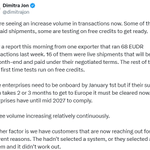
According to Jon Trask, a single exporter processed 68 EUDR transactions over the course of a week.
Of these, 16 involved actual shipments, scheduled to be invoiced at the end of the month in accordance with negotiated commercial agreements. The remaining 52 were test transactions carried out using free credits.
The infrastructure is beginning to integrate into the daily processes of agricultural supply chains.
But the real catalyst that will ramp up activity will be the EUDR; the implementation of the regulation could further expand the market for verification services.
68 transactions represent an initial observable sign.
The real story will be understanding how quickly this model can be replicated across thousands of exporters.
And this is precisely where the long-term thesis on ethereum:0x51cb253744189f11241becb29bedd3f1b5384fdb becomes interesting.

The next economy will need a map.
For decades, we have been building infrastructure to enable information to travel across the Internet.
We are now entering a phase in which intelligent machines will also need to understand where they are, what surrounds them, and how to collaborate.
Physical AI could represent one of the most significant boosts to global productivity.
The scale of the opportunity is enormous.
The distribution of value will depend on which companies succeed in building essential and sustainable infrastructure.
Auki is working on one of the fundamental challenges of this transition: making the physical world readable and navigable by artificial intelligence.
Just as the Internet connected information and blockchain introduced new forms of economic coordination, Physical AI could connect intelligence to the real world.
And every intelligent machine, before taking action, will need to know where it is.
It is within this context that the thesis on base: base:0xf9569cfb8fd265e91aa478d86ae8c78b8af55df4 is developed.
🤖 Made with AI

The first signs of a new phase of adoption for @dimitratech .
According to Jon Trask, a single exporter processed 68 EUDR transactions over the course of a week.
Of these, 16 involved actual shipments, scheduled to be invoiced at the end of the month in accordance with negotiated commercial agreements. The remaining 52 were test transactions carried out using free credits.
The infrastructure is beginning to integrate into the daily processes of agricultural supply chains.
But the real catalyst that will ramp up activity will be the EUDR; the implementation of the regulation could further expand the market for verification services.
68 transactions represent an initial observable sign.
The real story will be understanding how quickly this model can be replicated across thousands of exporters.
And this is precisely where the long-term thesis on ethereum:0x51cb253744189f11241becb29bedd3f1b5384fdb becomes interesting.
ѕтєνєη retweeted
Somewhere in this pipeline, a step exists just to forget faces.
A robot records video. base:0xf9569cfb8fd265e91aa478d86ae8c78b8af55df4
Before anything looks at that footage to understand what’s in it, another step blurs every person in frame.
That step is one node in a chain someone assembled, sitting between the camera and the computer vision that comes next.
@Auki is previewing a no-code tool for building chains like this one
By dragging nodes into place or describing it to an agent.
Which step someone chose to put in the middle, and why
Matters more than how fast the chain went together.

The Hidden Value in Agricultural Infrastructure
Major investment opportunities often arise where technology, economic needs, and structural transformations converge.
Global agriculture is currently undergoing precisely this phase.
Governments, producers, and multinational corporations need infrastructure capable of certifying the origin of raw materials, monitoring millions of hectares, and ensuring supply chain compliance.
It is on this convergence that ethereum: ethereum:0x51cb253744189f11241becb29bedd3f1b5384fdb business model is built.
The company combines artificial intelligence, satellite data, blockchain, and traceability tools to digitize fundamental processes in the agricultural economy.
🤖 Made with AI
