Underwater Cultural Heritage Of Stone Fish Weirs (@Stonefishweirs) header
Underwater Cultural Heritage Of Stone Fish Weirs (@Stonefishweirs) profile picture

Educational information site on the cultural heritage of stone fish weirs around the globe.

4 Chome-5-7 Konan, Minato City
Joined October 2021
Photo by Underwater Cultural Heritage Of Stone Fish Weirs (@Stonefishweirs)Photo by Underwater Cultural Heritage Of Stone Fish Weirs (@Stonefishweirs)Photo by Underwater Cultural Heritage Of Stone Fish Weirs (@Stonefishweirs)Photo by Underwater Cultural Heritage Of Stone Fish Weirs (@Stonefishweirs)Photo by Underwater Cultural Heritage Of Stone Fish Weirs (@Stonefishweirs)Photo by Underwater Cultural Heritage Of Stone Fish Weirs (@Stonefishweirs)Photo by Underwater Cultural Heritage Of Stone Fish Weirs (@Stonefishweirs)Photo by Underwater Cultural Heritage Of Stone Fish Weirs (@Stonefishweirs)Photo by Underwater Cultural Heritage Of Stone Fish Weirs (@Stonefishweirs)Photo by Underwater Cultural Heritage Of Stone Fish Weirs (@Stonefishweirs)
Some images of beautifully preserved #medieval wicker #fishweirs/trap from #Hemington, #England. The area around Hemington is known to have a large number of early fish weirs. Weirs dating to the mid-4th millennium BC have been claimed to exist from the #RiverTrent.1/4
8
132
12
784
44,138
Underwater Cultural Heritage Of Stone Fish Weirs retweeted
NEW Archaeologists have identified hundreds of Ice Age engravings 'hidden in plain sight' for decades in Catalonia, exposing a completely new rock art tradition in a region previously thought devoid of Palaeolithic art. 🆓 doi.org/10.15184/aqy.2026.10…
15
235
5
612
20,253
Fishing along the African coast, in many forms, appears in archaeological records for at least the last 100,000 years ago. Symbolising one of the deepest relationships between #African #indigenouscommunities and their aquatic environment. 1/4
1
3
8
234
#fishweirs made from stone and wood are found throughout the continent, made from a range of materials made to exploit local ecological niches. They represent an indelible link between aquatic environments, from the coast to the heart of Africa. 3/4
1
2
45
Fish protein is also a critical protein source for many of #African #indigenouscommunities. Historically, many communities used marine resources, whether they lived on the coast or in the interior, in the continent's many rivers, lakes, and wetlands. 4/4
3
38
Underwater Cultural Heritage Of Stone Fish Weirs retweeted
Very cool check it out. Newly discovered (noticed) Paleolithic rock art in Catalonia. A distinct artistic tradition to the more famous ones across in Southern France.
NEW Archaeologists have identified hundreds of Ice Age engravings 'hidden in plain sight' for decades in Catalonia, exposing a completely new rock art tradition in a region previously thought devoid of Palaeolithic art. 🆓 doi.org/10.15184/aqy.2026.10…
1
11
71
2,277
Images of the traditional “moka”, a fish trap on Makogai Island, Fiji. Makogai Island has several stone fish traps, ranging from large enclosures to smaller T-shaped ones. The trap's shape and its relationship to the coastline give insight into how it works. 1/4
1
1
1
23
1,244
The T-shaped traps have two distinct parts: a wall that extends from the high-water mark into the sea, acting as a physical barrier. The trap head is a heart-shaped enclosure. 3/4
1
3
74
The enclosures are more than traps; they are populated by fish, corals, and other species and become part of the area's living ecology. Rather than being a baited structure, it is constructed to create an ecological niche Which fish are attracted to. 4/4
6
52
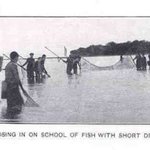
From 1901-4, a communal fishing scene with short drag seines and a fixed Moka (Wood/Brush Weir) in the background, by an indigenous Fijian fishing community. Pushing shoals of fish into nets to gather the catch, working as one unit to push and guide fish in a small space.
6
216
"Ðā cōm of mōrum under mist-hlēobum Grendel gongan, Godes yrre bǣr; mynte se man-scada manna cynnes sumne besyrwan in sele þām hēan." "In off the moors, down through the mist-bands / God-cursed Grendel came greedily loping." (Lines 710–713, translated by Seamus Heaney)
2
100
Stick in stone, humans and tide when knowledge and nature meet. Images of a fish yair weir /trap, Ardmore, Argyll and Bute, Scotland. From aerial pictures, it's very easy to identify the anthropogenic origin of these structures. 1/3
1
14
336
Historically, families owned them and sometimes donated them to religious foundations. Many of these traps are located at the mouths of small freshwater rivers, lakes, and lochs that attracted migratory species salmon and eels. 2/3
1
4
80
Fish yair weirs have been constructed for generations and likely date back to the medieval period, before any archaeological evidence. We have a large amount of written evidence about their running, maintenance, and taxation. 3/3
1
1
10
357
Images of large fish trap near Rabaul Township in New Britain, Papua New Guinea, 1975. The olval (Kuanau: babau) fish traps made from coconut and pandanus leaves and native plant materials. Making them was a closely guarded cultural tradition with great social value. #muSEAum
5
22
518
The long reach of Kent's maritime landscape! Herne Bay Pier was once one of the longest in the UK in its day. Designed in 1830, the pier began construction in 1831 under an Act of Parliament. 1/5
1
3
122
During its heyday, the pier had its own built-in rail system for passengers along the pier's length in a sail- and foot-powered trolley vehicle nicknamed Neptune's Car. As the route gained popularity, a train station was constructed in 1861, increasing the number of visitors. 4/5
1
38
Today, the landing stage still sits offshore, home to flocks of cormorants and other seabirds most of the year, while its partner on the shoreline draws tourists every year to buy ice creams and enjoy a day at the seaside. 5/5
25