

Real ships. Real cash flows. Structured on-chain.
Singapore
Joined January 2026
- Tweets272
- Following364
- Followers5.4K
- Likes1.1K
Pinned Tweet
SUPRO Vault is officially live. 🚢
Real ships. Real cash flows. Structured onchain.
Deposit USDT on BNB Smart Chain to access maritime private credit.
Launch-period target:
• Up to 15% net annualized yield
+ Referral boost
+ SUPRO Points
Another vault just got drained on BNB Chain.
This one was CoreVault. The attacker borrowed millions in a flash loan, bent the price oracle for a single transaction, and redeemed at 33 times the real value. The insurance pool - the fund meant to cover losses - paid for it. 160 BNB, gone in one block.
This is the weak point of vaults priced by code alone. An oracle reads whatever the market tells it, and enough borrowed money can rewrite the market for a moment.
A ship works differently. A signed time charter pays the same hire on green days and red ones. No flash loan can rewrite a contract already locked into a lockbox.
That is what we tokenize at Supro: real charter-hire receivables, not prices a single transaction can push around.
Price feeds can be fooled. Cash flow can't.
When inspecting a vault, do you first check the yield or the underlying number?
#RWA #BNB #Vault

SUPRO WEEKLY REPORT: RWA x Shipping 🚢⚓
Week of Nov 2-4
Our vault now holds a total of $2.07 million in deposits. This week, the live price of supUSDT started appearing in OKX Wallet and Binance Wallet.
Four things that moved this week:
⚓ Freight financing has gone digital. TradeGo and WaveBL have settled the first freight loan secured by electronic bills of lading. This means shipping’s oldest document is now loan collateral.
📈Research has shown that trade finance and maritime shipping are the real engines of tokenisation, not tokenised stocks. Their combined value has crossed $40 billion.
🏦Standard Chartered predicts that non-stablecoin on-chain assets will reach around $2 trillion by the end of 2028. This growth is driven by RWA tokenisation.
💳Fixed income is moving onto the blockchain. Centrifuge and Pendle have launched fixed-rate markets for tokenised credit on Base. Real-world credit already accounts for 82% of Pendle’s total value locked.
The takeaway is that $40 billion has been crossed bills of lading have become collateral and fixed income is now on-chain. Real yield from real trade isn’t a thesis; it’s compounding. ⚓

A big update: your SupUSDT is now visible in your wallet and shows the live price!
Deposit into the vault and receive SupUSDT. You can now track its price directly in your crypto wallet, such as OKX Wallet or Binance Wallet.
Contract: 0x2795f40bf9a20575125a8f42daa6461b4c0e5615
Not seeing it yet? Simply add the contract address manually and you’re done.
#SuproFinance #SupUSDT #RWA

When tokenised credit starts backing DeFi loans, the hard part is the cash schedule that gets underwritten.
On Supro, idle USDT funds short-tenor loans against signed hire and freight receivables.
Deposit and try: App.suprofinance.xyz

Tokenisation brings the asset onto the blockchain. Decentralised finance then determines its lending, borrowing or unused status.
A productive approach is short-term credit secured by signed receivables. Shipowners borrow against hire and freight they anticipate arriving on schedule. These loans are funded by idle USDT rather than vessel ownership.
Try it on 👉 app.suprofinance.xyz

One thing we think gets overlooked in the tokenization conversation is the role DeFi will play.
Getting financial assets onchain is one thing. Being able to use them across lending markets, as collateral, for borrowing, trading and generating liquidity is another.
We’re not just talking about moving existing assets onto new rails. We’re talking about opening up entirely new ways to interact with them.
Tokenization gets the assets onchain & DeFi gives them that utility.
Recent hack events at @binance serve as a reminder that security must evolve in the AI era. Cyber risk transcends cryptocurrency, impacting banks and the broader financial system.
Protecting assets is a shared responsibility, not a guarantee of complete security. Robust access controls and asset isolation are crucial for minimising damage. Credit diversification addresses a different risk and neither solution can replace the other.
Security incidents erode market confidence. Rebuilding trust requires improved safeguards and consistent effort.
We stand with those affected and everyone striving forward. Let’s stay vigilant support one another and continue building @BNBCHAIN.

🎃 SUPRO Finance × CryptoPulse | Halloween Special
🛳️ SUPRO Task
Follow @SuproFinance, connect your BSC wallet at app.suprofinance.xyz and deposit at least 20 USDT.
🎯 CryptoPulse Tasks
• Follow @CryptoPulseGLBL
(Don’t miss their social task with the USDT prize pool.)
• Download “CryptoPulse” from Google Play or the App Store
• Register and stay active
📅 Oct 29 – Nov 2, ending 23:59 UTC
Explore a target APY of up to 15%
*Target, not guaranteed. Withdrawals are not instant.
#SUPROFinance #CryptoPulse #Halloween

What makes a signed hire receivable fundable?
A signature is a starting point. What matters next is who owes the payment, where it flows, and how the financing is structured.
In Supro's model:
• The ShipCo is KYB-vetted and pledges its equity to an SPV.
• Charter hire is routed through the SPV's lockbox account.
• Clearing executes in code.
These are the arrangements behind the receivable, connecting an off-chain payment schedule with on-chain financing.
The next question goes beyond the headline yield: how is the cash flow structured?
Explore Supro Vault on BNB Smart Chain:
app.suprofinance.xyz/

Trade finance is putting dated payment obligations on-chain. Fair.
An electronic time draft is a buyer’s promise to pay later. A signed hire receivable is the same shape for ships.
Shipowners borrow against that schedule. Idle USDT funds those loans.
Learn more about SUPRO and Maritime private credit. Enjoy up to 15% APY on the yield.


A new milestone for Supro Vault: over 2 million USDT in total vault assets on BNB Smart Chain.
Thank you to everyone who's been part of the journey so far.
Explore the vault and its terms:
app.suprofinance.xyz/
More to come, stay tuned.

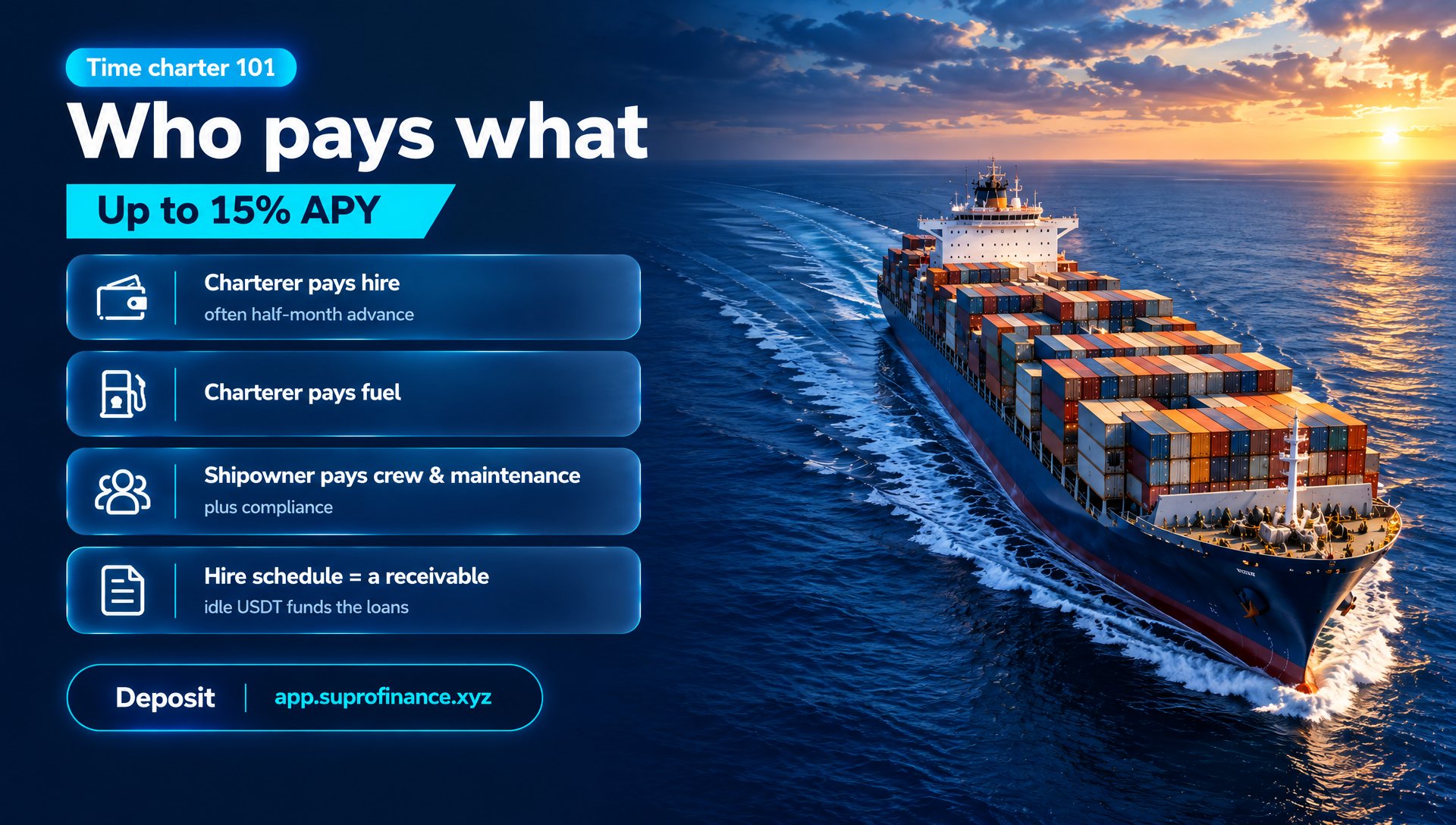
Time charter 101: who pays what.
Under a time charter, the charterer pays hire (often every half-month in advance) and covers the fuel.
The shipowner still pays the crew, keeps the ship maintained, and handles maritime compliance so the vessel can meet the speed and cargo terms in the charter.
Hire lands on a calendar. Crew and upkeep do not wait for that calendar.
A signed hire schedule is a receivable someone can underwrite. Shipowners borrow against it. Idle USDT funds those loans.
Now click app.suprofinance.xyz to deposit and enjoy up to 15% APY.
J.P. Morgan Asset Management (AM) has placed money and JLTXX on Solana for qualified US investors. These are tokenised money market funds offering cash parking with a guaranteed fund share. Unused dollars can also be used to fund short loans secured by signed charter hire. A schedule outlines when the cash is expected. Shipowners borrow against these receivables and idle USDT funds those loans.
BREAKING: @JPMorganAM's tokenized money market funds are live on Solana.
MONY and JLTXX are both available to qualified U.S. investors through Morgan Money, with subscriptions, redemptions and token balances handled on one platform.

ALT Solana and J.P. Morgan Asset Management logos in white on a purple Solana background
Banks still underserve many midsize shipowners.
That is one reason we chose shipping private credit. There are four more.
The financing need is real. Owners need cash between a signed charter and hire that arrives later.
The cash flows are identifiable. A charter sets the payment schedule up front.
The claim is contractual. Who owes what is already written.
Tenors can flex with voyage and time-charter cycles instead of sitting in a twenty-year box.
On Supro, idle USDT funds short loans against those signed receivables. Yield is a target, not a guarantee. Withdrawals are not instant.
Learn more about SUPRO, and maritime private credit.

Asset supply was never the scarce part. CoinDesk Research puts private credit near $2T and still calls stablecoin adoption the binding variable.
One credit object inside that supply is a signed charter. Hire is scheduled. Cash is expected later. Shipowners borrow against those receivables. Idle USDT funds those loans.
SUPRO funds short-term maritime loans, and it is the real demand in the world.

Supply of assets is not the constraint as private credit alone runs to roughly $2 trillion, before the far larger Treasury, money-market, and investment-grade universes the reserve also uses.
Even the bull case is well under 1% of private credit. Stablecoin adoption is the binding variable.
Full data and analysis from CoinDesk Research, commissioned by @RealFi_co: coindesk.com/research/beyond…

Mastercard just shipped risk scoring for stablecoin payments before the funds move on-chain.
Fast rails still need a yes or no on the counterparty.
Shipping finance has that step too. A signed charter pays hire across the contract while crew and maintenance bills keep coming. Someone has to underwrite that schedule before idle cash funds the loan.
On Supro, idle USDT funds those loans. Yield is a target, not a guarantee. Withdrawals are not instant. #Defi #RWA

DTCC is putting securities already held at DTC onto Canton and Besu.
That is a custody wrapper for assets that already exist in the books.
Another RWA stack starts earlier.
It funds short loans against signed charter hire and freight receivables.
Cash expected later under a contract already signed.
Not the hull. Not a tokenized stock.

DTCC picks Canton for launch, Stellar and Arc for 2027
DTCC (@The_DTCC) will launch its Tokenization Service this month on the @CantonNetwork and Besu, DTCC's private network. It starts with 25 stocks, ETFs, and US Treasuries, tokenized 1:1 with securities held at DTC and transferable 24/7 between registered wallets. DTCC puts the pool of assets available to tokenize at about $30 trillion.
@StellarOrg and Circle’s @arc are expected to join in 2027, per DTCC’s roadmap, which it says may still change.
The @Tesla just showed a Roadster that can fly.
We brought a flying ship.
RWA that flies. Maritime that flies.
Supro Flying Shipster.
The goal is the moon 🌕.
Let your idle stablecoins work for you.
Baltic assessed VLCC MEG to China at around $1.41 million a day this week.
A Baltic assessment at that level shows how hot tanker economics can run. The market is bigger than mega carriers. Mid-size shipping companies also need growth capital and working capital while hire and freight cash still clears on a voyage clock.
SUPRO is built for that need.
Idle USDT in the vault funds loans against signed charter-hire and freight receivables. Target about 8% net. For mid-size fleets, that can be a better fit than a bank line keyed to hulls and long underwriting cycles.
