

Swarm Robotics 🤖, Swarm Intelligence 🐜, Evolutionary Robotics 🧬, Bio-hybrid Systems 🌱🧍♀️, Machine Behavior ⚙️🦆
Konstanz, Germany
Joined November 2010
- Tweets5.3K
- Following673
- Followers2K
- Likes56.8K






Heiko Hamann retweeted

🚨Google DeepMind’s “AlphaProof Nexus” has solved 9 Erdős problems and the results have now passed peer review:
>two if them were open for 56 years
>also proves 44 OEIS conjectures
>every single step checked by Lean
>a few $100 per problem
>results are now published in Science
all while mathematicians are calling for a boycott of OpenAI after their paper dump.
WHAT A TIMING.


Heiko Hamann retweeted

How much do PhD students earn?
The first comprehensive overview of PhD income shows vast imbalances across much of Europe
Read the full story: nature.com/articles/d41586-0…

Heiko Hamann retweeted

Many staggering results here. But this is a particularly amazing one: the exponent for matrix multiplication is no more than 2.25. The previous world record had been something like 2.37. This leap in progress is like Bob Beamon's long jump.
github.com/openai/math/blob/…


We’re releasing a broad range of new mathematical results produced by an internal frontier model.
We’ve been consulting with the independent Advisory Group on Mathematics and Artificial Intelligence at the Institute for Advanced Study, and we have drawn on their advice and public recommendations to inform how we release these results.
github.com/openai/math

Heiko Hamann retweeted

BREAKING NEWS
The 2026 #NobelPrize in Physiology or Medicine has been awarded to Karl Deisseroth, Peter Hegemann and Georg Nagel “for their discoveries concerning light-gated ion channels and optogenetics.”

Heiko Hamann retweeted

Small bird, fast wings, Kolibri is here.
78B parameters. 3.46B active. Up to 1M tokens of context. Built in Europe.
Now the weights are yours. Run it on your own hardware, under Apache 2.0.
Heiko Hamann retweeted
This bioinspired robot can autorotate after aerial deployment to make a soft landing on water and convert to a sailboat—using only three actuators and three primary sensors. @sutdsg
Learn more in Science #Robotics: scim.ag/4d2c3Iu
Heiko Hamann retweeted

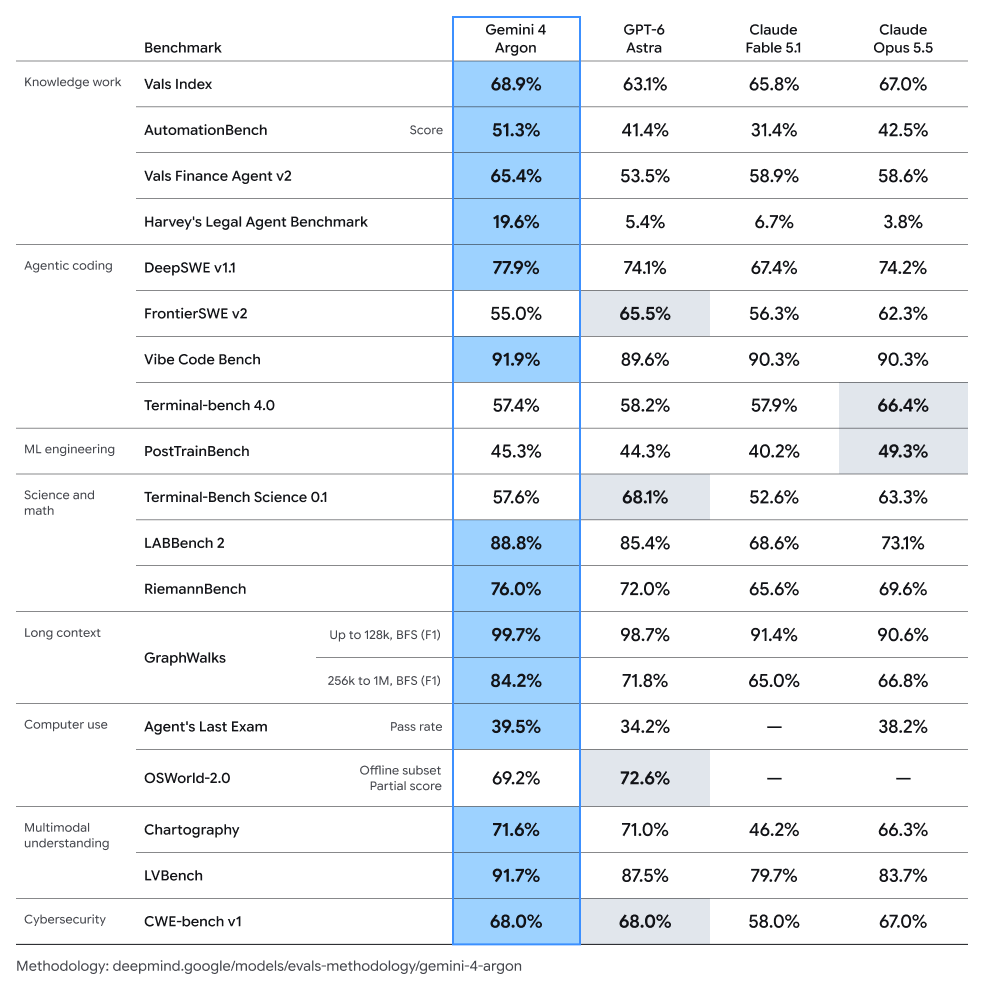
Introducing Gemini 4 Argon – our new frontier model.
It’s built for complex workflows across coding, enterprise knowledge work, and cybersecurity defense – rolling out today to a set of trusted testers through our Fairwind Program.
Heiko Hamann retweeted

An Anthropic AI solved a problem considered a “holy grail” of percolation theory—the math of how water passes through a porous solid, like coffee grounds. The landmark proof came just days after a Fields medalist predicted it.
spklr.io/6017EpVkL

Heiko Hamann retweeted

(1/n)
The number of research papers has gone wild. All generated by AI?
I pulled stats from CVPR/ICCV/ECCV, NeurIPS/ICML/ICLR, SIGGRAPH/SA/ToG since 2006: 119k papers + 460k arXiv preprints
Accepted/yr: 968 (2006) → 19,003 (2025) → 18,976 (2026 so far)
Quite surprising ->🧵


Heiko Hamann retweeted

🚨wtf. OpenAI says its new internal model it began training just 24 days ago has already resolved more than 100 long-standing open problems across most areas of mathematics.
The pace has surprised even OpenAI's own mathematicians.
An independent group including Edward Witten, Timothy Gowers and Martin Hairer is now helping assess the results and coordinate how they are released.

We’re working with an independent advisory group of mathematicians to help OpenAI responsibly share advances in AI and mathematics.
The group will advise on how we assess and communicate new mathematical results, uphold academic and professional standards, and build tools that support mathematical research and learning.
Through this work, we want mathematicians to be at the center of shaping how AI supports mathematical understanding and how its benefits reach the wider community.
openai.com/index/advisory-gr…

Heiko Hamann retweeted

New post reflecting on recent AI progress in math, how AI is changing the way we work, and some worries about where people will find meaning as they offload more of their work to AI (below)

ALT Infinite Faculty: Math, research, and meaning in the age of AI https://infinitefaculty.substack.com/p/math-research-and-meaning-in-the

Heiko Hamann retweeted
Do large language models actually understand the world, or are they just very good at pretending? Does it even matter?
Our recent special issue in the Royal Society, “World Models in Natural and Artificial Intelligence,” brings together pioneers across AI, biology, and philosophy to argue that the path to true intelligence runs through something deeper: the ability to model not just language, but causality, the self, and the physical world.
Featuring contributions from Douglas Hofstadter, Michael Levin, Josh Tenenbaum, Samuel Gershman, Melanie Mitchell, and others, the collection asks a radical question:
What if the next leap in AI requires not just more data, but systems that model themselves?
Here are 3 ideas that might redefine how we build AI:
1. Capability is not the same as true intelligence.
Current foundation models are incredibly capable, but they often lack true emergent intelligence. They learn surface statistics instead of compact, causal abstractions. Simply scaling compute will not fix this fundamental issue.
2. Self-modeling is an engineering primitive, not a philosophical luxury.
New research in the issue shows that when networks learn to predict their own internal states, they compress and simplify, becoming more efficient as a form of regularization. For physical AI and future agents, a self-model is what will allow them to adapt their own skills and morphologies in real-time.
3. The hardest problems in AI are continuous with the hardest problems of life.
Biological minds do not passively ingest data; they actively explore, driven by empowerment to increase control over their environment. If world modeling is about an agent representing itself in relation to its environment to survive and adapt, then general AI may need to look much more like artificial life.
The takeaway is that the next leap in AI won’t come from just scaling up next-token prediction, but rather from systems that are agentic, self-referential, and temporally grounded.
Read the introductory essay and the full special issue here: royalsocietypublishing.org/r…
What do you think is the most important missing ingredient in today’s AI systems?

Heiko Hamann retweeted

Indeed, it seems that the Caltech undergrads in question are showing remarkable perseverance adapting to this brave new world.
Many senior academics should take note, lest the Planck funeral march become deafening.
It's always important to understand the counterfactual: do you want students empowered to use models at scale, or (as the null-hypothesis) just the labs internally?
I strongly encourage everyone to read their thoughtful response to the letter:
proofsandprompts.com/2026/09…


Heiko Hamann retweeted

We’re sharing a solution to the Navier-Stokes Millennium Prize Problem, one of the deepest problems at the frontier of mathematics.
The proof was produced by a group of agents, using an OpenAI next-generation model significantly more capable than GPT-6 Astra.
The problem concerns whether the description of smooth three-dimensional fluid motion modeled by the Navier-Stokes equations can break down. It has remained unresolved for roughly 90 years.

Heiko Hamann retweeted

From the Tao’s posts on the Navier-Stokes (which made many people speculate on a possible solution and I don’t get why since, actually, his point was crystal clear), I can’t agree more with these two.
Indeed, mathematics (which exceeds its ‘practical’ uses) is not a matter of desperation -even elegance transcends urgency. On the other hand, the immense effort of solving (trying to) such a beast comes with valuable byproduct results.

Heiko Hamann retweeted

The recent Epoch benchmark below attempts to paint a fuller question (in short, about 3% of a set of hard open problems were solved by AI; I believe this figure to be true more widely also).
epoch.ai/latest/announcing-f…
