




Dokmai IC retweeted

Crypto Twitter is starting to lose hope
So much of the bull posting is coming from bot accounts, founders in denial about it being over, or influencers pay to play
Most everything else is despair
There are only 2 potential outcomes
ICP moves forward and becomes the hub for Web3. And maybe some L1s survive.
Or everything goes to zero.
No third option.
If you dont have very high conviction you should get off Crypto Twitter imo
Bc we are in the end game stages of Crypto
Best case scenario is one last mini bull for alot of Alts
Thats best case imo
$ICP ☁️♾️


Dokmai IC retweeted
🔴 BINANCE HACK
On today's edition of "Clown World"
$ICP ☁️♾️

Dokmai IC retweeted
Few will appreciate how prophetic my video from earier today was (before the hacks)
But the end result will be AI hacking everything into oblivion. AI IS THE END of "Crypto"
Easiest call of all time...
$ICP ☁️♾️


Dokmai IC retweeted

☁️ ICP IS THE ONLY CRYPTO GOING TO THE DUBAI AI FESTIVAL.
LET THAT SINK IN.
— Cloudlord ☁️


Dokmai IC retweeted

Tomorrow, Dominic Williams (@dominic_w) will present “Sovereign cloud for the AI era” at @DubaiAIFest on 27 October 2026, 3:10 pm GST (12:10 pm CET) on the Innovation Stage.
With Open Cloud, you create a cloud engine from nodes you choose by operator, country, datacenter, and hardware class. The Internet Computer combines them into one platform that keeps running when some nodes fail.
Choose where your cloud runs: opencloud dot org

Dokmai IC retweeted

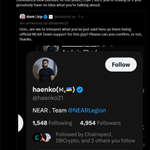
$NEAR accuses $ICP of spreading FUD and lies, but the factual reality says otherwise.
Everything @dominic_w says checks out against public receipts online.
NEAR's own records show where their "unique" tech came from.
Here's the timeline:
1/16 👇

Dokmai IC retweeted

50+ people have attacked internet-computer:native
@BobbyO_ challenged them to a debate
ZERO accepted
Instead they BLOCK, cower in fear & deceive those who don’t know better
If ICP is so bad, this is an EASY task
DEFEND YOUR COIN
PROVE ICP WRONG
Spoiler alert: THEY CAN’T

Dokmai IC retweeted
What is $ICP?
This is the first episode of my new series about the Internet Computer.
It starts with a simple question... Who owns the internet?
Dokmai IC retweeted
Another CEX hack! Solution: MULTI/DEX, the 1st order book exchange that's:
1. Open source
2. Runs onchain
3. Verifiable ledger
Plus, the 1st with an AMM, providing cross-market swaps, AI assist... Only possible on the Internet Computer | ICP 💪. Prod soon.
protos.com/bitgets-eighth-bi…

Dokmai IC retweeted
Only the tip of an iceberg folks 🔥 The Internet Computer is the 1st network providing core, mainstream technological utility, not a token database.
The world needs sovereign, tamperproof cloud that turbocharges AI: ICP is the first breakout network since Bitcoin and Ethereum.

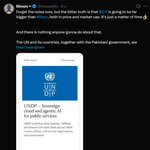
🚨YESTERDAY, DFINITY HELD A CALL ABOUT BUILDING DIGITAL INFRASTRUCTURE FOR ENTIRE NATIONS! $ICP
On the call were Pakistan's Digital Authority as well as the UNDP where they spoke on using $FOR sovereign cloud, AI and government apps.
Pakistan is already testing it. The UN wants to help bring the model to more countries.
Very few crypto projects are even aiming at national digital infrastructure!


Dokmai IC retweeted
150 million driver's licenses stolen: this will need to get on an ICP cloud engine already share.google/RSebdavxHOptAUt…

Dokmai IC retweeted
🔴 I've been saying for over 2yrs that "AI & cybercrime drive everything from here"
It's just taken this long for everything to start showing up on the timeline
Credit: @PaulFindable
$ICP $CLOUD ☁️ ♾️



Dokmai IC retweeted

Be alert, there are some scam emails being sent around.
OISY is a private wallet. It does not have any of your personal details and will never send you any communication.

Dokmai IC retweeted
🚨 The widespread attacks against the Internet Computer continued again today, and thankfully, have failed again.
The cabal's latest attack targeted the ckBTC "bitcoin twin" minting canisters. This time, they spent thousands of dollars on ICP tokens in the course of their attack, but only caused minimal disruption.
What did happen: the attacks revealed the need for some useful hardening, and the NNS (i.e. the network's autonomous governance and orchestration system) took down the ckBTC canister for an upgrade. The downtime was ~1hr.
Though the disruption was minimal, we must not thank the attackers for helping improve the network, because they are criminals.
The attacks reveal more about who they are:
1. They are willing to throw buckets of money at their attacks, confirming they are professionals on a mission, rather than amateurs.
2. Since their attacks lack a common thread (such as trying to steal tokens), we can see their true purpose is to harm the reputation of the Internet Computer by causing disruption.
Of course, as an ecosystem, we have experienced widespread attacks designed to harm our reputation before, albeit in different forms.
Most famously, in May 2021, the Internet Computer was widely seen as a potential crypto industry disruptor.
A key narrative at the time was woven around the potential of web3 apps that would actually run on blockchain networks i.e. "onchain," as per the original meaning of that phrase.
The fly in the narrative's ointment, however, which was being used to sell the potential of some major up-and-coming chains, was that the Internet Computer was the only network that could actually host general-purpose apps and services built from "smart contracts" (which are far better called "network code") thanks to years of R&D by the DFINITY Foundation.
A successful launch of the Internet Computer threatened to puncture this web3 apps narrative, which was at the heart of their marketing and fundraising efforts. Furthermore, their insiders were aware of the years of R&D at scale that had been performed to create the Internet Computer network, and they were downright terrified of the competitive threat it posed.
Simply put, in the fever of 2021, they feared that if the Internet Computer launched successfully, it might dramatically reduce their ability to hoover up billions from the markets in the crypto bull run.
The resulting attacks by corrupt but powerful industry actors involved massive market manipulation on an exchange before/after launch that made the ICP token price crash, lawsuits by a corrupt law firm secretly on the payroll of a big industry actor, and massive further manipulation of public perception using huge social media astroturf armies, paid crypto press, and even a huge mainstream publication whose key reporter was linked to an actor who is now in jail.
Events took place on a historic scale that was completely extraordinary, and I hope the full story, including what it was like dealing with what took place, makes the light of day some day — I am pleased to say there is no comparison to what is happening today.
As a result of these past events, to this current day, a large majority of people who consider themselves crypto industry aficionados, and interested investors and journalists, remain completely unaware that most blockchain networks can only host tokens and lightweight financial logic. The corruption and criminality of the time successfully hid what the Internet Computer does differently from other networks, and created a reality distortion field that persists to this day.
Crypto Leaks, an investigative journalism website that publishes reports based on covertly recorded video created by undercover investigators, has exposed what was behind some of the extraordinary happenings.
Thankfully, several of those exposed by Crypto Leaks now sit in jail, and American judges later took action against the law firm involved, among other wins Crypto Leaks gifted to the industry. However, many of those exposed have so far escaped major consequences, and crypto press has often taken a hear-no-evil see-no-evil approach, preventing people from learning what happened. That's a shame, because we all want the crypto industry to be a clean place, where competition is fair and normal.
My personal view, is that the happenings of 2021 marked a pivotal moment for the industry, when the original crypto movement, and technical folks and idealists interested in making the world a better place through innovation and advanced cryptography and computer science, were overwhelmingly steamrollered by sharp-elbowed speculators and manipulators.
The Internet Computer ecosystem would have set a standard for the crypto industry that kept it honest, but as a result of its suppression at the time, we got an age of speculation and scams, and vaporware and narratives, in which money could often much more profitably be invested into hyping rubbish than into R&D that produces technological utility.
Thankfully, what happened is now far in the rearview mirror for the Internet Computer ecosystem, because it has moved on to mainstream pastures, and has a incredibly exciting future ahead. Those currently paying for the new tide of poisonous trolls on web3 social media, and black hat hackers, will be disappointed to find this isn't 2021.
Initiatives such as Caffeine (see caffeine dot ai), the AI chat service that builds apps on the Internet Computer, have shown that the network has enormous mass market utility, which does not depend on tokens and speculation — for example, 99% of those building on the Internet Computer using Caffeine have no idea that their apps run on a secure crypto network that can play the role of cloud.
Now, forthcoming advances like ICP "cloud engines", and initiatives such as Open SaaS and the Internet Intelligence Gateway, and growing sovereign tech adoption, and many other things currently underway, promise to take the network to another level entirely.
Crucially, as intended since work began in 2015, the network is becoming a revolutionary new tech stack for the AI era, and for the sovereign tech movement generally. While the massive potential exists in mainstream fields, projects like MULTI/DEX (dot ai) also continue to demonstrate how the extraordinary capabilities of the network can also be applied in fields such as defi.
As the Internet Computer rapidly approaches escape velocity all over again, the moment when its stunning differentiating features and capabilities will become obvious within the web3 industry also approach again.
Today, networks talk about AI tokens, and digital currencies for AI. Cynically, one might imagine these things were created because they are easy for retail investors to latch on to, if not undestand.
Meanwhile, the Internet Computer has pioneered a new kind of onchain "AIware" software (Motoko), which, when compared against software running on traditional technology stacks, creates apps and services that integrate AI in game changing and previously impossible ways, which software can also be written and maintained far more effectively and safely by AI agents working autonomously without human oversight.
The potential of AI is real and truly beyond anything we have seen before, and I predict that AIware will power one of the largest business transformation stories in history.
For the Internet Computer, an exciting event horizon approaches all over again, and my guess is this is agitating some people in the crypto industry. It may even be reactivating bad actors from the past.
But, we in the ICP community are not afraid, because these bad actors are a spent force. Moreover, the Internet Computer's future now depends on the mainstream world much more than it goes the crypto world, and the mainstream world affords these bad actors no power.
Of course, crypto would be better without them, and that's why DFINITY continues to offer substantial rewards to anyone who can provide information that exposes them, but —
This latest growing wave of attacks is in fact just a hot signal that it's game on again for the Internet Computer, which we should all welcome.
And, seeing the Internet Computer reach its potential, after all the years of toil and effort, is what keeps my fire, and the fire of many others, burning bright. We stay focused in pursuit of our goals, no matter how long it takes.
We are creating the next tech stack for the AI era, we remain undeterred, and the potential of what we have created is tremendous.
My thanks again to the ICP community 💪
Dokmai IC retweeted
We love sovereign cloud growth. Can the Internet Computer be the new tech stack? Yes. It. Can.
More details following, and get ready to join the ICP cloud engine party at opencloud dot org.
axios.com/2026/08/25/un-sove…

Dokmai IC retweeted
Tell me I'm wrong — quantum has now become Crypto's Y2K narrative (which enabled scaremongering consultants to make bank in the late 90s).
Hardly a day goes by without some not-very-technical network claiming kudos because it's quantum safe.
As Chief Scientist of DFINITY and someone who has hopefully created some interesting applied cryptography and network designs in the form of the Internet Computer, here's my honest take.
I've spoken to a lot of senior people who don't have an iron in the quantum computing game, and the consensus seems to be that cryptographically-relevant quantum computing (which can break established cryptography) could still be decades away, however...
Let's assume, for the sake of argument, that it is in fact coming in 5 years, which we can theorize AI might help happen — and we should hope it comes quickly, because this kind of quantum computing would be a great thing for humanity, just like AI, and hopefully fusion power.
Even if we assume this, should quantum be what Crypto is focusing on, and should networks be switching over to the latest "quantum-secure" cryptography schemes to impress everyone with how advanced they are, and how unsafe their competitors are?
Sadly, I can tell you, they should not be. Let me explain...
Firstly, the very real problem that Crypto faces, is that AI is getting extremely good at finding holes in open source software code. Running on open source, which reduces the need to trust the developer, is a cornerstone of the Crypto industry (and anyway, AI can find holes in private code too by reverse-engineering binaries, so doing a HyperLiquid doesn't really solve the situation).
Secondly, the vast majority of blockchain projects are really just simple copy/pastes of existing blockchain projects, upon which some unique feature has been grafted or claimed. There isn't really any engineering talent behind them, which creates problems when you have to act quickly in response to real time threats.
What, you may say!!? However, insiders like me understand that the industry mostly departed from first-principles crypto engineering long ago, in search of quick riches from token sales. For that you need a narrative, and since token buyers don't understand much about how these networks actually work, and are not interested in actually verifying technical claims themselves, and don't understand product/market fit, what matters to them is the narrative marketing machinery they can bring to bear (instead of engineers and researchers, they invest in social media bot armies, paid press, partnering with big money that can be used to literally manufacture and establish market prices, and partners who can help spin the narrative flywheel). This is the real situation, and it doesn't put the industry in a good place to address the real emerging threat — AI.
As we've seen from the constant procession of hacks across the industry, the industry's software was already not in a good place before the advent of super smart AI that turbocharge hackers. And AI is getting smarter all the time.
Rather than focusing on quantum, most chains should be focusing on improving the security of their code as quickly as they can, and improving the quality of their engineering. But it gets worse...
Adopting "quantum-safe" cryptography schemes to spin the narrative flywheel is making them even MORE unsafe. Let me explain.
The cryptography schemes that we use today, which are not quantum-safe, have been around for decades. That means we understand the mathematical assumptions that make them work, and armies of researchers have been kicking their tires for a very long time.
The world has a very good understanding of how hard it is to break, e.g., elliptic curve crypto on standard computers, through decades of research. We therefore have high conviction that the parameters used are safe against classical computers.
Unfortunately, we have no such track record for most quantum-safe schemes, apart from the least efficient hash-based signature schemes.
To see this in action, look at what just happened to HAWK, which was under consideration for being made an official US standard (Mythos found the problem): arstechnica.com/security/202…
We could see improved attacks against other schemes too, like the NIST-standardized Dilithium and Falcon.
Crypto needs to go slow with this, not fast, because cryptographically-relevant quantum computing is not just around the corner (even if new narratives and marketing can be).
We need to go slow and take steps nearer the time, giving all this a chance to shake out.
TLDR; we should not be rushing to implement quantum-safe schemes that could be broken by AI tomorrow, when cryptographically-relevant quantum computers that can break traditional cryptography are years away.
Note that the situation is slightly different for governments and corporations transmitting super secret encrypted communications, because adversaries are recording them so they can decrypt them years from now when cryptographically-relevant quantum computing is real. They need to use stronger ways to encrypt their communications.
However, this is not the situation for Crypto at all. Crypto needs to focus on protecting users from holes in code that AI uncovers. End of.
AI is vastly greater threat, and it's happening NOW.
Stay safe out there.


🚨IBM WARNS QUANTUM COMPUTERS COULD HACK CRYPTO BY EARLY 2030s!
IBM Quantum Adoption VP Scott Crowder appeared live on @FoxBusiness and said quantum systems strong enough to break into crypto wallets could arrive by the early 2030s.
The scenario is being called a “crypto doomsday.”