

Author: Horns, Hogs, and Nixon Coming; Third Down and a War to Go; '77: Denver, the Broncos, and a Coming of Age; Olympic Affair; The Witch's Season; 3 more.
Colorado
Joined February 2012
- Tweets359
- Following3.6K
- Followers7.3K
- Likes4.2K


Pinned Tweet
Olympic Affair opening: Despicable filmmaker Leni Riefenstahl joins Swanson, Coppola at Telluride Film Fest. Aso visits Simla, home of '36 decathlon champ Glenn Morris. She's still bitter that Morris dumped her. terryfrei.com/olympicaffairc…


Terry Frei retweeted

Tom Jackson must have been calling out to me yesterday when I featured him prominently in my column. He didn’t pass away. He blitzed and intercepted and entertained the world.
TJ's death two days before a Raiders game is a sad reminder that the 50th-anniversary benchmark of the Broncos' transformational '77 is on the horizon. It should be -- and swill be --a major 2027 NFL storyline. We keep losing these guys.
Terry Frei retweeted

TJ carried himself with class, warmth and humility, forging deep connections and lifelong friendships with teammates and throughout Broncos Country.
A statement from the Broncos on the passing of legendary Ring of Fame linebacker and Hall of Fame broadcaster Tom Jackson.

I just passed through Texas-Arkansas broadcast. Somehow, I don't think the Longhorns are going to need a miraculous "Right 53 Veer Pass" this time. But you can read about that famous play in this excerpt from my 2002 book, "Horns, Hogs, and Nixon Coming."
terryfrei.com/veerpass.html

2
426
Terry Frei retweeted
The Death of Dave Schreiner
This brief heart-wrenching passage is adapted from my 2004 / 2007 book, "Third Down and a War to Go." Schreiner, a two-time All-American and Big Ten MVP at Wisconsin, was the 4th Marines' team captain for the Mosquito Bowl. I interviewed or corresponded with 21 ex-Marines who served on Okinawa with Schreiner and fellow ex-Badger Bob Baumann. Several of them saw and heard Schreiner after he was shot on June 20, 1945.
Gus Forbus of Fallon, Nevada, was in a hospital on Tinian after he was wounded on Okinawa. He was close to the other Marines in his unit and kept his ears open.
"The report I got on it was that they were putting in the lines for the night on the 20th and (a new officer) wasn't satisfied," Forbus told me. "He wanted Dave to check it out. He was an Annapolis man, but he couldn't pour water out of a boot."
William Ramey of Kernersville, North Carolina, was a corpsman and pharmacist's mate. He worked on Schreiner after he was brought back to the lines.
"We were trying to get plasma started," Ramey said, his voice cracking.. "(Schreiner) told me, 'Doc, they pulled a sneaky trick on us.'"
Ramey didn't remember Schreiner mentioning a white flag, but he soon concluded that one of the handful of stories making the rounds was correct -- that Schreiner was mortally wounded in a bogus enemy surrender.
"It's been a long time," Ramey said slowly. "But somebody's last words like that, they stick with you pretty good."
Ed Liguori of Lakeland, Florida heard Schreiner had been wounded. He scrambled out of his foxhole and found the spot where Ramey was working on Schreiner.
"He was unconscious, breathing heavily, and it was so sad," Liguori told me. "He wasn't moving. He wasn't talking. There might have been a moan. They were giving him plasma. They were giving him fluids through his ankle because the blood vessels collapsed. I didn't know anything about it at the time, being a young, dopey kid. But later. when I was teaching, I learned about these things. They couldn't find any blood vessels in his arm, so they were administering plasma in his ankle."
Vern Courtnage of Hayward, California, told me that Schreiner "was on the ground, on a stretcher, with a covering over him. The corpsmen were working on him ... My friend drove the Jeep; his name was Duane Carey. We loaded him onto that Jeep, and everyone was wishing him well, and he was conscious.
"The last words he spoke, that I heard, anyway, were, 'If any of you guys think I'm crying, I'll get out of here and kick the ---- out of you.' That stuck with me all those years."
Dave Schreiner died the next day, on June 21. 1945.
(Ex-Badger Bob Baumann served in the same company as Schreiner and also played in the Mosquito Bowl. He was killed in action two weeks before Schreiner's death.)
Pictured: Dave Schreiner's First Grave
Grave 789, Row 32, Plot A, Sixth Marine Division Cemetery, Okinawa
In 1949, his grave was transferred to the family plot in Hillside Cemetery in his hometown of Lancaster, Wisconsin.
Full version: terryfrei.com/schreiner.html

Terry Frei retweeted

@TFrei Ninh Binh is one of Asia's greatest natural wonderlands but the northern Vietnam province also has some worrying tourist traps. We navigated the glorious area for my latest Dog-Eared Passport: johnhendersontravel.com/ninh…

Terry Frei retweeted
terryfrei.com/mosquitobowl.h…
Young readers, this is what we used to call "a newspaper."
It's the Denver Post, November 2, 2003.
My story on Sixth Marine Division's Christmas Eve 1944 touch (yeah, right) football game on Guadalcanal anchors the sports section.
Yes, the Mosquito Bowl.
I was just getting started with the research that led to my 2004/2007 book Third Down and a War to Go, on my father's 1942 Wisconsin Badgers.
Denver North and CSU A&M / State star Bus Bergman, pictured and featured in the newspaper story, played for the 29th Regiment and within months was awarded the Bronze Star for valor in the Battle For Sugar Loaf Hill on Okinawa.
A total of 15 Marines who played in the game on Guadalcanal were killed in action on Okinawa, and two of them -- Dave Schreiner and Bob Baumann -- were Jerry Frei's Wisconsin teammates.
Mosquito Bowl? The rough mimeographed program called the game the "Football Classic" and the kickoff seems to have been moved to the morning after the program was printed. Sgt. Harold T Boian, a Marine combat correspondent, wrote the dispatch distributed by UPI and carried by many news outlets back home. His story had a "SOMEWHERE IN THE SOUTH PACIFIC -- Delayed --" dateline. He labeled the game the "Mosquito Bowl football classic." (Six degrees of separation: Boian later was the Denver Post's advertising director.) None of the surviving Marines I tracked down many years later remembered the game being called the Mosquito Bowl.


Join the fight, James Reynolds. Join the fight.
deadline.com/2026/11/james-r…

409
The Death of Dave Schreiner
This brief heart-wrenching passage is adapted from my 2004 / 2007 book, "Third Down and a War to Go." Schreiner, a two-time All-American and Big Ten MVP at Wisconsin, was the 4th Marines' team captain for the Mosquito Bowl. I interviewed or corresponded with 21 ex-Marines who served on Okinawa with Schreiner and fellow ex-Badger Bob Baumann. Several of them saw and heard Schreiner after he was shot on June 20, 1945.
Gus Forbus of Fallon, Nevada, was in a hospital on Tinian after he was wounded on Okinawa. He was close to the other Marines in his unit and kept his ears open.
"The report I got on it was that they were putting in the lines for the night on the 20th and (a new officer) wasn't satisfied," Forbus told me. "He wanted Dave to check it out. He was an Annapolis man, but he couldn't pour water out of a boot."
William Ramey of Kernersville, North Carolina, was a corpsman and pharmacist's mate. He worked on Schreiner after he was brought back to the lines.
"We were trying to get plasma started," Ramey said, his voice cracking.. "(Schreiner) told me, 'Doc, they pulled a sneaky trick on us.'"
Ramey didn't remember Schreiner mentioning a white flag, but he soon concluded that one of the handful of stories making the rounds was correct -- that Schreiner was mortally wounded in a bogus enemy surrender.
"It's been a long time," Ramey said slowly. "But somebody's last words like that, they stick with you pretty good."
Ed Liguori of Lakeland, Florida heard Schreiner had been wounded. He scrambled out of his foxhole and found the spot where Ramey was working on Schreiner.
"He was unconscious, breathing heavily, and it was so sad," Liguori told me. "He wasn't moving. He wasn't talking. There might have been a moan. They were giving him plasma. They were giving him fluids through his ankle because the blood vessels collapsed. I didn't know anything about it at the time, being a young, dopey kid. But later. when I was teaching, I learned about these things. They couldn't find any blood vessels in his arm, so they were administering plasma in his ankle."
Vern Courtnage of Hayward, California, told me that Schreiner "was on the ground, on a stretcher, with a covering over him. The corpsmen were working on him ... My friend drove the Jeep; his name was Duane Carey. We loaded him onto that Jeep, and everyone was wishing him well, and he was conscious.
"The last words he spoke, that I heard, anyway, were, 'If any of you guys think I'm crying, I'll get out of here and kick the ---- out of you.' That stuck with me all those years."
Dave Schreiner died the next day, on June 21. 1945.
(Ex-Badger Bob Baumann served in the same company as Schreiner and also played in the Mosquito Bowl. He was killed in action two weeks before Schreiner's death.)
Pictured: Dave Schreiner's First Grave
Grave 789, Row 32, Plot A, Sixth Marine Division Cemetery, Okinawa
In 1949, his grave was transferred to the family plot in Hillside Cemetery in his hometown of Lancaster, Wisconsin.
Full version: terryfrei.com/schreiner.html
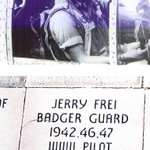
Jerry Frei was 18 when he was called off Wisconsin campus. He flew 67 missions in F-5 recon version of single-seat, twin-boom P-38. Cameras replaced guns. He flew over enemy targets, often alone, taking recon photos in advance of bombing runs. When anyone marveled that he did this unarmed, he said that was wrong. "I had a pistol," he said.


1
9
531