






Pinned Tweet
Our revision of the simplex species group of Triepeolus is now published in @ejtaxonomy: doi.org/10.5852/ejt.2024.950…. Included are 18 species, of which seven are newly described.

I'm pleased to announce our taxonomic revision of the bee genus Triepeolus in South America is now published in @ejtaxonomy: doi.org/10.5852/ejt.2024.931…. The 9 species can be identified with our fully-illustrated, dichotomous key (available in English, Portuguese, and Spanish).

That seems like a reasonable wait time. Seriously, will we even be around as a species when the embargo expires?

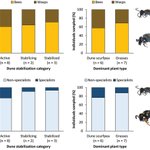
The results of our study on bees and aculeate wasps in Canada's threatened prairie sand hills is now published in @InsectDiversity: doi.org/10.1111/icad.12659. Read more about this project with @MuseumofNature here: nature.ca/en/about-the-museu….

Dear copyeditor who removed the Oxford commas from my manuscript, you are the worst. At least be consistent! This one left about half of them in.
175
Why am I only now learning that there are blue bananas?

The Blue Java is a hardy, cold tolerant banana cultivar known for its sweet aromatic fruit, which is said to have an ice cream like consistency and flavor reminiscent of vanilla
[read more: ow.ly/SqUn30o6i14]

1
162
Ashamed that my alma mater @YorkUniversity has among their faculty someone who spreads Kremlin lies and Ukrainophobic propaganda.

Did the US not back the 2014 fascist coup d’etat in Ukraine — overthrowing its democratically elected Govt. followed by 8 years of ethnic genocide of Russian speaking Eastern Ukrainians (over 8k dead)? (@1WhiteRabbitt )
1
174
Review of the Epeolus julliani species group (Hymenoptera, Apidae, Epeolus Latreille, 1802), with descriptions of two new species doi.org/10.3897/jhr.94.96429 via @HymenopteraJour
New paper with @jscottmacivor, @cwdekeyzer, and @madi_marshall1 reporting on the establishment and range expansion of Osmia cornifrons and O. taurus in Canada: doi.org/10.7717/peerj.14216

Hot off the press: An impressive taxonomic review of the metallic green halictids from Middle America by @zachportman: zookeys.pensoft.net/article/…

This species of Epeolus was only described a few months ago, but there have since been three observations of it on iNaturalist. What a great resource! This image was taken by Lisa Hill, some rights reserved.

I missed this one in my 2018 revision of the genus: a new species of Epeolus from Western North America described with @CorySilas (photo courtesy of Lisa Hill)
centerforsystematicentomolog…

Delighted to learn that a new species of Dialictus has been named after me by prolific taxonomists Joel Gardner and Jason Gibbs in the following paper: doi.org/10.4039/tce.2021.47. It's a sand specialist known only from the inland dune systems in the southern Canadian Prairies.


You can also read about this unusual bee here: nature.ca/en/about-us/museum…

[#Entomology] 🐝 Brachymelecta Linsley, 1939, previously the rarest North American bee genus, was described from an aberrant specimen and is the senior synonym for Xeromelecta Linsley, 1939 ⬇️
🔗 DOI: doi.org/10.5852/ejt.2021.754…
▪️ @TOnuferko et al.
▪️ #bees #bee #hymenoptera

5
You know it's springtime in Ottawa when inquiries re local "murder hornet" sightings start filling up your inbox.
4
Check out this tiny first instar of the cleptoparasitic bee Epeolus americanus, described here: journal.lib.uoguelph.ca/inde…. Those unusually long sickle-shaped mandibles are used to destroy any eggs or other larvae within the host's brood cell.

Congratulations to my good friend Dr. Vern Lewis on his successful PhD defense. He can't save you during a heart attack/stroke at a dinner party, but he is the authority on brain gene expression associated with learning in Bombina orientalis as shown by transcriptomic profiling
2
Another excellent contribution to our understanding of the taxonomy of Lasioglossum in the Nearctic (published today): doi.org/10.5852/ejt.2020.725….
4