

The Theodore Roosevelt Center is dedicated to preserving the legacy of America’s 26th president. Visit our digital library for over 100,000 primary sources!
Dickinson, North Dakota
Joined September 2010
- Tweets5.6K
- Following331
- Followers3.7K
- Likes2.1K


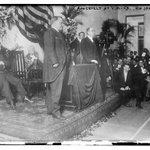



#OnThisDay in 1903, President Roosevelt spoke at the Pan-American Missionary Service at the Peace Cross on Mount Saint Alban.
Roosevelt based his address on three biblical quotations: "Thou shalt serve the Lord with all thy heart, with all thy soul, and with all thy mind;" "Be ye therefore wise as serpents and harmless as doves;" and "we being ready both in body and soul may cheerfully accomplish those things which thou commandest."
In closing his address, Roosevelt did as he always did, and reminded his audience that it is not good enough just to be moral; one must act on those morals.
"In the seventh hymn which we sung, in the last line, you all joined in singing "God save the State!" Do you intend merely to sing that, or to try to do it? If you intend merely to sing it, your part in doing it will be but small. The State will be saved, if the Lord puts it into the heart of the average man so to shape his life that the State shall be worth saving, and only on those terms. We need civic righteousness. The best constitution that the wit of man has ever devised, the best institutions that the ablest statesmen in the world have ever reduced to practice by law or by custom, all these shall be of no avail if they are not vivified by the spirit which makes a State great by making its citizens honest, just and brave."
Read the full address at the American Presidency Project: presidency.ucsb.edu/document…

As National Archives Month comes to a close, the Theodore Roosevelt Center would like to once again highlight the work of seven future archivists and public historians–our 2026 summer interns!
Part of their internship included completing digital humanities projects for the TRC, and three of these interns chose to complete data normalization projects in our Digital Library.
What is data normalization?
Data normalization is the process in which metadata (ex: the names of creators or recipients, creation dates, record descriptions, and subject terms) is analyzed and reworked to eliminate redundancies, make information more clear, and ensure usability and accessibility over a long period of time. This process is not a simple or quick undertaking, especially for a digital library of 142,000+ items, cataloged over the last 19 years!
Why is it important?
Over one hundred individuals have cataloged records in our Digital Library. While there is a set of strict guidelines that catalogers follow, archival standards and users’ needs change over time. Humans are also human–mistakes happen! Because of this, there are several data normalization projects that need to be done to ensure that the users of our Digital Library can continue to find what they need.
One of our interns, Jessica Yu, worked on updating the Authorized Subject Names of previously unnamed women in our databases. Through her research, Jessica was able to locate and name twenty-eight previously unidentified women in our database–among them a California postmistress, a suspected New Mexico murder victim, and a newspaper correspondent living in Texas. While these women are not famous, their stories still deserve to be heard and help to give a more complete insight into what life was like during Theodore Roosevelt’s lifetime. Thanks to Jessica’s work, these twenty-eight women can now be found.
Read more about Jessica’s work on our Substack (trcenter.substack.com/p/frid…) and listen to the interns discuss their projects in more detail at our 2026 Intern Symposium, available on our YouTube channel here: youtube.com/watch?v=UhARzNWZ…
#DataNormalization #DigitalHumanities #NationalArchivesMonth #ArchivalScience #FutureArchivists

The Theodore Roosevelt Center will be CLOSED to the public next week, October 26 through October 30. We hope to see you another day!
Our staff will be out of office, for personal leave and for participation in the annual Northern Great Plains History Conference in Bozeman, Montana. Three TR Center staff members will be presenting or moderating, alongside another Dickinson State University faculty member, and three of our students!
Because the conference will take leading up to and on Halloween, among the topics we present about will be Theodore Roosevelt's relationship with spiritualism, superstition, and the supernatural.
For more information about the conference: ngphconference.org/

#OnThisDay in 1907, President Roosevelt established three new federal bird reserves in Washington State: Flattery Rocks, Copalis Rock, and Quillayute Needles.
Roosevelt set aside these clusters of approximately 800 rocks, reefs, and islands in Cape Flattery as refuges for migratory seabirds, including terns, shearwaters, oystercatchers, and murres. More than a million birds from dozens of species still shelter in these refuges each year.
Today, all three areas are still preserved as part of the Washington Maritime National Wildlife Refuge Complex. They are closed to the public so that they will remain in natural condition, but allow for observation from boats outside a 200-yard buffer zone.
This image is not one we have yet obtained for our digital library. It comes from the special collections of the University of Washington.

#OnThisDay in 1913, former president Theodore Roosevelt delivered an address to the Y.M.C.A in Rio de Janeiro, Brazil.
Roosevelt had come ashore the day before, to much pomp and circumstance, and was put up in the Guanabara Palace, the seat of the state government of Rio de Janeiro. He had a full agenda ahead of him on the 22nd. In the morning, he visited the Supreme Court and had breakfast at the presidential palace with various legislators, ministers, and other officials. In the afternoon, visited the war college, where he was toasted by the Minister of War and was taken on an inspection tour of the campus. It was after this that he spoke at the Y.M.C.A. That evening, he attended the Theatro Municipal, a magnificent modern establishment that was only a few years old at the time.
Unfortunately, although his visit was enthusiastically covered by American newspapers - with headlines like "Theodore Roosevelt Royally Welcomed at Rio Janeiro" and "An Ovation for Roosevelt" and "Roosevelt Will Be A Busy Man" - they don't seem to have made a record of the actual words he spoke that afternoon. They simply report that there was a large crowd in attendance and that Roosevelt was received cordially.
In an article for The Outlook magazine, Roosevelt recorded his thoughts on Rio de Janeiro, including visit to the South American headquarters of the Y.M.C.A. Finding the hall "jammed" with people, "including members of the Government, judges, Senators, and Deputies," Roosevelt says he "made them precisely the type of address that I would have made in my own country, and they responded precisely as an audience in my own country would have responded."
A few months later, Roosevelt set off on the expedition descending the River of Doubt, a harrowing journey which he nearly did not survive and from which he never fully recovered.

In today’s #WednesdayWisdom, you’ll see Theodore Roosevelt express a little fatherly frustration with his eldest son Ted, who was skipping classes in college. (Ted is pictured above jumping a horse as his father watches.)
As Roosevelt related in a March 15, 1908 letter to his second son, Kermit, Ted, who was a junior at Harvard University, had skipped thirty-eight lectures “without sufficient excuse” since January 1 and had been put on probation.
Roosevelt finds such behavior completely unacceptable and is out of patience with Ted for being “such an utter goose,” comparing Ted to the title character in William Thackeray’s novel Pendennis.
While expressing his frustration, Roosevelt also philosophizes about the situation, lamenting Ted’s inability to “understand the folly” of simply not trying. After noting that many challenges are out of our control—what he calls “a sufficient number of defeats”—he pens today’s #WednesdayWisdom.
“The only way to come out ahead is not wantonly to court defeat where by the exercise of ordinary prudence and forethought and skill and resolution it is possible to be sure of victory.”
Roosevelt hopes that Ted will start to adopt such an attitude, expressing frustration and worry “as to how Ted will do in after life” and hoped that he would put “boyish things” aside and “show the character that he showed during the year before he went to college.”
We wanted to share this quotation as today’s Wednesday Wisdom because not only does it show Roosevelt’s care for his eldest son even as he expresses his fears but also it reveals Roosevelt’s way of approaching the world.
While the world will sometimes do its best to defeat people, individuals can do all they can to avoid poor decisions, exercising prudence, forethought, skill, and resolution, and they will come out ahead.
#CharacterBuilding #LifeLessons #TheodoreRoosevelt

#OnThisDay in 1905, President Roosevelt delivered several speeches is Roswell and Atlanta, Georgia.
The speeches were part of a speaking tour of the South during which Roosevelt spoke at state capitols and to college students, to Civil War veterans and in public parks. He even visited the home of his mother, Bulloch Hall, in Roswell.
In Roswell and Atlanta, Roosevelt spoke fondly of his Southern heritage and enjoyment of Southern culture. He proclaimed that his blood was "half Southern and half Northern," paid tribute to the author Joel Chandler Harris, who recorded the "Uncle Remus" and "Br'er" Rabbit stories, and praised Georgia's Senator Alexander Stephens Clay.
Read a version of the speeches published with additional context and analysis in the Theodore Roosevelt Association Journal in our digital library: theodorerooseveltcenter.org/…

Did you know that before Theodore Roosevelt started planning a hunting trip to Africa after he left the presidency, he was thinking of going to Newfoundland or south of the Yellowstone for elk hunting?
We recently ran across a June 1, 1907 letter from Roosevelt to Kermit proposing the idea and were shocked to learn that Africa wasn’t his first idea. But even if it wasn’t the initial idea, it quickly became Roosevelt’s focus. Correspondence makes it clear that by March 1908, Roosevelt had set his sights on Africa.
Even still, the time Roosevelt initially proposed for visiting Africa was in the summer of 1909, slightly different dates than the end result would be. While it took some time to finalize the dates, Roosevelt told Kermit on May 1, 1908: “I believe we can take the trip. At any rate, if I ever do go to Africa, I shall take you with me.”
As news about Roosevelt’s trip to Africa spread, other people reached out with different places Roosevelt could hunt. But as Roosevelt told Ben Lilly of Texas, “I am going to Africa next spring, but do let me know if you find a good hunting place in Mexico. We might use it in the future.”
Roosevelt likewise wrote to John Willis on January 23, 1909, “I ought to have a pretty good time in Africa; but I do wish I could be with you in some of your wolf and coyote hunting.”
Still others had complaints about the expedition party, encouraging Roosevelt to leave Kermit at home, which Roosevelt related in a January 5, 1909 letter to Edward North Buxton, but Roosevelt disagreed.
Even when other people’s names were proposed, Roosevelt insisted, “[U]nder no circumstances do I believe that more than two rifles can hunt together; and my son Kermit and I must be those two rifles.”
Although the planning for Roosevelt’s post-presidential hunting trip took some twists and turns, it finally became the iteration we know it as today: the Smithsonian-Roosevelt Expedition.
Read more about Roosevelt’s expedition in our digital encyclopedia article here: theodorerooseveltcenter.org/… Where do you think Theodore Roosevelt should have gone for his post-presidential hunting trip and scientific expedition? Let us know in the comments below!
#SmithsonianExpedition #TheodoreRoosevelt #HuntingTrip


October is Pregnancy and Infant Loss Awareness Month, so we felt it was fitting to share a little bit about the miscarriages Edith Roosevelt experienced. We are aware of three miscarriages and potentially a fourth, occurring in 1888, 1902, 1903, and potentially 1905.
The miscarriage for which we have the most information occurred on August 8, 1888. Less than a month before, Theodore Roosevelt had written to his sister Anna “Bye” that Edith was expecting again, and they expected the baby to arrive in January, meaning that Edith was likely five or six months pregnant.
“Now for a bit of private information. Alice’s wish for ‘another brother or sister’, will, I rather regret to say, probably be gratified about the end of next January.”
Sadly, less than a month just two days after Edith turned twenty-seven years old, Roosevelt updated Bye to let her know that Edith had miscarried.
He blamed Edith’s miscarriage on the stress that his fall in a recent polo match had caused her. Roosevelt said his fall had looked worse than it actually was, writing, “though I was all right in an hour, the mischief had been done to Edith, though we did not know it for over a week.”
Edith was bedridden for several weeks after miscarrying but was finally out and about by Monday, August 20. One day later on Tuesday, August 21, 1888, Roosevelt started off west, a trip he had delayed to be with his wife.
Read Roosevelt’s letter to Bye from August 8, 1888 when he had to deliver the sad news in the digital library here: theodorerooseveltcenter.org/…
#MiscarriageAwareness #PregnancyAndInfantLossAwareness #MiscarriageSupport #EdithRoosevelt #InfantLossMonth

#OnThisDay in 1903, the Alaskan Boundary Dispute between the United States and Great Britain was settled amicably.
The boundary between British Canada and Russian Alaska was already ill-defined before the United States purchased Alaska in 1867. But the issue was not a pressing one until the Klondike Gold Rush, beginning in 1898, after which both parties pushed for a favorable border with the best access to the Pacific Ocean.
For his part, President Roosevelt felt so strongly about the issue that he told Secretary of State John Hay that he was willing to take territory by force, if necessary. Luckily, it did not come to that.
Read more about the issue in our online encyclopedia, in a student-produced entry: theodorerooseveltcenter.org/…

In honor of #NationalDictionaryDay, we wanted to share a fascinating piece of linguistic history related to Theodore Roosevelt from several years before the Simplified Spelling movement when Roosevelt wanted to change the spelling of a word.
As Roosevelt wrote in a 1903 letter to Brander Matthews, “At the White House we give in the winter what have been called ‘musicales.’ I loathe the word. I should like to call them hereafter ‘musicals,’ but I can’t find this word in the dictionaries. There is need of the word. I do not wish to use a clumsy paraphrase and invite people to come in the evening and listen to music. I wish to invite them to a ‘musical.’”
At the time, the French word “musicale” was used to describe a social gathering centered around a musical performance. While the word “musical” was used regularly as an adjective, it wasn’t often used as a noun. For example, we checked Webster’s 1897 dictionary (perhaps one of the dictionaries Roosevelt himself checked) and didn’t find “musical” listed as a noun.
Matthews agreed with Roosevelt, as he wrote in an August 1903 letter, “Musicale is absurd, of course . . . . It is a common practice of our language to make a noun out of an adjective. . . . And if it is the President’s English, you may be sure that it will get into the dictionaries promptly.”
Roosevelt clearly used Matthews’s response as approval and started adopting the spelling of “musical” as he had proposed. And as far as we can tell, the dictionaries did seem to make adjustments. We looked at a 1907 version of Webster’s dictionary and sure enough, “musical” was listed as a noun!
What word would you want to change the spelling of? Let us know in the comments below.
Read the full letter here in the digital library: theodorerooseveltcenter.org/…
#LinguisticHistory #WordOrigins #SimplifiedSpelling #DictionaryFacts #EnglishLanguage

#OnThisDay in 1903, President Roosevelt spoke at the dedication of the General William Tecumseh Sherman Monument in Washington, D.C.
Roosevelt spoke of the importance of honoring Union generals such as Sherman, but not just with statues. He impressed upon the audience that monuments and speeches were empty gestures if not backed by honest deeds. Roosevelt encouraged people to be patriotic, to live full and honest home and family lives, and to be civically active.
"Moreover, our homage must not only find expression on our lips; it must also show itself forth in our deeds," said Roosevelt. "It is a great and glorious thing for a nation to be stirred to present triumph by the splendid memories of triumphs in the past. But it is a shameful thing for a nation, if these memories stir it only to empty boastings, to a pride that does not shrink from present abasement, to that self-satisfaction which accepts the high resolve and unbending effort of the father as an excuse for effortless ease or wrongly directed effort in the son. We of the present, if we are true to the past, must show by our lives that we have learned aright the lessons taught by the men who did the mighty deeds of the past."
Read the full address at the American Presidency Project: presidency.ucsb.edu/document…

#OTD 114 years ago, Theodore Roosevelt was shot on Monday, October 14, 1912 just outside the Hotel Gilpatrick in Milwaukee, Wisconsin at 8:10 p.m. as Roosevelt was standing up in the car that was going to take him to the Milwaukee Auditorium where he was going to speak.
This year, since the anniversary of Roosevelt’s attempted assassination falls on a Wednesday, we thought it would be fitting to share a sentence Roosevelt wrote to his son Kermit just five days after reflecting on the attempted assassination as our #WednesdayWisdom.
We also wanted to note that the photograph we selected to accompany the quotation is significant as well, as it was taken of him on October 14 speaking from the car before he was shot.
While Roosevelt's whole letter to Kermit is worth reading to get a feel for what Roosevelt was thinking and feeling at the time, there is one particularly long sentence that stood out to us since it encapsulates Roosevelt’s character and his plans should he ever be on the receiving end of a bullet.
“As you know, I am a great hand to think possible contingencies out in advance, and I had always determined that if I was shot when I was about to make a speech or anything of the kind I should go on with the speech or whatever I was doing, because two or three hours always elapse before a man is so incapacitated by a wound as to make it physically impossible for him to do his work.”
As Roosevelt relayed later in the letter, he wanted to give the speech since he believed it would be the “last real speech [he] could make in the campaign,” given that the assassination attempt occurred just three weeks before election day.
Roosevelt also mused about his chances in the election, suggesting that he thought Woodrow Wilson might win. Just three days before the assassination attempt, Roosevelt had written something very similar to Kermit reflecting on the enthusiastic supporters who thought Roosevelt was going to win.
“Looking at it coolly I hardly think this comes within the boundaries of possibility. I think I will beat Taft, that he will carry half a dozen small states, and I a dozen larger ones. But the odds in Wilson’s favor are so enormous that I do not see how they can be overcome.”
As it turned out, Roosevelt was even generous in his estimate. Taft carried two states (Vermont and Utah), and Roosevelt carried six (California, Oregon, South Dakota, Minnesota, Michigan, and Pennsylvania).
Although Roosevelt feared October 14 would be the last time he could give a campaign speech, he was wrong. He gave three additional speeches, including one at Madison Square Garden in New York to 16,000 people where 30,000 people were turned away.
Roosevelt of course ultimately lost the election, but he was alive, and he carried the bullet in his chest the rest of his life.
Read Roosevelt’s entire letter to Kermit in the digital library here: theodorerooseveltcenter.org/…
#ElectionHistory #PresidentialHistory #WisconsinHistory

#OnThisDay in 1979, Archibald "Archie" Bulloch Roosevelt passed away at the age of 85.
The third son of Theodore and Edith, Archie was known for making mischief with his younger brother Quentin. Like the other Roosevelts, he greatly enjoyed reading, and was also known for his skill at puzzles.
Archie was a decorated war hero, having fought with distinction in both World Wars as an infantry soldier. He suffered severe wounds to his knee each time, and is the only United States soldier to have received 100 percent disability as a result of wounds sustained in both World Wars.
Learn more about Archie in our online encyclopedia: theodorerooseveltcenter.org/…

#OnThisDay in 1915, Theodore Roosevelt delivered a speech titled "Americanism" before the Knights of Columbus at Carnegie Hall in New York City. Defining what he believed made good Americans and a stronger America, Roosevelt laid out his various "principles of civil and religious liberty."
He declared that Americans must be loyal only to America and to democracy, and that social, economic, and military preparedness for war were critical. He argued for a clear separation of church and state ("complete severance," as he put it), and was very strongly against religious tests for holding office and public money being used for religious schools. He crusaded against "hyphenated-Americans," whom he saw as not American at all.
Read the full address as it was published: ow.ly/iKCJ50ZTJ58

#OnThisDay in 1910, Theodore Roosevelt became the first (former) president to fly in an airplane!
While participating in the Missouri State Republican Party's campaign, he was invited to fly by aviator Arch Hoxsey, a teacher at the Wright Brothers' flight school in Montgomery, Alabama. At first Roosevelt refused, but the lure of adventure proved great enough that he changed his mind. He was in the air for about four minutes, and called it "the finest experience I ever have had," wishing he could have flown for an hour.
See film footage of the event in our digital library: theodorerooseveltcenter.org/…

#OTD 137 years ago, Theodore and Edith Roosevelt’s second son, Kermit Roosevelt, was born in 1889 at Sagamore Hill, the family home.
Roosevelt considered his second son not only a great sportsman but also “a boy with his refined tastes and his genuine appreciation of literature—and of so much else,” as he wrote in a November 13, 1909 letter to his daughter Ethel.
In honor of his birthday, here are three things we found in Roosevelt’s correspondence that give a behind-the-scenes look at Kermit and his father's opinion of him.
-Roosevelt considered him a bad shot, but a good hunter, explorer, and writer. As he wrote in a 1911 letter to Ted, “Kermit is not a good shot, but he is a very good hunter and explorer in wild and somewhat dangerous country; I believe he will have the gift of writing.” Roosevelt’s hunch was right, as Kermit would go on to write six books.
-Roosevelt liked the cold, but Kermit didn’t. As he wrote in a 1916 letter to Kermit, “I am afraid [Mother and I] have grown rather to sympathize with your views of the cold; altho I wish you, and darling Belle especially, were at this moment where the climate is colder.” At the time, Kermit and his wife Belle were in Buenos Aires, Argentina.
- Roosevelt loved hearing Kermit play the mandolin during the Smithsonian-Roosevelt Scientific Expedition. As he stated in a June 1909 letter to Ethel, “I much like to hear him play his mandolin, by the way. Altogether this is a ‘great adventure.’”
Read more about Kermit in our digital encyclopedia article here (theodorerooseveltcenter.org/…) and let us know in the comments below what your favorite story about Kermit is or what you especially admire about him!
#KermitRoosevelt #RooseveltFamily #Explorers


#OnThisDay in 1905, President Roosevelt hosted a summit at the White House regarding the future of football.
Collegiate football was less than a decade old in the United States when Theodore Roosevelt saw his very first game as a Harvard College undergraduate in 1876. This young sport soon came to be known for several troubling aspects, including excessive violence during play, fatalities on the field, the use of non-student athletes, recruiting scandals, and corrupt referees.
The head of Roosevelt’s alma mater, Harvard College President Charles Eliot, joined the swelling ranks of those criticizing football in his 1903 annual report. Eliot’s disgust was so great that he called for the sport to be outlawed altogether. Roosevelt never thought football should be abolished, but he did support rule changes to make the game safer.
In September, just before the fall 1905 season began, President Roosevelt received a letter from Endicott Peabody of Groton, the school all four Roosevelt boys attended. Peabody insisted that “the teaching of Foot-ball at the Universities is dishonest” and asked Roosevelt to use his bully pulpit to convince coaches to stop teaching underhanded plays.
Roosevelt determined to clean up football. On October 9, 1905, he brought together seven men for a White House meeting: football coaches Walter Camp of Yale, Arthur T. Hildebrand of Princeton, and William T. Reid of Harvard, along with the three heads of their respective alumni committees, and Secretary of State Elihu Root. Roosevelt encouraged them to lay out methods to decrease gratuitous violence. He lacked authority to force the coaches to do anything, but he had faith in the ability of wise and good-hearted Americans to come to a mutually beneficial agreement. The men issued a statement denouncing on-field viciousness and pledged themselves to a higher level of play. It was the first time that a president had actively involved himself in reforming college athletics.
By the end of the year, the Intercollegiate Athletic Association had been founded. This precursor to the National Collegiate Athletic Association (NCAA) would eventually adopt safer rules of play. Theodore Roosevelt is often credited with the reform of football. When he put his personal convictions and the moral force of the presidency behind it, coaches and universities paid attention.

The TR Center is CLOSED to the public today and tomorrow, 10/8 and 10/9 for staff preparation and participation in #TeddyCon, the first ever Theodore Roosevelt Convention!
For our friends attending the events, we look forward to seeing you! And for those who would like to visit the gallery, we hope to see you another day!
theodoreroosevelt.org/teddyc…

#OnThisDay in 1910, Theodore Roosevelt delivered an address at the Berry Schools (which became Berry College in 1926) in Mount Berry, Rome, Georgia.
Martha Berry founded her Boys' Industrial School in 1902, in which the students worked for free in exchange for their education. Roosevelt said in a 1909 letter to Martha Berry that there was "no school in which [he had] taken more interest," and encouraged her to open a girls' school as well. In fact, the girls' school would open later that year.
Speaking at the Berry Schools, Roosevelt spoke on the topic of good citizenship, and how boys and girls must learn to help both themselves and others, and to back their words with deeds. He told them he'd got what he had only through his virtues, and through working at it.
"Honesty, courage, decency, tenderness and force, combined, they are all commonplace virtues, but they are essential virtues. They are the main things that I want to see developed in the American man and the American woman, and, therefore, in the American boy and the American girl. I never got anything in my life by an unusual display of genius, or even by an unusual display of talent. Whatever I got has always come through doing a number of things just as hard as I know how; each of them perfectly ordinary things, but ordinary things that ordinary people do not do, or, at least, did not do to the extend that was necessary in order to make a great success through the doing of them."
Berry and the Roosevelts became good friends - she maintained correspondence with both Theodore and Edith, and she visited their home in Oyster bay, New York. Theodore Roosevelt addressed the Berry Schools again when their association met in New York City in 1911.
After Roosevelt's first visit, the guest cabin on campus was renamed Roosevelt Cabin. It still stands today and was restored in 2015. This undated image of the cabin comes from the college's collections.
Read Roosevelt's 1910 speech as published in a later pamphlet: ow.ly/uL9250ZTHkB
