

Nigeria's peer-to-peer micro-utility network that turns excess solar capacity into reliable monthly income. Join Waitlist: https://teapawt.org/t.co/hfp72RgEy8
Lagos,Nigeria
Joined May 2026
- Tweets108
- Following4
- Followers1.1K
- Likes49





Pinned Tweet
Your solar might be costing you money instead of saving you money.
While you're at work, excess energy is being wasted every day.
We turn your solar into a smart income system that is automated, and paid directly to you.
Visit tspowergrid. com/waitlist for more information
16 neighbours. 29 days. ₦558k earned in Ogun State.
Gateway Hub orders are open. If your solar has 25%+ spare power, we install it, meter it and bill it for you.
tspowergrid.com/waitlist
Be your own NEPA💡


In 29 days, we've earned 558k naira from 16 neighbours in Ogun State. We're creating a testimonial video with users from these sites.
We're taking orders for our Gateway Hub. If you have a solar system with at least 25% oversupply and are willing to share it with neighbours who need it, we provide retrofit boxes that integrate with your setup to efficiently distribute, meter, bill, and enforce power supply.
Be your own NEPA.

TSPowerGrid retweeted

In 29 days, we've earned 558k naira from 16 neighbours in Ogun State. We're creating a testimonial video with users from these sites.
We're taking orders for our Gateway Hub. If you have a solar system with at least 25% oversupply and are willing to share it with neighbours who need it, we provide retrofit boxes that integrate with your setup to efficiently distribute, meter, bill, and enforce power supply.
Be your own NEPA.
Our Gateway Hub costs less to set up than prepaid meters alone, and it lets the host run the site.
Powering a plaza, market or estate? tspowergrid.com/waitlist
Be your own NEPA💡
One detail I left out of this post, and it changes the picture.
Every shop in that Computer Village setup also paid ₦80,000 for its own STS single prepaid meter.
Here’s what it costs to connect 7 customers:
—Their setup: 7 meters × ₦80,000 = ₦560,000. Each meter counts units and does nothing else.
—Ours: one Gateway Hub at ₦325,000 with a meter included, plus 6 meters at ₦30,000 each. Total: ₦505,000.
So it’s cheaper to set up, and the host gets live usage for every customer, power caps per connection, remote cut and reconnect, and evening pricing that protects the battery.
In the market, a prepaid meter only collects money. A Gateway Hub lets the host run the site.
If you’re powering a plaza, market or estate, the numbers are above.
Let’s talk.
109
TSPowerGrid retweeted
One detail I left out of this post, and it changes the picture.
Every shop in that Computer Village setup also paid ₦80,000 for its own STS single prepaid meter.
Here’s what it costs to connect 7 customers:
—Their setup: 7 meters × ₦80,000 = ₦560,000. Each meter counts units and does nothing else.
—Ours: one Gateway Hub at ₦325,000 with a meter included, plus 6 meters at ₦30,000 each. Total: ₦505,000.
So it’s cheaper to set up, and the host gets live usage for every customer, power caps per connection, remote cut and reconnect, and evening pricing that protects the battery.
In the market, a prepaid meter only collects money. A Gateway Hub lets the host run the site.
If you’re powering a plaza, market or estate, the numbers are above.
Let’s talk.
I went to Computer Village today and found our business model already running in the market.
A solar vendor has put prepaid meters on the shops around him and sells power by the unit. The receipt says ₦894 per kWh plus VAT, which comes to ₦967.50. A shop paid ₦5,000 and got 5.17 kWh.
At T&S Power Grid, the most we charge on any site is ₦400 per kWh. The same ₦5,000 buys 12.5 kWh from us. That’s more than twice the power.
So I sat down and asked him how it works.
He was honest. On many days the solar doesn’t last two hours, because the shops lean on it when NEPA fails. If a customer plugs in a heavy appliance, he can’t see it and can’t stop it. One big load drains the battery and everyone goes dark.
That isn’t a pricing problem. It’s a control problem.
This is why we built the Gateway Hub.
It gives the host control of every connection:
→ Live usage per customer. The host sees who is drawing power and how much.
→ A power cap on each connection. If a shop plugs in a pressing iron or a freezer above its limit, that line trips on its own. The other customers stay on.
→ Remote cut and reconnect. The host does it from the dashboard without going to the meter.
→ Time-of-day pricing. Evening power can cost more, which protects the battery for the hours that matter.
→ Prepaid billing that runs on the device. It keeps working when the internet drops.
Control is what brings the price down. When the battery isn’t drained by one customer, it serves everyone for longer. More kWh sold per day means the host earns well at a fair price, and customers stop paying a scarcity premium.
The Computer Village vendor proves that people will pay for reliable power next door. Our job is to make it fair, measured and in the host’s control.
If you own solar with spare capacity, or you’re funding solar for a market, an estate or a plaza, let’s talk.


Exactly, @mastersam_. Power by the unit means people pay only for what they use, with no big upfront cost and no generator to fuel.
That's what we're building at T&S Power Grid, with a meter for every neighbour.
Be your own NEPA💡

TSPowerGrid retweeted

The sachetization of power
I went to Computer Village today and found our business model already running in the market.
A solar vendor has put prepaid meters on the shops around him and sells power by the unit. The receipt says ₦894 per kWh plus VAT, which comes to ₦967.50. A shop paid ₦5,000 and got 5.17 kWh.
At T&S Power Grid, the most we charge on any site is ₦400 per kWh. The same ₦5,000 buys 12.5 kWh from us. That’s more than twice the power.
So I sat down and asked him how it works.
He was honest. On many days the solar doesn’t last two hours, because the shops lean on it when NEPA fails. If a customer plugs in a heavy appliance, he can’t see it and can’t stop it. One big load drains the battery and everyone goes dark.
That isn’t a pricing problem. It’s a control problem.
This is why we built the Gateway Hub.
It gives the host control of every connection:
→ Live usage per customer. The host sees who is drawing power and how much.
→ A power cap on each connection. If a shop plugs in a pressing iron or a freezer above its limit, that line trips on its own. The other customers stay on.
→ Remote cut and reconnect. The host does it from the dashboard without going to the meter.
→ Time-of-day pricing. Evening power can cost more, which protects the battery for the hours that matter.
→ Prepaid billing that runs on the device. It keeps working when the internet drops.
Control is what brings the price down. When the battery isn’t drained by one customer, it serves everyone for longer. More kWh sold per day means the host earns well at a fair price, and customers stop paying a scarcity premium.
The Computer Village vendor proves that people will pay for reliable power next door. Our job is to make it fair, measured and in the host’s control.
If you own solar with spare capacity, or you’re funding solar for a market, an estate or a plaza, let’s talk.
Thank you @Ayoola209003. Six months of steady power is what we work for. Providing homes power one day at a time.
Be your own NEPA.

TSPowerGrid retweeted

I’m a living testimony of T&S for over 6 months I never experienced power failure
Sorry to hear that @tundealuko ,With T&S Power Grid, every neighbour is metered and has a power cap they can't exceed. That protects the host's solar system from overloading.
Be your own NEPA.

TSPowerGrid retweeted

Unrelated, as a people we are very selfish and wicked. My mom used to power her entire house, all her tenants connected to the generator, no matter how long power outage was & asked for nothing in return, tenants were overloading and killed 2 generators till we stopped.
I went to Computer Village today and found our business model already running in the market.
A solar vendor has put prepaid meters on the shops around him and sells power by the unit. The receipt says ₦894 per kWh plus VAT, which comes to ₦967.50. A shop paid ₦5,000 and got 5.17 kWh.
At T&S Power Grid, the most we charge on any site is ₦400 per kWh. The same ₦5,000 buys 12.5 kWh from us. That’s more than twice the power.
So I sat down and asked him how it works.
He was honest. On many days the solar doesn’t last two hours, because the shops lean on it when NEPA fails. If a customer plugs in a heavy appliance, he can’t see it and can’t stop it. One big load drains the battery and everyone goes dark.
That isn’t a pricing problem. It’s a control problem.
This is why we built the Gateway Hub.
It gives the host control of every connection:
→ Live usage per customer. The host sees who is drawing power and how much.
→ A power cap on each connection. If a shop plugs in a pressing iron or a freezer above its limit, that line trips on its own. The other customers stay on.
→ Remote cut and reconnect. The host does it from the dashboard without going to the meter.
→ Time-of-day pricing. Evening power can cost more, which protects the battery for the hours that matter.
→ Prepaid billing that runs on the device. It keeps working when the internet drops.
Control is what brings the price down. When the battery isn’t drained by one customer, it serves everyone for longer. More kWh sold per day means the host earns well at a fair price, and customers stop paying a scarcity premium.
The Computer Village vendor proves that people will pay for reliable power next door. Our job is to make it fair, measured and in the host’s control.
If you own solar with spare capacity, or you’re funding solar for a market, an estate or a plaza, let’s talk.
Thank you @Ayoola209003. Our goal is simple: uninterrupted power for our neighbours at an affordable rate.
More sites are on the way. Want one on your street? tspowergrid.com/waitlist
Be your own NEPA💡
Since we added Site 4, our numbers have grown.
16 homes now run on one solar system. Neighbours pay for every kWh they use.
Over ₦900k in power sales in a month, across our sites.
Same sun. More neighbours. More light.
Got solar? Your street could be next. Join the waitlist: tspowergrid.com/waitlist
Be your own NEPA💡
18 days ago, Mr. Sunday's neighbours were still running generators.
Today, 16 of them get their light from his roof.
He's made ₦300k from it.
Same solar he already had. It just wasn't working for him before.
Got solar? Your roof could be next. Join the waitlist below 👇
tspowergrid.com/waitlist
Be your own NEPA💡
TSPowerGrid retweeted
We’re adding 1 more neighbor.
It would disrupt our inverter KVA calculations, but we already implemented a human-in-the-loop system and are working on an AI control system for efficient inverter management.
Site 4 still has about 60% oversupply every day, based on remaining battery levels from dusk to dawn.


Five months ago, the first T&S host switched on.
Today, solar owners on T&S have earned over ₦1,000,000.
From 2,488 kWh of power they were already wasting.
Same roofs. Same sun. Their neighbours just stopped buying fuel.
We're still early. But the number is real.
Got solar? Your street could be next. Join the waitlist below 👇
tspowergrid.com/waitlist
Be your own NEPA💡

TSPowerGrid retweeted
We’ve added dedicated operator dashboards to Sites 3 and 4 of T&S Power Grid—bringing more human oversight into how we manage shared electricity.
Here’s what prompted the build.
Site 4 serves 16 single-phase households from a 12kVA inverter and a 30kWh battery. We allocated a maximum of 0.55kW per household, with a higher allowance of 1.5kW each for three households using air conditioners.
That creates a potential simultaneous demand of:
13 × 0.55kW + 3 × 1.5kW = 11.65kW
Our highest observed inverter draw so far has been around 6kW. But the highest load we’ve seen is different from the highest load our allocations could allow. As usage patterns change, more households could draw heavily at the same time.
There’s an important distinction here: kVA, kW and kWh describe different things.
•kVA is apparent power. A 12kVA inverter’s continuous kW rating must be checked separately; we shouldn’t assume it can continuously deliver 12kW.
•kW is the actual power being drawn at a particular moment.
•kWh describes stored energy. A 30kWh battery helps determine how long we can supply a load; it doesn’t, by itself, establish how much power the system can safely deliver at once.
Air-conditioning equipment can also introduce startup demand, depending on the compressor and its controls. That makes operating headroom worth paying attention to.
So we built separate, view-only monitoring access for the operators of Sites 3 and 4. Each operator can see their own site’s neighbours and available load readings, identify rising demand, and coordinate usage when necessary.
Human oversight complements the system’s electrical protections. It gives us another way to notice problems early and make informed operational decisions.
For us, building shared energy infrastructure means thinking beyond getting electricity into homes. It also means protecting the equipment, managing simultaneous demand, and keeping that electricity reliable as more people depend on it.
That’s the thinking behind this build: better visibility, clearer responsibility, and humans in the loop.


TSPowerGrid retweeted
And in less than 5 days we are approaching 100k of energy sold to 16 neighbors.


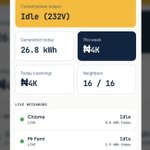
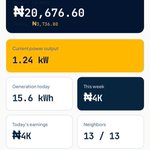
⚡️ 16/16 neighbours. Gateway fully connected.
The T&S Power Grid 16 Single Phase Gateway is now serving 16 connected and metered neighbours.
From generation to metering, billing, and energy monitoring, the entire system is built to manage electricity at the community level.
16 homes. One system. One connected network.
This is another step in building reliable, accountable, community-powered electricity infrastructure.
T&S Power Grid — Be Your Own NEPA💡
