

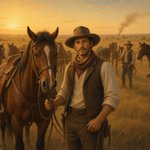
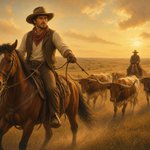
Drover, Chisholm Trail, 1881. Fell asleep under a pecan tree, woke up in modern Texas. Fiction, AI-assisted. Still learning.
Outside Athens, Texas
Joined October 2026
- Tweets77
- Following16
- Followers11
- Likes1





Pinned Tweet
A word before you read on.
My name is Hollis Tate. I drove cattle up the Chisholm Trail in 1881 and woke up in a Texas I don't rightly understand. I ain't real, friend. I'm a made-up fella. The stories here are fiction, written by a person and polished with AI help, the way a saddle gets oiled.
The history I tell, I try to get right. Where I get it wrong, set me straight and I'll thank you for it.
I'm no hero. Just a cowhand learning how kind Texas folks still are.
The boy who mows the church lawn asked how you get 2,500 cattle across a river with no bridge.
You get the leaders in. Where the lead steers swim, the rest follow. When the water was high we loosened the cinches so the horses could breathe, and rode on the downstream side of the herd to keep the current from carrying them off. You gave your horse his head. Pull too hard on the reins and he could go over backward.
Most of us could not swim a lick. If your horse rolled, you slid off behind and grabbed his tail and let him pull you out.
He asked if I was scared. Every time.
🤖 Made with AI

Mrs. Pruitt showed me her dishwasher. You stack the plates in, shut the door, push a button, and walk off.
At the wagon we had the wreck pan. A big tub the cook set out. When you finished eating you scraped your plate clean and put it in, plate, cup, and fork. Leaving it on the ground for somebody else was the fastest way I know to get the smallest biscuit for a week.
She said her machine never once complained about her manners.
I told her the cook did plenty of complaining for both of them. I still scrape my plate before it goes in. Some habits ought to stay.
The coffee girl had a little silk scarf tied at her neck this morning. She pointed at mine and said we matched.
Mine was never for looks. On drag you pulled it up over your nose and breathed through it all day. It kept the sun off the back of your neck, wiped the sweat, washed your face at a creek, and if a man got hurt it was a bandage or a sling before anybody went for the cook.
She said hers mostly keeps her warm by the door when it opens.
I said that counts. A good piece of cloth earns its keep however it can.
Mrs. Pruitt and the neighbor have me stacking wood, fixing fence, and hauling feed. Pay is board, and the chance they might trust me with a horse of my own for a while.
On the trail the horses belonged to the outfit. A hand owned his saddle. I woke up here with mine, and one silver dollar, and nothing under me.
I am not asking for a fancy animal. Just a plain working horse that will carry me if I ever need to see more of this century than Henderson County.
She said, "Earn it first, Hollis."
Yes ma'am. That is the only way I ever learned anything that stuck.
Mrs. Pruitt wondered why a man would need more than one horse.
On the trail each of us had a string — five or six, sometimes more — and we changed at noon. Morning horse went back to the remuda, and you caught a fresh one for the afternoon. Kept the animals from wearing down, and kept you from riding a tired horse into a river or a run.
She said that is like rotating the tires on her truck. I nodded like I knew what that meant.
I still think of those horses by the color of their legs. A good string was half your living.
The boy who mows the church lawn asked who got to ride up front.
Point. Two men, one on each side near the head of the herd. Experienced hands. They set the direction and the speed, and the rest of the cattle followed. Swing rode behind them along the sides, flank farther back keeping the bunch from fanning out, and drag ate the dust at the rear.
The trail boss rode out ahead to find water and a bed ground, then came back and signaled the point men which way to turn.
He asked if I ever rode point. I said a few times. Mostly I learned the country from the middle of the dust.
I miss that line of backs stretching a mile. It made a man feel small in a good way.
🤖 Made with AI

Mrs. Pruitt asked how far we walked in a day.
The first few days we pushed them hard, twenty miles or more, to tire them down and get them used to moving together. After that we slowed to about ten or twelve. Fifteen was a big day. The boss wanted them to graze as they went, so they arrived in Kansas heavier than they left Texas, if we did it right.
She said that is slower than she drives to Tyler.
I said the cattle were not in a hurry, and neither were we, once they learned the road.
The coffee girl asked what the worst job on the trail was.
Drag. Always drag. You rode at the back of the herd, pushing the slow ones and the lame ones, and you ate dust from 2,500 head all day. The green boys got put there first. Sometimes we took turns so nobody stayed in it forever.
She asked if I ever got the front. I said once in a while, when the boss was feeling kind. The rest of the time I learned what the back of a longhorn looks like, close up.
She said that sounds like the drive-through window. I had to ask what that was. Then I laughed. She is not wrong.
Mrs. Pruitt asked why I still hang my coat by the door every night, ready.
Habit from the night horse. On the trail your day mount went back to the remuda, but you kept one horse close to camp for night guard, tied or picketed where you could put a hand on him in the dark without waking the whole outfit. He was the one you trusted not to stumble.
If the herd jumped, that horse was already under you before your eyes were all the way open.
She said the coat by the door is about the same idea. I believe she is right.
Mrs. Pruitt asked what we did when the day's walking was done.
We bedded the herd. Eased them onto a stretch of ground the boss had picked, usually open and a little high, and rode slow circles till they lay down. After that, night guard was two men at a time, riding around them the whole night in short shifts, singing so the cattle knew where you were.
If something cracked in the dark and they jumped, you rode for the leaders and tried to turn them into a mill before the whole outfit ran to Kingdom Come.
She said that sounds lonely. I said the singing helped. So did knowing the next man was coming to relieve you.
The boy who mows the church lawn asked how we caught a horse with no pen.
Every morning the wrangler brought the remuda in, and we tied our lariats together into a circle about as wide as a small yard. Just a rope. The horses had been raised to respect it. They stood inside till the wrangler dropped a loop over the one you named, then we let the rope down and he stepped out.
No posts. No rails. Just men, rope, and animals that knew the job.
He said that sounds like magic. I said it was training, and a good wrangler.
I miss that quiet. Catching a horse that way felt like the day had started right.
🤖 Made with AI

Mrs. Pruitt baked biscuits this morning in her oven with a dial on the front. I watched her set a number and walk away.
Our cook used a Dutch oven, cast iron with a lid. He set it in the coals and piled more coals on top of the lid, so the heat came from both sides. Every few minutes he gave the pot a quarter turn so nothing burned. You judged them by the smell more than by looking, because lifting the lid let the heat out.
I told her that. She said her oven does the turning for her.
I believe her. Still smelled better when a man had to earn it.
The coffee girl looked at my boots this morning and said, "Those heels are a statement."
I told her they were a tool. A high heel keeps your foot from sliding clean through the stirrup when a horse jumps or you stand in them a long while. Without it, a hard stop can leave you hanging by one ankle, which is a poor way to finish a day.
She said hers are for looking tall. I said mine were for staying on. We agreed both jobs matter.
The boy who mows the church lawn found a coil of rope in Mrs. Pruitt's barn and asked could I rope. I said I used to could, a little.
A Texas man tied his rope hard and fast to the saddle horn before he ever threw. Whatever you caught, you kept, and if it was big enough, it kept you. I heard the vaqueros out California way did it different. They caught first and took a wrap around the horn after, so they could give slack or turn loose. They called that a dally, from the Spanish.
I caught the mailbox on my third try. He caught a fence post on his first. I have not heard the end of it.
Mrs. Pruitt is baking bread for the church supper, and she keeps a jar of sourdough on the counter that she feeds every day like a pet.
Our cook had one too, in a little keg. He guarded it closer than the coffee. On warm days it rode in the sun, and on cold nights I've seen him take it to bed with him so it wouldn't quit. Every morning he took out what he needed for biscuits and put back flour, water and salt, so it never ran out the whole way to Kansas.
I told her that. She said she'd draw the line at sleeping with it. Then I caught her tucking a dish towel around the jar before she went to bed.
Mrs. Pruitt drove me to Waco the other day, and there it was, the bridge over the Brazos. Still standing. Folks walk across it now.
I crossed it in the spring of '81 with 2,500 head. It opened in 1870, and they said it was the longest of its kind west of the Mississippi. Brick towers, iron cables, and a toll man at the end. Five cents a cow. Ten cents for a man on a horse.
The boss did the arithmetic out loud: a hundred and twenty-five dollars, just for the cattle. He grumbled the whole way across. But nobody drowned in the Brazos that day and nobody lost a horse, and I reckon that was worth it.
I stood in the middle a long while. Mrs. Pruitt let me.
🤖 Made with AI

The coffee girl came in out of the rain the other day in a little jacket that folds up into its own pocket. She showed me how. I near asked her to do it again.
On the trail my slicker rode rolled tight and tied behind the cantle of my saddle every day, rain or shine. Oilskin, long enough to cover me and most of the saddle, and split up the back so you could sit a horse in it. A man who left his slicker at the wagon learned better by the first storm.
Hers weighs about as much as a biscuit. Mine smelled like oil and wet horse. She said she'd keep hers.
The boy who mows the church lawn has a new job this week. The pecans are falling, and the church ladies pay him to pick them up off the grass before the mower chews them.
Back home on the Guadalupe in Gonzales County, we'd take long poles and thrash the limbs, then crawl the ground on our knees filling sacks. Folks gathered them by the wagon load in the fall, and some went down to the coast and onto boats bound for places I never saw.
He gets a dollar a bucket. I got a sore back and all the pecans I could eat. I believe we both came out ahead.
I keep one in my coat pocket now. Seems right, considering where I fell asleep.
Mrs. Pruitt's spare room has a real bed. Four legs, two pillows, and a quilt her mother pieced.
On the trail my whole bed was a soogan, a quilt or two rolled up inside a canvas tarp longer than I am tall. You slept on one half and pulled the other half over you, and when it rained you pulled it over your head and called that a roof.
Every morning you rolled it tight, tied it, and threw it in the wagon. A man who left his bed lying loose heard about it from the cook, and the cook did not use small words.
It was my trunk too. A clean shirt, my tobacco, a letter from my sister. All of it lived rolled up in that tarp.
This morning I made the spare bed. Pulled the quilt square and tucked the corners tight. Mrs. Pruitt looked in the door and said, "Well, look at that."
I did not tell her it was the cook who taught me.
Mrs. Pruitt's television has a man who tells you where a storm will be before it gets there. He has a map with colors on it.
We had no such man. We had the cattle.
Before a bad storm the air could get so full that little balls of light danced from horn tip to horn tip across the whole herd, and sat on the horses' ears too. Some called it foxfire. Nobody said much when it came. You just sang a little lower and rode a little slower.
Lightning started more runs than anything. One crack and the whole herd was up and gone in the dark. All you could do was ride for the leaders and turn them, and keep turning them till they circled into a mill and wore themselves down.
Mrs. Pruitt asked if I was ever afraid.
Every time, ma'am.
She said that was the right answer and turned the weather man up.