

Restoring coherence and optimizing health through honouring God’s design. ♱ My skincare products 👇🏼
Joined July 2023
- Tweets6.9K
- Following230
- Followers16K
- Likes29.9K






I went to see a neurological chiropractor recently to investigate some of the lingering issues I’ve been experiencing since my concussion earlier this year. One of the things she found was suspected left-sided BPPV (benign paroxysmal positional vertigo). Essentially, head trauma can cause tiny calcium carbonate crystals in the inner ear to become displaced, interfering with the vestibular system and how the brain interprets movement and spatial orientation.
Vestibular dysfunction following a head trauma can contribute to visual disturbances, brain fog, cognitive difficulties, headaches, motion sensitivity and feelings of disorientation. There are also connections between vestibular processing, cervical proprioception and autonomic function, which I’m especially interested in exploring considering my whiplash injury and all the strange neurological symptoms I’ve experienced since my concussion.
Yesterday I had an Epley manoeuvre performed, which involves a series of head movements intended to reposition the displaced crystals. Afterwards I felt like I had just gotten off a boat. I was so nauseous, had a headache and felt completely disoriented. It was WILD. I feel a lot better today, but I’m really interested to see what happens from here. This is an area I hadn’t looked into much until very recently, and I’m curious how much of what I’ve been experiencing could be connected to vestibular dysfunction.
If anyone else has looked deeper into this, I would love to hear your thoughts or experiences!
Milk 𖤓 retweeted

let me impart my neurodivergent pattern recognition to put you on to the problem. GABA signaling and histamine are the common threads.
PMDD = extreme dysphoria, mood changes, and dark thoughts in the luteal phase. in the luteal phase, women should be progesterone dominant and feel its calming, soothing effects. women with PMDD tend to run lower in progesterone relative to estrogen, and they also can't feel the calming effects because of differences in their GABA receptors.
the calming effect works by progesterone breaking down into allopregnanolone, a compound that calms the brain by boosting GABA, its main "brake" signal. in PMDD, the brain doesn't adjust well as allopregnanolone rises and falls across the cycle, so the calming effect doesn't come through when it's needed most.
this hits autistic and ADHD women harder. autism and ADHD are linked to an imbalance between "go" and "brake" signals in the brain. less GABA, which slows things down, and more glutamate, which speeds things up. before a period, the calming effect of allopregnanolone becomes unreliable, which leaves an already thin margin of inhibition even thinner. that typically shows up as bigger emotional swings, sensory overload, and trouble with planning and executive function.
histamine explains why estrogen stays elevated relative to progesterone. this is the estrogen-histamine axis. estrogen promotes mast cell degranulation and lowers DAO activity, while histamine can stimulate more ovarian estradiol production. this creates a loop that tightens when estrogen clearance is poor. the usual drivers of poor clearance are gut dysbiosis and low liver phase II conjugation.
impaired methylation compounds this, and it is common in ADHD and autistic women. this fits with the many reports of women getting massive PMDD relief on antihistamines.
so the typical presentation is a sensitive neurodivergent woman with gut symptoms, dark thoughts before her period, and unexplained allergic-type reactions that shift across her cycle.
my high-ROI interventions:
- magnesium glycinate and L-theanine to support GABA and dampen glutamate activity
- low-histamine diet (aged cheese, cured meats, leftovers) plus DAO enzymes as needed
- go alcohol-free for 90 days
- resistance training
- B6, vitamin C, vitamin E
- calcium D-glucarate and daily nettle tea for estrogen clearance and mast cell support
- taurine, glycine, choline for phase II conjugation, GABA/methylation support




Milk 𖤓 retweeted
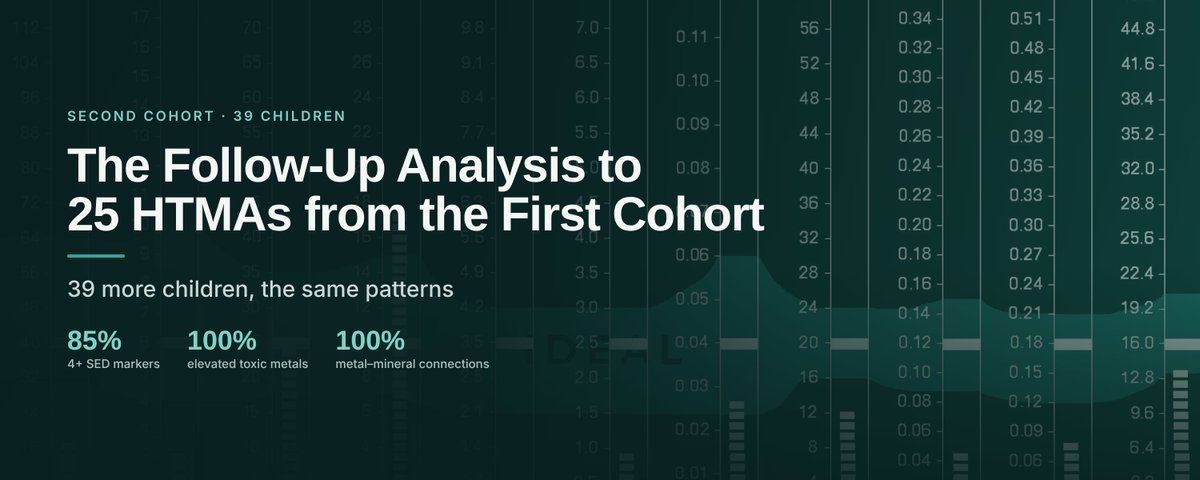
39 More HTMAs Analyzed in Children With a Diagnosis of Autism From My 1:1 Practice - Corroborating the Findings from the First 25 HTMA Dataset


This is why you need to meet your mutuals.

@TheRawSol and I found a restaurant with extremely un-aesthetic Boomer decor and the freshest West Coast oysters for $1.75 CAD each. Naturally we yapped about herbalism till we shut the place down. One point on the board for Canada.


One of my favourite health practices that I’ve been preaching about for years: BATHS! 🛁
A study published in 2025 compared the physiological effects of hot water immersion, traditional saunas and far-infrared saunas, with some really interesting findings.
Researchers found that hot water immersion (40.5°C for 45 minutes) produced significantly greater thermoregulatory, cardiovascular and immune responses than either sauna protocol.
Core body temperature increased by approximately 1.1°C during hot water immersion, compared to 0.4°C in traditional saunas and essentially no change in far-infrared saunas. Hot water immersion also produced the greatest increase in cardiac output, indicating a stronger acute cardiovascular response.
The immunological findings were especially interesting. Hot water immersion was the only modality to produce a statistically significant increase in interleukin-6 (IL-6), a cytokine involved in inflammatory and immune regulation. Researchers also observed significant increases in the relative proportions of natural killer (NK) cells at 24 hours and CD8+ T cells at both 24 and 48 hours following immersion.


For those with POTS, MCAS, and/or hEDS, what have you found most helpful in managing your symptoms and improving your overall health? Any particular protocols, supplements, lifestyle changes, or practitioners that have made a significant difference?
Just gathering information! Quite a few people in my life are dealing with these conditions, and I’ve noticed how differently they seem to manifest in everyone. I’m curious to hear about individual experiences and what has actually made a difference!
I’ve noticed a certain psychological disposition among chronically ill people who are absolutely convinced that nothing they do could ever improve their health. I think the same patterns of thinking that lead them to believe improvement is impossible are what prevent them from recognizing or pursuing opportunities to change their circumstances. Learned helplessness easily becomes a self-fulfilling prophecy.