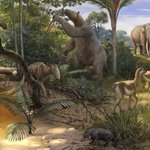
Exploring our Lost Worlds

Joined January 2021
Check out the new article at TheExtinctions by @GottGro! Art by yours truly of course 😌 This year started with a lot of lions, but the true protagonists here are the ground squirrels :B
6
17
109
6,728
Violence... I don't remember if I ever shared this picture I did a while back for @Theextinctions ! I want two things; a bear skull pole like that for my yard, and adding a proboscis monkey nose to the Neanderthal :B
8
41
357
9,617
The Extinctions retweeted
Interested in the late-Quaternary #megafauna #extinctions 🦣πŸͺπŸ˜πŸ¦£πŸ†- check our new review of the patterns, causes, consequences & #Anthropocene implications bit.ly/4aBR9fI 🌿🌐🦘🐎 #pleistocene #mammals #paleoclimate #homosapiens #rewilding #ecosystem #defaunation
1
91
7
337
28,251
Another quick doodle, inspired by fossil evidence of the Neotropical wild dog Protocyon (a cerdocyonine, that is, relative to the bush dog and maned wolf, but filling a dhole or African wild dog type niche), preying on an old, arthritic glyptodont :B
8
82
2
390
10,547
Two subantarctic bears (Arctotherium tarijense), hungry after a harsh winter, fight over a dead king penguin somewhere in Pleistocene Patagonia :B This was the southernmost bear, and the closest to a southern polar bear although it was actually a tremarctine (short-faced bear)
21
198
3
1,233
33,765
Your reminder that South America's southernmost regions were once inhabited by the Patagonian panther, a descendant of an early migration wave of jaguars that grew as big as tigers and preyed on giant ground sloths. These jaguars were likely paler and furrier than modern ones.
21
194
3
1,205
35,391
Don't miss our latest article!
NEW on The Extinctions - The Great Auk, the lone flightless bird in the North Atlantic, went extinct in the 19th century. Despite seeming like a modern extinction, the species faced a slow decline and once inhabited a much wider area. Read more below: theextinctions.com/articles-….
3
14
5,841
The Extinctions retweeted
Rich megafaunas were the norm across Earth's land masses from >30 million years ago until just 10-40 thousand years ago- here illustrations of #megafauna from North America 15 mio years incl #elephants (s.l.) 🐘🫏πŸͺ #megabiota – at Arhus, Denmark
This quoted post is unavailable.
14
2
91
14,210
The Extinctions retweeted
"Time-series modeling strongly implicates humans as the primary cause of the state shift and resulting #extinctions" - analysis of the La Brea #megafauna fossil record in @ScienceMagazine today 🐘🦬🐎
O’Keefe et al. study the fossil in the "La Brea tar pits in conjunction with nearby core samples and found a clear relationship between an increase in #fireβ€”and fire-related #ecosystemsβ€”and large mammal #extinction" science.org/doi/10.1126/scie…
1
12
51
6,595
For #WorldPenguinDay, remember the original β€œpenguin”: the Great Auk! Although it looks a lot like a penguin and was an adept diver and swimmer, the Great Auk was most closely related to the razorbill!
1
10
50
2,916
NEW on The Extinctions - Pachyderms, Power, & Politics: The history of the elephant in Northeastern Africa. In this guest-article by @ReginaldODonog1, explore the history of elephants in the ancient milieu of the Nile and the lands below. theextinctions.com/articles-… #megafauna
16
3
52
8,926
The Extinctions retweeted
Maxilla of the extinct Giant Koala of Australia, Phascolarctos stirtoni (ca. 50 kyr). These things weighed 20-25 kg, 2-3 times as big as the modern koala (skull in background), no doubt placing great strain of the branches of Australia's ancient gum trees! #FossilFriday #Koala
9
46
2,802
The Extinctions retweeted
Cranial remains of Ramsayia magna from the Late Pleistocene of Australia and the evolution of gigantism in wombats onlinelibrary.wiley.com/doi/… @ARCHE_Griffith @TheFatWombat @Mat_Duv64 @marsupialtapir @robinmdbeck @marsupialtapir @MorphoSource @MorphoBank @datadryad
2
13
1
71
At the same time that Mylohyus inhabited North America's forests, Platygonus roamed open habitats (although it seems like it was pretty adaptable). It has been suggested that its tail (long for a peccary) may have been used as a visual sign to communicate with herdmates.
7
68
488
Quick doodle of the night! A Pleistocene beast seldom talked about, the long-nosed peccary Mylohyus lived in North America's forests during the Pleistocene and could grow quite a bit larger than today's peccaries, weighing up to 70 kg or so! Thanks @A3Dnazrigar 4 the inspiration!
10
64
3
380
:B Thank you, @Hieraaetus, @BayKruse! Very proud and excited of being part of the team!
(1/3) We are proud to announce @HodariNundu as an official part of The Extinctions Team! He has already done numerous wonderful pieces for the website and is constantly evolving as an artist! The partnership continues to be a fruitful one.
1
6
50
Reminder that the island of Ibiza used to be home to a pygmy viper (Vipera latastei ebusitana) that went extinct around 4000 years ago shortly after human arrival due in good part to the accidental introduction of venom-resistant dormice that likely ate the viper's young.
6
61
3
395
THREAD: The Giant Marabous of Asia (1/12) The Marabou Stork (Leptoptilos crumeniferus) is a remarkable bird, the largest of the modern adjutants (Leptiptilus). exceptional individuals can attain wingspans of over 3 meters and stand at about 1.5 metres in height and weight 9kg…
1
21
1
83