

PhD candidate. Machine learning & probabilistic models for immune receptor repertoires (AIRR-seq). Computational immunology, deep learning, open-source tools.
Tel-Aviv, Israel
Joined February 2023
- Tweets37
- Following127
- Followers85
- Likes172


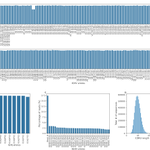


Big news! Our paper on enhancing immune receptor alignment with deep learning is out in #NAR!
We introduce AlignAIR: a new state-of-the-art tool for AIRR-seq analysis that we've been working on for the past two years.
#Bioinformatics #DeepLearning

AlignAIR sets a new state-of-the-art. Benchmarks show it significantly outperforms existing tools, especially at high mutation rates. #Genomics #Immunology

1
1
25
Beyond accuracy, AlignAIR provides calibrated likelihood scores that reflect true alignment confidence, a critical feature for interpreting results.
Explore the paper or try our easy-to-use web app!
📄 Paper: doi.org/10.1093/nar/gkaf651🖥️ Web App: alignair.ai

1
19
Thomas Konstantinovsky retweeted

Check out our new publication: An unbiased comparison of immunoglobulin sequence aligners academic.oup.com/bib/article…

Thomas Konstantinovsky retweeted

Compactly supported orthogonal wavelets are defined using filter banks. en.wikipedia.org/wiki/Daubec… en.wikipedia.org/wiki/Ingrid…
Big news! I'm excited to share our latest research, "An unbiased comparison of immunoglobulin sequence aligners," now published in Briefings in Bioinformatics! Co-authored with Ayelet Peres, this work sets a new benchmark for Ig sequence alignment evaluations. 🧬✨#Bioinformatics
Our analysis revealed strengths and limitations in each aligner, emphasizing how noise and mutation rates impact their accuracy. GenAIRR now should drive the improvement and future development of new Ig alignment algorithms.

1
43
Explore GenAIRR and generate your custom sequences and datasets, taking your immunogenetic analyses to the next level! Open-source and designed to integrate seamlessly with research routines. Read the paper: lnkd.in/dqcJHxUC | GenAIRR: lnkd.in/dsZW9urG
38
Thomas Konstantinovsky retweeted
Oldies but goldies: Shepard, Donald, A two-dimensional interpolation function for irregularly-spaced data, 1968. A popular interpolation method based on radial basis functions. en.wikipedia.org/wiki/Invers…
Thomas Konstantinovsky retweeted
Laplacian eigenmaps perform non-linear dimensionality reduction ("manifold learning") by embedding data points using the eigenvectors of a graph Laplacian as coordinates. en.wikipedia.org/wiki/Nonlin…
Thomas Konstantinovsky retweeted
Strong convexity and smoothness are the two key hypotheses to make optimization well-posed and obtain a linear rate of descent schemes. They define upper and lower bounding quadratic approximants. Generalizes the condition number of linear systems. en.wikipedia.org/wiki/Condit…

Thomas Konstantinovsky retweeted
The structure tensor is the local covariance matrix field of the gradient vector field. It encodes the local anisotropy of an image. At the heart of anisotropic filtering and corner detection. en.wikipedia.org/wiki/Struct…

Thomas Konstantinovsky retweeted
Oldies but goldies: Eugene Wigner, Characteristic Vectors of Bordered Matrices with Infinite Dimensions, 1955. The empirical distribution of eigenvalues of random symmetric matrices converges to a half-circle density. en.wikipedia.org/wiki/Wigner…

Thomas Konstantinovsky retweeted
Oldies but goldies: Shepard, A 2-dimensional interpolation function for irregularly-spaced data 1968. Shepard interpolation uses singular radial basis functions inversely proportional to distances. Generalizes Nearest neighbors en.wikipedia.org/wiki/Invers…
Thomas Konstantinovsky retweeted

New work from my lab on "Weakly supervised identification and generation of adaptive immune receptor sequences associated with immune disease status" led by @rlyhighvariance and @PRobertImmodels. Great collaboration with @SandveGeir and L. M. Sollid. See 🧵 below.

1/8 New preprint: generative modeling of AIRR repertoires, the last piece of my PhD, >2 years of work, a project that is very dear to me biorxiv.org/content/10.1101/…

Thomas Konstantinovsky retweeted
The Ising model is one of the most celebrated model from statistical physics exhibiting a phase transition at a critical temperature in dimension 2 and higher. Models variety of phenomena from ferromagnet to neural networks. en.wikipedia.org/wiki/Square…
Thomas Konstantinovsky retweeted

Very cool study: ancient antibodies were recovered from the teeth of a Medieval individual, and some of those antibodies were still able to bind parts of Epstein-Barr virus! EBV is a great proof-of-concept: it's shed in the mouth and is incredibly common. doi.org/10.1016/j.isci.2023.…