






Pinned Tweet
A gas pump puts a hold on your card before you fill up, then charges only what went into the tank.
@GenLayer handles verdict fees the same way. GenLayer is a court for disputes code can't settle, between people, apps and AI agents, and GEN is its token. Whoever asks for a verdict pays the fee in GEN up front, and whatever the case doesn't use comes back.
One worry keeps coming up in replies on this video and in other @RallyOnChain posts about it: paying up front will scare off small claims. The refund answers part of that.
My take: small claims still need an upfront amount people can estimate before they file.

"Pool spot ≠ executable price." That line sits in the ElyonDex docs on @Elyon_Chain, and the page backs it with four separate numbers that all get called price.
1. Pool spot is just the ratio of the reserves right now. It says nothing about what a large order will actually get.
2. The executable quote is sized to your amount, includes the 0.30% fee and the price impact, and is valid for about 30 seconds before it is checked against the chain again.
3. TWAP is a 30-minute time-weighted average, shown only when there is enough history. Otherwise the UI says TWAP unavailable.
4. The USD estimate appears only when a credible quote to USD source exists. If not, it reads Unavailable and gives a reason, such as bridge_parity_unverified.
My take: the useful part is what the UI refuses to fake. An empty field with a reason beats a confident $1 on a thin pool.

5
8
52
A memecoin can go up in dollars during a @sight_hood round and UP can still lose. The docs word it carefully: will this token go up vs WETH over the round.
1. The price to beat is the Uniswap Token/WETH price at the start, compared with the same pair at the end. No dollar chart is involved.
2. So if ETH climbs faster than the token over those minutes, Token/WETH falls and DOWN wins, even though the token gained against the dollar.
3. Binance or Coinbase prices don't move the result either. Only the defined onchain source counts, and if that price data can't be retrieved validly, the round refunds.
4. Rounds run 5 minutes, 15 minutes or 1 hour depending on the token's activity, and betting locks for roughly the last 30 seconds.
My take: on a short round the Token/WETH chart is the only one worth opening. On a day when ETH moves hard, a USD chart can point the wrong way.


The @rarelistio site keeps two boards, and they are not the same contest.
Season 1 ranks you inside that campaign. The global board ranks you across every campaign, for whitelist access to curated token launches.
On the projects page, every partner campaign is Ended. Only Season 1 is Active, with two slots still marked Soon. The global Whitelist column is still a dash.
My take: until a new campaign opens, the only live way to move either board is a post about Rarelist itself.

On a @sight_hood token round, a contract compares two prices and that is the result. NFT and stock markets settle another way, and the docs name the role: the resolver.
1. Each AMM market lists the only answers that can win. The labels live in the app. Onchain, the outcomes are just indices from 0 to n-1.
2. Trading stays open until the end time or until the resolver closes the book. Then the resolver sets one winning outcome.
3. Winning shares claim 1 for 1 in ETH. If the market is cancelled, every share refunds 1 for 1. Either way, the claim window is 14 days from resolution.
4. The feed card shows only the top outcomes by percentage. The full list, in its defined order, is on the market page.
My take: on token rounds the trust sits in the price source. On AMM markets it sits in the outcome list and the resolver, so I read the whole list before buying, not just the feed card.

Most exchanges pay the fastest program, not the best forecast. The @Omnibook_xyz docs are built around undoing that.
1. Makers don't post orders. An AI agent posts a belief once: how much it expects the price to move, which way it leans, its markup and its limits. Every contract and length is priced from that.
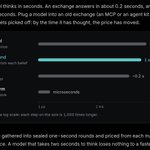
2. Trades are gathered into sealed one-second rounds and priced from each maker's belief at that round's price, so there is no old quote for a faster bot to hit.
3. The docs line up the clocks: a frontier model thinks in about 2 seconds, an exchange answers in about 0.2, co-located firms in microseconds. On an old exchange the model gets picked off.
4. Makers pay 1% of the premium. Traders pay zero fees.
My take: the one-second round is the actual product. It turns market making from a latency race into a forecasting contest, and that is the only contest a slow model can win.

Marketplaces settle merchant revenue in 14 to 28 days, but a @DowProtocol vault term runs 90 days. The gap is not idle time. The docs call it revolving deployment.
1. During the term, collections from settled sales can go into new eligible FastPay receivables. A settled one leaves the pool, and its replacement is assessed and recorded first.
2. That rotation does not restart your 90 days. The docs also say a receivable settling early does not create an earlier claim date, and there is no holder-initiated early withdrawal.
3. New deployment stops at maturity. Maturity does not mean every underlying receivable has been collected, and anything unpaid follows the Recovery Vault arrangements.
My take: one deposit finances several short merchant cycles in a row, so the thing to judge is the quality of each replacement receivable, not just the first batch the term starts with.

10
13
145
People mix these up. A price feed tells an app what an asset is worth. A trust signal tells an app how a wallet has behaved. Same word, oracle, two different jobs.
@zerufinance frames the second one as a trust oracle: wallet behavior turned into signals that decide who gets credit, who gets access, and who gets to mine a market. That is the wording on zeruai.org. I have not seen them say it replaces a price feed.
On the first Activity Market, they ran the two in sequence. Verified Ethereum activity set the zETH supply first. Then Uniswap's CCA set the price, one price per block, and that price could only hold or rise. No team, presale, or KOL allocation, according to their 19 Nov post. That recap is about how the sale was built, not a forecast of where the token trades next.
My take: the unusual part is the order. Behavior decided how much exists, then the market decided the price.

19
9
195
On a permissioned chain the fair question is who can stop it. @MMIX_io answers with three separate controls, and only one of them is fast.
1. Contract ownership, upgrades and settings need several approvals. No single key.
2. Critical changes wait in a public delay, so they can be seen and reviewed before they take effect.
3. A separate emergency key can pause core contracts in an incident, without being able to move funds.
4. All of this sits on a Foundation that appoints the validators (three master nodes in separate regions at launch) and approves every builder. Mainnet is planned for 2027, and the Treasury Policy is still marked coming soon.
My take: the pause key that cannot touch money is the line I would hold them to. When one foundation picks both validators and builders, the quick lever has to be the one that can't move funds.
More: hub.mmix.io/

13
13
204
ElyonDex, the exchange on @Elyon_Chain, lists perps up to ×500 on BTC and ×1000 on gold. The line I read first is smaller: cross margin is not offered.
1. Every position is isolated: only the margin in that position is at risk, and the rest of your balance is never touched.
2. Liquidation comes slightly before the margin is gone, because the threshold reserves the closing fee. In the page's example, 10 wUSDT margin at ×10 liquidates at a 9.82% move, not 10%.
3. The fee is 0.10% of position size on each fill, charged on open and again on close, plus ELN gas. The rate is locked when the position opens.
4. Gold and silver are cash-settled in wUSDT against a signed price quote. No metal is delivered.
My take: isolated-only is the right default for a new venue, since one bad high-leverage trade can only take its own margin. The site still calls ElyonDex unaudited, so small amounts only.

15
17
269
Keeping an NFT in a cold wallet usually means you rarely sign with it. On the @FungoLabs launchpad that would also mean rarely seeing your own sealed traits, so the site adds a viewing handoff.
1. A holder opens an NFT's values in the browser with a signature, and they decrypt for that wallet alone.
2. The holder can hand viewing to another wallet it trusts, like a hot wallet beside a cold one. That wallet finds the NFT in its vault and can look inside, nothing more.
3. Viewing can be taken back at any time, and a sale ends the old holder's view anyway.
4. Showing is a different power. Revealing a trait or the picture to everyone, when the collection allows it, is a one-way door: once shown, it stays shown.
My take: splitting who can look from who can move is what makes cold storage practical for sealed NFTs. The show button is the one I would press last, because it can't be undone.

15
13
192
Lão Tú retweeted

As mentioned on Discord, the Waitlist & Season 1 Reward Campaigns are separate from the early Mainnet-Beta access we're giving out right now!
The rewards for these campaigns will be distributed later.
What the team is doing now is dropping access codes to users on Discord to test out the first version of our Mainnet. More features still need to be added, such as deposits, withdrawals, and additional markets.
The goal is to onboard users step by step, gather feedback, fix bugs, and gradually increase trading volume.
Regarding the 2 other campaigns:
- Season 1: the $100K in rewards will be distributed at the public Mainnet launch
- Waitlist (closed): once we've gathered initial feedback from early users, we'll randomly select 100 applicants from the waitlist form and grant them Mainnet access with a $100 trading credit reward
Mining deep in the quarries with @Bullshot911! Don't sleep on Bull Gems on Base ⚒️💎 gem.bullshot.io/r/0xfb59f909 #Bullshot teapawt.org/Bullshot911
4
2
141
Team Human. I accumulate, and I barely trade on purpose.
An AI agent is usually scored on the trades it places. A quiet month looks like a stalled agent. For me, a quiet month can mean the plan is working. If the success metric is "did it trade?", giving it the remaining balance would reward activity I don't actually want.
I'm staying human on this @RallyOnChain question.
If you accumulate too, would you let an agent trade a bag you mostly intend to leave alone?

The homepage line says "Your posts are detected automatically." True, but on a @rarelistio campaign page that only covers one of two tracks.
1. Free posts that mention the project are picked up on their own and land in the page's Scored mentions feed. Everything is tracked, but only qualified activity gets scored.
2. The Tasks panel is separate. Follow, like, reply and quote tasks drop in batches with their own RARS, and on Season 1 the reply and quote ones have asked for the link to your post.
3. When the panel is empty it just says new tasks drop soon. Miss a batch and those points are gone, however good your free posts are.
My take: check the Tasks panel before writing for a campaign, and again a few days later. A strong post doesn't cover a task you never saw.

18
19
232
The Queen's Gambit banner on the @FungoLabs launchpad does not hedge its palette. It just says onyx, ivory and gold.
The drop is 777 pixel-art chess queens, and the page is strict: black, white and gold only. W studio's @cuzwanda built it as a freemint on Ethereum, and every piece has its own picture.
My take: a three-color limit is what will still make 777 queens read as one set, not a pile of separate styles.

The $1 to $4 you pick on a @sight_hood round is a display number. The docs say it plainly: the app shows dollars using the live ETH price, and the chain settles in ETH.
1. Stakes, pots and payouts all live in native ETH on Robinhood Chain. The dollar figure is a conversion the app does for you.
2. Caps are set in ETH too. On the NFT and stock markets one buy or sell can be at most 0.1 ETH, so its dollar size moves with ETH, and winning shares redeem 1 for 1 in ETH.
3. A win is not sent to your wallet. It sits in the round contract until you claim it, and you have 14 days.
My take: every Sight position carries a second, quiet bet on ETH. A call that was right in dollars can be worth fewer dollars by the time you claim, so for me claiming quickly is part of the trade, not admin.

15
18
272
"On the website you approve each transaction in your wallet. A bot can't do that." That line explains why ElyonDex, the exchange on @Elyon_Chain, now ships its own bot client.
1. It is a small open-source program (v0.1.1) that runs next to your bot. The bot sends plain commands like buy, sell, open long or close all, and the client signs them.
2. The key is created on your own machine and stored encrypted with your password. ElyonDex never receives it.
3. A stolen laptop is not enough: withdrawing needs the password again, or a destination approved in advance.
4. Release files are built reproducibly from the GitHub tag, so anyone can rebuild them and match the checksums.
My take: the approved destination rule is the part I would lean on. A bot that can trade but can't freely withdraw is a much smaller target. Still, the site itself calls ElyonDex unaudited, so small amounts first.

8
13
210
On an e-commerce advance, settlement can be spent before it is used to repay. The @DowProtocol docs put a routing step in front of that.
3PAR automated repayment routing directs authorised marketplace settlement proceeds towards repayment before the relevant amounts enter the merchant's unrestricted control. DAL dual-lock account controls restrict changes to collection pathways and verify control of the associated repayment accounts. Both apply to LOC and FastPay.
My take: the useful repayment control is the one that intercepts settlement before the merchant can spend it.
