

British academic in China 🇨🇳 since 2011. Writing little stories about life here, academic papers nobody reads, and occasionally novels. Getting older daily.
China
Joined November 2009
- Tweets38.2K
- Following1.6K
- Followers2.7K
- Likes7.6K




Pinned Tweet
A small note about my China stories.
I've lived in China 🇨🇳 for nearly 15 years. These are affectionate recollections of things I've experienced, noticed and sometimes found amusing along the way.
They're stories, so occasionally there is a little exaggeration or hyperbole. That's part of storytelling.
They aren't intended as criticism of China or Chinese people. Quite the opposite. I wouldn't still be here after all these years if I didn't enjoy living here.
The humour is affectionate, and quite often the person I'm making fun of is myself.😂
Please read 📖 them in that spirit.🕊️🙏
Han Shan 寒山 — Cold Mountain #63
白鶴銜苦桃
千里作一息
欲往蓬萊山
將此充糧食
未達毛摧落
離群心慘惻
卻歸舊來巢
妻子不相識
A white crane carries a bitter peach,
Flying a thousand miles without rest.
It hopes to reach Mount Penglai,
With the peach to sustain it on its journey.
But before arriving, its feathers fall,
Alone and separated from its flock, its heart grows heavy.
At last, it returns to its former nest,
Where its wife and children no longer recognise it.
When I first came to China 🇨🇳, I discovered that the Chinese idea of a comfortable mattress was rather different from mine.
In fact, my first Chinese mattress seemed to have been designed by someone who thought sleeping on a wooden floor was an unnecessary luxury.
Let me explain.
When I arrived in China in 2011, I was given an apartment on the school campus.
The bed looked perfectly normal. It had what appeared to be a substantial Western-style mattress, with the usual fabric covering.
Unfortunately, underneath that fabric was what felt like a solid wooden board.
After several nights of uncomfortable sleep, I began to investigate.
There did seem to be some springing somewhere in the mattress. Perhaps, I wondered, I was sleeping on the wrong side?
So I turned it over.
And there they were. Springs!
Well, some springing at least.
The improvement was noticeable, although the mattress was still considerably harder than anything I'd been accustomed to in Britain.
My solution was to visit Auchan, the French supermarket, where I bought two Japanese mattress toppers.
Two!
Apparently, one wasn't going to be enough to rescue me from Chinese sleeping arrangements.
Eventually, I moved to another apartment.
Surely, I thought, the mattress situation couldn't get any worse.
It could.
This time the mattresses were only about two or three inches thick and seemed to be stuffed with something resembling straw.
I'd apparently progressed from sleeping on a wooden board to sleeping on agricultural produce.
Enough was enough.
Off we went to IKEA, where I purchased a proper mattress.
And I'm still sleeping on that same mattress today.
What interests me is that a bed is something we rarely think about as a cultural object. We simply assume that everyone wants the same thing: a comfortable night's sleep.
But comfort is something we learn.
What feels reassuringly firm to one person can feel like sleeping on a park bench to another.
And while I've adapted to many things during my years in China, I've never quite acquired an enthusiasm for sleeping on something resembling a billiard table.
So here's my question for Chinese readers: do you actually prefer very hard mattresses, or is this something that's changing with younger generations?
And for those who've lived in both China and the West, which beds do you find more comfortable?
I'm firmly on the side of the springs. Preferably with a little cushioning between me and them.
MISTY MOUNTAINS OF CHINA | Through the Coach Window in Zhejiang youtu.be/RmrHIqnV8UM?si=_l8G… via @YouTube
🤖 Made with AI


Worst Trip Ever To Waterfall Coffee - Fake Fake China youtu.be/cvLizVZwO4g?si=7QYt… via @YouTube
Han Shan 寒山 — Cold Mountain #62
余曾昔睹聰明士
博達英靈無比倫
一選嘉名喧宇宙
五言詩句越諸人
為官治化超先輩
直為無能縧後塵
忽然富貴貪財色
瓦解冰消不可陳
I once knew a brilliant scholar,
Learned and gifted beyond compare.
His name rang out across the land,
His five-character poems surpassed all others.
As an official, he outshone his predecessors,
Leaving lesser men trailing behind.
But wealth and rank awakened greed and desire,
And all his greatness melted away like ice.
There are four little shops in my apartment community in China 🇨🇳 selling almost exactly the same things.
My wife and I regularly use one of them. Occasionally another. We practically ignore the other two.
And I haven't the faintest idea why.
Let me explain.
Like many modern Chinese apartment complexes, ours has a little parade of shops built into the ground floors of the high-rise buildings.
Four convenience shops, all within a short walking distance of each other.
They sell much the same things. Cigarettes. Sweets. Chocolates. Basic groceries. Refrigerators full of soft drinks. The usual assortment of things you might need without making a trip to the supermarket.
Two of these shops are right next door to each other.
Both shopkeepers are friendly. Both are helpful. Both sell essentially the same products. As far as I can tell, there's very little to distinguish them.
Yet my wife and I have somehow developed a preference for one.
It's not a language problem. My wife is Chinese, and I've been into both shops on my own and managed perfectly well.
Nor is it a question of convenience. They're literally next door to each other.
As for the other two shops, I've barely been inside them. On the few occasions I have, it was simply to see whether they stocked anything different.
I don't think my wife has ever visited either of them.
And this is where the sociologist in me starts getting interested.
Why do we do this?
Somewhere along the way, without any conscious decision, we've developed a shopping habit. Perhaps even a little loyalty.
We don't compare prices. We don't carefully examine the stock. We just walk into our usual shop.
And the strange thing is that I suspect we'd continue doing exactly the same thing even if the shop next door offered us a slightly better deal.
But there's another mystery.
How on earth do four little shops, all selling virtually identical products within a few metres of each other, manage to make a living?
I see this kind of thing all over China. Little clusters of shops apparently competing for exactly the same customers.
Perhaps each has its own loyal following. Perhaps their regular customers are just as irrationally attached to them as we are to ours.
Or perhaps there's something about Chinese neighbourhood shopping habits that I still haven't understood after nearly fifteen years here.
I've considered conducting a little sociological experiment by deliberately shopping at the other three.
Although I suspect that within a week I'd be back at the usual one.
Old habits die hard. Especially when the shop is only a short walk from your front door.
So here's my question. Do you have a favourite little shop that you always visit, even when another one nearby sells exactly the same things?
And can somebody explain how four almost identical convenience shops, practically next door to one another, all manage to stay in business?


Dr Rob 🐀 (RATified) retweeted
For generations, Chinese schoolchildren have spent a few minutes every day massaging their eyes to prevent short-sightedness.
There's just one problem. Nobody seems entirely sure it works.
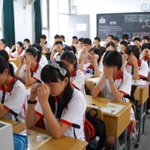
When I started teaching at a high school in Nanjing, China 🇨🇳, I encountered one of the more extraordinary rituals of Chinese education.
At a particular time each day, an entire classroom of teenagers would stop working, close their eyes and begin massaging their faces.
Every day. In perfect unison.
These were China's famous eye exercises, 眼保健操 (yǎn bǎo jiàn cāo).
The exercises involve massaging specific points around the eyes, usually accompanied by music and recorded instructions.
Coming from Britain, I found this fascinating. Getting thirty British teenagers to sit quietly for five minutes would have been an achievement in itself.
Getting them all to give themselves a synchronised facial massage would probably have required military intervention.
But here's the curious thing.
China has an enormous problem with short-sightedness among young people. And despite generations of students faithfully performing these exercises, scientific research has yet to establish convincingly that they actually prevent myopia.
Of course, five minutes away from books and screens might be beneficial anyway. And perhaps simply closing your eyes and relaxing for a few minutes is worthwhile.
But I sometimes wonder about those students I taught in Nanjing.
Did they genuinely believe they were protecting their eyesight?
Or were they simply enjoying five minutes when nobody expected them to read anything?
I'm curious to hear from Chinese readers. Did you do these exercises at school? Do students still do them today? And did you think they actually worked?

Read the story? Now watch the movie: youtube.com/shorts/SBCkDvlHC…


I've lived in China 🇨🇳 for nearly fifteen years, and I've reached a rather disturbing conclusion.
I'm not entirely sure I could survive twenty-four hours here without my mobile phone.
Not because I'm addicted to social media. Because China has made the smartphone an almost indispensable part of everyday life.
Take shopping. I hardly ever carry cash. I pay for practically everything using WeChat or Alipay. Supermarkets. Coffee shops. Restaurants. Even the little old lady selling vegetables beside the road has a QR code.
Want a taxi? Open DiDi. Want to order food? Open Meituan. Need to find somewhere? Open a map. Can't understand what somebody is saying? Open a translation app.
Even getting into my university involves technology. The gates use facial recognition, although fortunately my ageing face still seems to be recognisable.
Then there's the train. I can book a ticket on my phone, choose my seat and travel across China without ever needing a paper ticket.
It's extraordinary. And wonderfully convenient.
Until you start thinking about what happens when the phone stops working.
Imagine you're out shopping. Your battery is almost dead. You want to get home, but you can't book a DiDi. You want to buy something to eat, but you can't pay. You can't even telephone your wife to come and rescue you.
Of course, cash still works in China. Shops are supposed to accept it. But that isn't much consolation when you haven't brought any.
I actually have a wallet containing two 100 RMB notes. Emergency money. The trouble is that the wallet usually lives in a drawer beside my bed.
Very useful in an emergency. Provided the emergency happens in my bedroom.
And here's the strange thing. When I first arrived in China in 2011, I managed perfectly well without all these apps. I carried cash, hailed taxis in the street and occasionally got hopelessly lost.
Fifteen years later, China has made almost everything easier.
But I sometimes wonder whether we've exchanged a little independence for all that convenience.
So here's a question for people living in China, and perhaps elsewhere too.
Could you manage twenty-four hours of ordinary life without your smartphone?
And I don't mean sitting at home watching television. I mean going out, shopping, travelling, eating and getting home again.
I'm beginning to think I should try it.
Although perhaps I'll take my wallet.
Han Shan 寒山 — Cold Mountain #61
富兒多鞅掌
觸事難祇承
倉米已赫赤
不貸人斗升
轉懷鉤距意
買絹先揀綾
若至臨終日
吊客有蒼蠅
The rich man is always busy,
Every little matter troubles him.
His stored rice has turned red with age,
Yet he won't lend a measure to anyone.
His mind is full of cunning schemes,
When buying silk, he demands the finest.
But when his final day arrives,
Only flies will come to mourn him.
For generations, Chinese schoolchildren have spent a few minutes every day massaging their eyes to prevent short-sightedness.
There's just one problem. Nobody seems entirely sure it works.
When I started teaching at a high school in Nanjing, China 🇨🇳, I encountered one of the more extraordinary rituals of Chinese education.
At a particular time each day, an entire classroom of teenagers would stop working, close their eyes and begin massaging their faces.
Every day. In perfect unison.
These were China's famous eye exercises, 眼保健操 (yǎn bǎo jiàn cāo).
The exercises involve massaging specific points around the eyes, usually accompanied by music and recorded instructions.
Coming from Britain, I found this fascinating. Getting thirty British teenagers to sit quietly for five minutes would have been an achievement in itself.
Getting them all to give themselves a synchronised facial massage would probably have required military intervention.
But here's the curious thing.
China has an enormous problem with short-sightedness among young people. And despite generations of students faithfully performing these exercises, scientific research has yet to establish convincingly that they actually prevent myopia.
Of course, five minutes away from books and screens might be beneficial anyway. And perhaps simply closing your eyes and relaxing for a few minutes is worthwhile.
But I sometimes wonder about those students I taught in Nanjing.
Did they genuinely believe they were protecting their eyesight?
Or were they simply enjoying five minutes when nobody expected them to read anything?
I'm curious to hear from Chinese readers. Did you do these exercises at school? Do students still do them today? And did you think they actually worked?
Watching Edward Fox in The Day of the Jackal - can't believe that right wing twat Laurence Fox is related.
Han Shan 寒山 — Cold Mountain #60
東家一老婆
富來三五年
昔日貧於我
今笑我無錢
渠笑我在後
我笑渠在前
相笑儻不止
東邊復西邊
An old woman lives next door,
She's been rich for three or five years.
Once she was poorer than I,
Now she laughs because I've no money.
She laughs at me for being behind,
I laugh at her for being ahead.
If we never stop laughing at each other,
It will go on from east to west.
I feel remarkably safe from thieves living in China 🇨🇳.
But perhaps that's because the thieves have gone digital.
You can leave an expensive laptop unattended in a café, yet lose your savings to somebody you've never met, operating through your phone.
I've lived in China for nearly fifteen years, and I rarely worry about somebody stealing my belongings. A few weeks ago, I photographed twenty suitcases sitting unattended in a shopping mall. Nobody appeared particularly concerned.
But recently, I came across a university security notice warning students about several online scams.
One student had been tricked by somebody pretending to be an online customer-service representative. Another had been deceived through social media. Others had fallen victim to fraudulent online tasks, fake account-verification procedures and scams involving online gaming contacts.
Some had lost substantial amounts of money.
These weren't stories about somebody stealing a handbag or picking a pocket.
The victims had been persuaded to hand over their money themselves.
And that's what fascinates me.
In China, I can walk into a café and see somebody leave an expensive laptop sitting on a table while they disappear to the toilet.
Nobody seems particularly worried.
Yet the same person might receive a message claiming there's a problem with an online purchase, an account that needs unlocking, or an urgent payment that needs making.
And suddenly the danger isn't sitting at the next table.
It's sitting inside the phone.
We've developed increasingly sophisticated technology to make everyday life safer and more convenient. Cameras. Facial recognition. Digital payments. Security systems.
But none of them can entirely protect us from somebody who knows how to manipulate another human being.
In the old days, a thief had to get close enough to steal your wallet.
Now he can empty it without ever leaving his bedroom.
Do you think everyday life in China has become safer, while the risks have simply moved online?
Or have we become so comfortable with digital technology that we've learned to trust it a little too much?
Dr Rob 🐀 (RATified) retweeted
A new road sign has appeared at my university in Wenzhou, China 🇨🇳.
Apparently, bugling is now prohibited.
I posted a photograph in our professors' WeChat group.
One colleague said it reminded him of that old American television comedy, F-Troop.
I could see his point.
Without the bugles, how are we supposed to know whether to attack, retreat or report to the cookhouse?
Of course, the sign actually means no honking.
And judging by what's been happening on campus lately, I suspect I know why it's appeared.
We've recently welcomed a new intake of freshmen.
And with them has come an invasion of electric bicycles.
Now, e-bikes are a wonderful invention. Cheap to run, convenient and ideal for travelling around a large university campus.
There's just one small problem.
Some of their new owners haven't quite mastered the art of riding them.
Or, more particularly, riding them while doing several other things at once.
I've seen students negotiating campus roads while holding their phones, checking messages, following directions and having conversations.
Occasionally attempting to manage an umbrella at the same time.
All while travelling at a speed that suggests they're late for the last helicopter out of Saigon.
The consequences are becoming rather visible.
Walk through the university corridors and you'll see students limping along with bandaged knees, walking on crutches or nursing various injuries.
Last week, I saw a young woman in a wheelchair, her leg heavily bandaged.
I asked whether she'd fallen off an e-bike.
She had.
Another student suffered a broken leg, and a colleague has also been knocked down.
One of the campus security staff told me that many of the new students had never ridden an e-bike before arriving at university.
Perhaps a little training wouldn't go amiss.
Meanwhile, I approach the campus roads with the caution of a man crossing a battlefield.
Look left.
Look right.
Look left again.
And then look behind you, because somebody may be approaching from an entirely unexpected direction.
Still, I'm pleased to see the university taking action.
The new sign limits speed to 20 km/h.
And prohibits sounding your horn.
Although personally, I think the bugle might be rather useful.
At least then I'd know when to retreat.

Dr Rob 🐀 (RATified) retweeted
Who knew my breakfast blueberries could be such a hot potato? 🇨🇳🫐
Most mornings here in Wenzhou, China, I put a handful of blueberries on my breakfast oats.
Nothing terribly exciting.
A cup of coffee, a bowl of oats, a few blueberries.
Or so I thought.
Apparently, I've been eating the subject of an international commercial dispute.
It seems there's a blueberry war going on between an American company and Chinese growers.
And somehow, my breakfast has become involved.
Here's the story.
About fifteen years ago, the American fruit company Driscoll's decided that China might be a rather promising market for blueberries.
So it brought its expertise, commercial varieties and growing technology to Yunnan province.
The business flourished.
Blueberries, once something of a luxury in China, became increasingly popular.
But then Chinese farmers noticed that there was money to be made.
And started growing blueberries themselves.
Lots of them.
The market expanded, competition increased and prices fell.
Good news for people like me who enjoy blueberries on their porridge.
Not necessarily such good news for everyone trying to make a profit from growing them.
Then came the arguments over intellectual property.
You see, you cannot own the blueberry.
Nature got there first.
But apparently, you can own the rights to particular varieties of blueberry.
And Driscoll's isn't happy about some of the blueberries being grown in China.
There have been accusations of copying its varieties, lawyers have become involved, and even the Chinese courts have had their say.
All rather complicated for something I sprinkle on my porridge.
Meanwhile, Chinese growers have been producing so many blueberries that prices have fallen.
And this has given rise to a wonderful expression.
Blueberry freedom!
Apparently, that's what some Chinese consumers are calling the pleasure of being able to buy as many blueberries as they like without worrying too much about the price.
Blueberry freedom.
I love it.
Who would have thought that my breakfast fruit would become the subject of an international dispute?
Personally, I'm delighted that blueberries have become more affordable.
I shall probably continue eating them.
But tomorrow morning I may look at my breakfast rather differently.
Perhaps I should check whether the blueberries have brought their lawyers.
🤖 Made with AI

Dr Rob 🐀 (RATified) retweeted
Watch the bulging in China story here: youtube.com/shorts/LawsJtGp6…

A new road sign has appeared at my university in Wenzhou, China 🇨🇳.
Apparently, bugling is now prohibited.
I posted a photograph in our professors' WeChat group.
One colleague said it reminded him of that old American television comedy, F-Troop.
I could see his point.
Without the bugles, how are we supposed to know whether to attack, retreat or report to the cookhouse?
Of course, the sign actually means no honking.
And judging by what's been happening on campus lately, I suspect I know why it's appeared.
We've recently welcomed a new intake of freshmen.
And with them has come an invasion of electric bicycles.
Now, e-bikes are a wonderful invention. Cheap to run, convenient and ideal for travelling around a large university campus.
There's just one small problem.
Some of their new owners haven't quite mastered the art of riding them.
Or, more particularly, riding them while doing several other things at once.
I've seen students negotiating campus roads while holding their phones, checking messages, following directions and having conversations.
Occasionally attempting to manage an umbrella at the same time.
All while travelling at a speed that suggests they're late for the last helicopter out of Saigon.
The consequences are becoming rather visible.
Walk through the university corridors and you'll see students limping along with bandaged knees, walking on crutches or nursing various injuries.
Last week, I saw a young woman in a wheelchair, her leg heavily bandaged.
I asked whether she'd fallen off an e-bike.
She had.
Another student suffered a broken leg, and a colleague has also been knocked down.
One of the campus security staff told me that many of the new students had never ridden an e-bike before arriving at university.
Perhaps a little training wouldn't go amiss.
Meanwhile, I approach the campus roads with the caution of a man crossing a battlefield.
Look left.
Look right.
Look left again.
And then look behind you, because somebody may be approaching from an entirely unexpected direction.
Still, I'm pleased to see the university taking action.
The new sign limits speed to 20 km/h.
And prohibits sounding your horn.
Although personally, I think the bugle might be rather useful.
At least then I'd know when to retreat.
Dr Rob 🐀 (RATified) retweeted
I've been a Soviet cosmonaut in Ukraine and a character in Blade Runner in China. 🇨🇳
All without leaving the back seat of a taxi.
Let me explain.
Long before I moved to China, I used to visit Ukraine quite regularly.
Internet romance.
Of course.
I was a child of the Space Race. Yuri Gagarin was one of my childhood heroes, and the idea of being a cosmonaut had always appealed to me.
Now imagine this.
It's late at night in Ukraine.
I'm sitting in the back of a rattly old Lada, perhaps after a beer or two, or the occasional vodka - I'm buzzed.
Buzzed Lightyear.
We're bouncing along dark streets, with very little street lighting.
The driver is concentrating on the road.
Suddenly, the radio crackles into life.
A voice speaks in Russian.
The driver replies.
More crackling.
Another burst of Russian.
I haven't the faintest idea what they're talking about.
But in my alcohol-assisted imagination, I'm no longer sitting in the back of a Ukrainian taxi.
I'm Yuri Gagarin.
I'm Major Tom, sitting in my tin can.
The driver is my spacecraft commander.
And those Russian voices crackling over the radio?
Mission Control.
Somewhere out there, someone is guiding us through the darkness.
All that's missing is the countdown.
Fast forward a few years.
I've moved to China.
I'm travelling through Shanghai or Nanjing at night, again in the back of a taxi.
But this is a very different world.
Outside the windows are enormous illuminated buildings, elevated highways, flashing signs and great expanses of neon.
The city seems to stretch endlessly into the night.
And once again, the taxi radio crackles into life.
This time the voices are speaking Chinese.
I understand almost nothing.
But the atmosphere is extraordinary.
Suddenly, I'm not a Soviet cosmonaut.
I'm in Blade Runner.
The neon-lit streets, the skyscrapers, the strange voices coming over the radio.
I'm half expecting Harrison Ford to appear out of the darkness.
I know.
A grown man sitting in the back of a taxi imagining he's in a science-fiction film.
But I enjoyed those journeys enormously.
These days, of course, everything has changed.
I open DiDi on my phone.
A car appears.
I know the driver's name, the registration number, where the car is, how long it will take to arrive and roughly what the journey will cost.
No mysterious voices from Mission Control.
No crackling radio.
No sense of travelling through an unfamiliar world.
Just a little electronic message telling me my driver will arrive in three minutes.
It's infinitely more convenient.
But somehow, it doesn't make me feel quite so much like a cosmonaut.
🤖 Made with AI

Into Science Fiction? Check out the movie: youtube.com/shorts/YmZRQzTBY…

I've been a Soviet cosmonaut in Ukraine and a character in Blade Runner in China. 🇨🇳
All without leaving the back seat of a taxi.
Let me explain.
Long before I moved to China, I used to visit Ukraine quite regularly.
Internet romance.
Of course.
I was a child of the Space Race. Yuri Gagarin was one of my childhood heroes, and the idea of being a cosmonaut had always appealed to me.
Now imagine this.
It's late at night in Ukraine.
I'm sitting in the back of a rattly old Lada, perhaps after a beer or two, or the occasional vodka - I'm buzzed.
Buzzed Lightyear.
We're bouncing along dark streets, with very little street lighting.
The driver is concentrating on the road.
Suddenly, the radio crackles into life.
A voice speaks in Russian.
The driver replies.
More crackling.
Another burst of Russian.
I haven't the faintest idea what they're talking about.
But in my alcohol-assisted imagination, I'm no longer sitting in the back of a Ukrainian taxi.
I'm Yuri Gagarin.
I'm Major Tom, sitting in my tin can.
The driver is my spacecraft commander.
And those Russian voices crackling over the radio?
Mission Control.
Somewhere out there, someone is guiding us through the darkness.
All that's missing is the countdown.
Fast forward a few years.
I've moved to China.
I'm travelling through Shanghai or Nanjing at night, again in the back of a taxi.
But this is a very different world.
Outside the windows are enormous illuminated buildings, elevated highways, flashing signs and great expanses of neon.
The city seems to stretch endlessly into the night.
And once again, the taxi radio crackles into life.
This time the voices are speaking Chinese.
I understand almost nothing.
But the atmosphere is extraordinary.
Suddenly, I'm not a Soviet cosmonaut.
I'm in Blade Runner.
The neon-lit streets, the skyscrapers, the strange voices coming over the radio.
I'm half expecting Harrison Ford to appear out of the darkness.
I know.
A grown man sitting in the back of a taxi imagining he's in a science-fiction film.
But I enjoyed those journeys enormously.
These days, of course, everything has changed.
I open DiDi on my phone.
A car appears.
I know the driver's name, the registration number, where the car is, how long it will take to arrive and roughly what the journey will cost.
No mysterious voices from Mission Control.
No crackling radio.
No sense of travelling through an unfamiliar world.
Just a little electronic message telling me my driver will arrive in three minutes.
It's infinitely more convenient.
But somehow, it doesn't make me feel quite so much like a cosmonaut.
Han Shan 寒山 — Cold Mountain #59
兩龜乘犢車,
驀出路頭戲。
一蠱從傍來,
苦死欲求寄。
不載爽人情,
始載被沈累。
彈指不可論,
行恩卻遭刺。
Two turtles rode in a little ox-cart,
Out for a jaunt along the road.
A scorpion appeared beside them,
Begging desperately for a ride.
To refuse would seem unkind,
But once aboard, he brought them grief.
In less than the snap of a finger,
Their kindness was repaid with a sting.