

A Family Tree DNA community project
Joined January 2017
- Tweets40
- Following23
- Followers11.5K
- Likes477
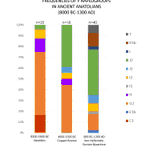
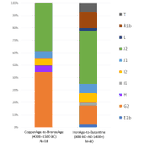


Y-DNA haplogroups in different time periods of ancient Anatolia
Neolithic (n=25) → CopperBronze (n=18) → IronHellenisticRomanByzantine (n=40)

Y-DNA Haplogroups in Chalcolithic and Bronze Age Anatolians
Çamlıbel Tarlası, Çorum (n=4)
İkiztepe, Samsun (n=4)
Ilıpınar, Bursa (n=2)
Yassıtepe, İzmir (n=1)
Harmanören, Isparta (n=1)
Kalehöyük, Kırşehir (n=3)
Ovaören, Nevşehir (n=1)
Devret Höyük, Amasya (n=2)


Y-DNA haplogroups in Kurds
Sulaimani Polytechnic University, 2023
Source: doi.org/10.26682/sjuod.2023.…

East Eurasian (occasionally referred to as East Asian) admixture in ethnic Turks of Turkey
• Not to be confused with Central Asian admixture. The medieval Turkic samples from Central Asia have a mixed ancestry of West Eurasian and East Eurasian.
Data: docs.google.com/spreadsheets…

• The colored provinces are represented by their native ethnic Turkish population in terms of genealogy.
• Some provinces are represented by less than 3 individuals, they are likely to show some changes over time.
East Eurasian admixture in various ancient (Turkic, Mongolic, Para-Mongolic and Uralic) populations
teapawt.org/TurkDNAProject/status/…

Y-DNA haplogroups in Volga Tatars
Sample Size: 1970
Source: shorturl.at/mrvR5


Early Medieval Slavic ancestry in present-day Balkan and Aegean populations
qpAdm admixture modelling of present-day Balkan and Aegean populations
Source: sciencedirect.com/science/ar…
(Data S2, Table 8)

The Early Medieval Slavs used in the qpAdm model are genetically close to present-day East European Slavs.


Y-DNA haplogroups in ancient Anatolians (Iron Age, Hellenistic, Roman/Byzantine)
Sample size: 40
Sources:
• science.org/doi/10.1126/scie…
• sciencedirect.com/science/ar…


East Eurasian ancestry in various ancient populations
high-res image: abload.de/img/easteurasian27…

Türkiye'deki etnik Türklerde Y-DNA (n=523) ve mtdna (n=209) haplogruplarının dağılımı.
3. resimde grafiğimiz etnik kökenin dikkate alınmadığı ve bölgelerin adil temsil edilmediği Cinnioğlu et al. (2004) grafiği ile karşılaştırıldı.


Whole genome analysis sheds light on the genetic origin of Huns, Avars and conquering Hungarians
• 9 Hun, 143 Avar and 113 Hungarian conquest period samples from Hungary
biorxiv.org/content/10.1101/…


A new study has revealed that N-VL73 was one of the major paternal lineages of the Oghuz tribes that migrated to Anatolia.
yfull.com/tree/N-VL73/
