







Tweenhaven retweeted

Vibe coders are getting sued.
The app you hacked together and shipped over the weekend is 𝗮𝗹𝗿𝗲𝗮𝗱𝘆 𝗯𝗿𝗲𝗮𝗸𝗶𝗻𝗴 𝟲 𝗹𝗮𝘄𝘀 without you knowing:
1. Signup doesn't ask for age. Let in one kid under 13 and that's a COPPA violation, up to $53K, counted per child.
2. Load Google Fonts from their servers and every visitor's IP gets sent over. A Munich court ordered one site to pay a visitor €100 for it under GDPR.
3. Use session replay to record what users type without consent, and in California you get sued for wiretapping under CIPA, up to $5K per violation.
4. Marketing emails with no unsubscribe link or postal address violate CAN-SPAM, up to $53K per email.
5. If renewal terms aren't right next to the subscribe button, California treats every renewal as an unconditional gift. You have to give the money back.
6. Skip the $6 DMCA agent registration with the Copyright Office and you're on the hook for whatever infringing content users upload. Willful infringement can cost up to $150K per work.
Each of these 𝘁𝗮𝗸𝗲𝘀 𝗺𝗶𝗻𝘂𝘁𝗲𝘀 𝘁𝗼 𝗳𝗶𝘅. Throw this at Claude Code before you launch:
"Check my app for: missing age gate, externally loaded fonts, session replay without consent, marketing emails without unsubscribe and address, renewal terms not beside the subscribe button and no DMCA agent. Fix what you can and list what I need to do myself."
Tweenhaven retweeted

Introducing: Self-Improving Memory 🧠✨📈
We let the model discover its own memory skills, then train them into its weights:
- Meta-optimizes memory from the model's own runs with large gains.
- Distilling these gains works too.
Blog post: 📝 facebookresearch.github.io/R…
🧵1/6

Tweenhaven retweeted
Claim: Humans & AI are better together if we want to recursively (co-)improve to a brighter future for *humanity*
Instead of racing towards methods for AI replacing us, work on how to make AI work *with* us!
New paper that makes 4 contributions here:
1) The role of humans in directing research agents: Autobenchmark
2) Reward hacking in autoresearch agents: HackBench
3) Training agents to interact with humans: AutoInteract
4) Training agents to communicate with humans: unslopping AI
Full Paper: arxiv.org/abs/2610.38882
Blog posts for each section:
1) facebookresearch.github.io/R…
2) facebookresearch.github.io/R…
3) facebookresearch.github.io/R…
4) facebookresearch.github.io/R…

Tweenhaven retweeted

Must-read papers of the week
▪️ World In-Context Learning for Agentic Robot Manipulation
▪️ Don’t Just Trust Your Memory
▪️ Is Your Robot’s Memory Just a Clock? Temporal Shortcuts in Memory-Augmented VLA Policies
▪️ Unbundling Multimodal Vision Encoding
▪️ V-JEPA-LM
▪️ Learning Heterogeneous Tactile Representation for General Dexterous Manipulation
▪️ Training Reasoning Models in Simulation to Natively Use Real Robots
▪️ Embodied First Exam
▪️ Continual-ARC: Measuring Skill Acquisition over a Working Lifetime
▪️ Reframe: Observation-Aligned Multi-Teacher On-Policy Distillation for Agentic Visual Reasoning
▪️ MemInStream: Memorizing or Merely Recognizing? Rethinking Streaming Video Memory Evaluation
▪️ Infrathon: Benchmarking Language Agents for Real-World, Long-Horizon AI Infra Optimization
▪️ Actor, Judge, or Teacher? Understanding Decision Models in Long-Horizon Agents
▪️ GTAGym: AAA Game Tasks Environment for Evaluation and Reinforcement Learning
Explore these to keep up with main AI trends. Here’s also the full list of outstanding papers + links, and our weekly AI news digest: turingpost.com/p/who-are-we-…

Tweenhaven retweeted

Do loop models need a new residual design?
Sharing our new work: Loopback Transformer 🔁
With nearly the same training FLOPs, can a model use fewer Transformer-layer parameters and still outperform a Standard Transformer?
Sharing layers saves parameters. But running the same layers again raises another question: which information should survive across passes, and which updates should fade?
Inspired by recurrent models, we introduce a unified view of residual connections as memory across depth: write, transport, and read. It brings ordinary residuals, Attention Residuals, Hyper-Connections, and linear attention readers into one framework.
Loopback puts this view into practice: store each block's update, geometrically discount older passes, and use attention to retrieve useful information—even from earlier loops. The original input stays on its own path.
⚡ Matched training tokens and executed depth:
• 1.4B: 68% of Standard's Transformer-layer parameters, lower validation loss and higher 13-task mean.
• 3B: 75% of the layer parameters, 11/13 task wins, mean accuracy 48.56% → 49.45%.
• At 191M, 374M, and 778M, the main comparisons give Loopback the lowest validation loss and highest 13-task mean among Standard and seven looped residual baselines.
If you find the work useful, an upvote on Daily Papers and a GitHub star would help others discover it!
🤗 Paper on Daily Papers: huggingface.co/papers/2611.0…
⭐ Code: github.com/yancyou/Loopback
The idea, the video, and the results below 🧵
1/11

ALT Direct crop of the original Loopback paper first page: full title; authors Xuan Ouyang, Zefan Cai, Chenlong Zhang, Cheng Luo, Ke Wan and Junjie Hu; affiliations; complete abstract; Code and Project page links. The result chart below is outside the crop.
Tweenhaven retweeted

Self-improving AI is one of the most discussed ideas right now.
This is one of the most exciting papers I've read recently on the topic.
(bookmark it)
It proposes AutoRL, which lifts Qwen3 on AIME 2024 from 46.67% to 66.67% by letting agents supervise a live RL run instead of following a fixed recipe.
AutoRL works like an RL researcher on call.
Perceptor agents watch training curves, rollouts, and evaluations and flag problems. Three Proposer agents diagnose the issue and suggest changes. An Orchestrator approves them and applies them with a hot update or a restart from a checkpoint.
On math, AIME 2025 and HMMT 2025 each improve by 11.67 points. On agentic coding with LongCat-Flash-Lite, pass@1 rises from 52.29% to 65.13% over a long unattended run with interruptions.
Given a deliberately broken recipe, AutoRL found and fixed the problems.
The authors say agents can already handle routine RL supervision. Validating each change still takes a lot of compute.
arxiv.org/abs/2611.17790
Chat with Paper: academy.dair.ai/papers/autor…

Tweenhaven retweeted

Great paper on why SFT can generalize just as well as RL if you give it enough diverse training data.
Like everyone else since DeepSeek-R1 dropped, I’ve been treating "RL generalizes, SFT memorizes" as gospel.
Whenever SFT runs plateaued on out-of-domain reasoning, everyone just blame the algorithm.
Turns out, we might have been running an unfair comparison the entire time.
In standard setups, RL gets to explore a huge rollout budget per prompt while SFT gets trained on a tiny slice of data.
So the authors decided to actually level the playing field on Qwen2.5 and Qwen3 models by testing two things: mixing data sources instead of just distilling from one giant teacher, and scaling up the SFT data to match RL's rollout budget.
The results completely flip the usual narrative.
A carefully mixed dataset easily beats single-teacher distillation, and matching RL's rollout budget lets SFT generalize just as well as RL.
And when you combine both, SFT actually outperforms it.
To figure out why, they used LLM annotations to inspect the rollouts and proved (both empirically and theoretically on shallow transformers) that larger data budgets expose SFT to rare, "tail" solution methods.
Those uncommon reasoning paths are where the actual generalization signal lives.
Honestly, for everyone tired of debugging finicky online RL pipelines, this is a huge relief.
SFT wasn't broken, we were just starving it of diverse rollouts.
Full paper PDF: arxiv.org/pdf/2611.14912

Tweenhaven retweeted

GITHUB IS ACTUALLY INSANE RIGHT NOW.
You can build an entire AI content factory without hiring a team.
Here are 10 open-source repos worth checking out:
1. OpenCreator
Give Codex a creator workspace for writing scripts, generating images, creating voiceovers, translating videos, and editing content.
github.com/krillinai/Open…
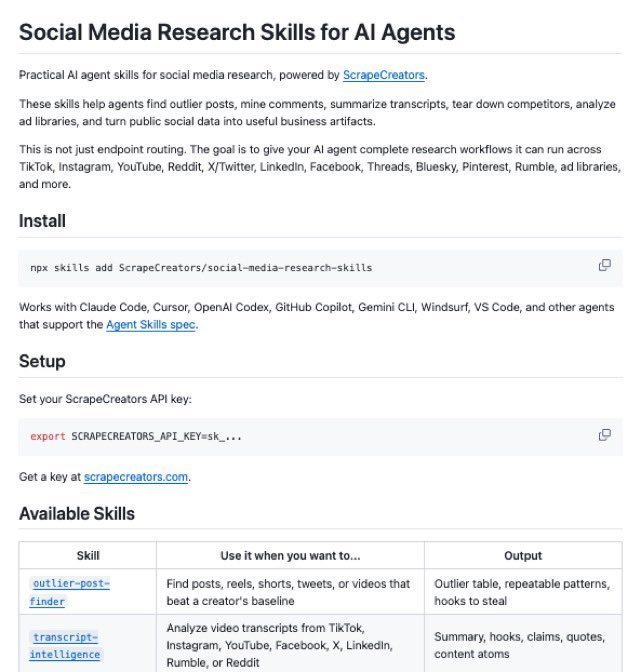
2. Social Media Research Skills
Use Claude Code or Codex to research viral posts, analyze competitors, mine comments, and extract hooks from video transcripts.
github.com/ScrapeCreators…
3. Local Deep Research
Turn any topic into a detailed research report using web searches, your documents, and local or cloud AI models.
github.com/LearningCircui…
4. FLUX.2
Generate and edit images for thumbnails, social posts, and marketing campaigns. The Klein 4B models have Apache-licensed weights.
github.com/black-forest-l…
5. Kokoro
Turn written scripts into AI voiceovers with a compact, open-weight text-to-speech model.
github.com/hexgrad/kokoro
6. ACE-Step 1.5
Generate music from text prompts, create instrumentals, and regenerate specific audio sections. It can run locally on supported hardware.
github.com/ace-step/ACE-S…
7. Short Video Factory
Create batches of short videos from prompts and your footage, with AI-generated scripts, voiceovers, editing, and subtitles.
github.com/YILS-LIN/short…
8. AI YouTube Shorts Generator
Convert long YouTube videos into vertical Shorts with AI-selected highlights, transcripts, and automatic cropping.
github.com/Anil-matcha/AI…
9. Podcastfy
Turn source material into AI-generated podcast conversations, customize the dialogue, and produce audio in multiple languages.
github.com/souzatharsis/p…
10. Social Media Agent
Turn a URL into X and LinkedIn posts, review and edit the drafts, then schedule them through an AI agent workflow.
github.com/langchain-ai/s…
Research, writing, visuals, voiceovers, music, video editing, and distribution.
You can automate almost every stage of content creation with the right tools.
Which part of your workflow would you automate first?
Want to build your own AI content factory? 👀
Follow me for more AI tools, open-source gems, and workflows that help you create smarter and faster. 🚀


Tweenhaven retweeted

Bad news for Figma, I woke up ☕️
Good news, I made 10 brutalism style posters for you🗿


Tweenhaven retweeted

Researchers at the Chinese Academy of Sciences cut AI-agent token consumption by up to 92.9%, without retraining a single model.
They also reduced execution time by up to 89%.
The problem is familiar if you've built AI agents. Ask a coding agent to investigate one error, and it may read an entire log, repository file, or document when only a few passages are relevant.
Those unnecessary tokens can remain in context across subsequent model calls, increasing cost and latency.
The researchers developed SparseRead, a system that controls what an agent reads before the content enters the model's context.
It works through three components →
1./ Read Intent Protocol: Tracks what information the agent needs, which evidence has been found, and what remains unresolved.
2./ Adaptive Reader Backends: Locate relevant evidence across documents, PDFs, code repositories, and structured data.
3./ Budgeted Read Gate: Limits how much source content enters context, with the option to fall back to reading the complete file.
Across six models and five workload scenarios, the researchers reported →
> Up to 92.9% fewer tokens consumed.
> Up to 89% less execution time.
> Median reductions of 61.4% in tokens and 53.7% in time.
> Task quality preserved or improved in most evaluated settings.
No model retraining is required.
The interesting engineering lesson is that context optimization doesn't have to begin with compression or KV caching.
You can reduce a substantial amount of work by controlling what enters the context in the first place.
(Link to the paper and code in comments)


Tweenhaven retweeted

Everybody with an ounce of political literacy knows and understands that this is lifted straight from the classic CIA destabilization playbook, routinely deployed across the Global South to recruit desperate youths who will later serve as useful idiots to organize synthetic protests against their own governments on behalf of Washington. We also know that this is precisely how Western intelligence networks hijack legitimate public grievances and manufacture toxic media narratives that serve Western geopolitical interests and facilitate the uninterrupted extraction of African wealth and mineral resources.
All of this is undeniable material fact, but we must have the courage to ask ourselves the deeper, uncomfortable question: why do our people continue to aggressively trip over themselves to accept these Western NGO gigs, foreign fellowship grants, and imperial media funding? Why is it that whenever imperial powers launch a psychological operation to destabilize the continent and manufacture false narratives for the sole purpose of resource plunder, there is always an endless queue of educated African youths standing in line, ready and willing to sell out their own sovereign nation-states for absolute pennies on the dollar?
The answer is not that the Black man is inherently corrupt or genetically self-destructive. It is precisely because these imperial powers are ruthlessly exploiting a profound, structural economic vacuum that exists on the continent. You see, even if you possess an authentic passion for systemic change, a burning revolutionary fire in your chest, and an ironclad conviction to liberate your people, raw ideology alone cannot fund modern investigative journalism, build media platforms, or sustain political movements. To run a credible platform, you need serious, non-stop operating capital: you must pay for reliable intelligence leaks, subscribe to classified databases, hire investigative reporters, retain legal counsel, and pay professional writers just to maintain a functional digital presence. To reach a mass audience and compete with mainstream propaganda, you have to spend thousands of dollars on high-end production cameras, studio lighting, sound equipment, and a dedicated team of video editors, which easily runs into tens of thousands of dollars annually. This does not even account for the massive logistical expenses of airline tickets, hotel accommodations, car rentals, daily feeding, and emergency operational reserves. While Western platforms can easily recoup these operating expenses through paid subscriber models, the catastrophic fact that the middle class in most African nations has been completely decimated means that domestic digital subscription models are an immediate dead end, especially for emerging independent creators. The New York Times can boast of generating hundreds of millions of dollars in recurring reader revenue, but that model only functions in high-income, industrialized societies with a prosperous, comfortable middle class.
This proves that even though Africa is bursting with an exceptionally educated, creative, and energetic youth population, our brutal economic reality turns this demographic into a strategic liability rather than an asset in the arena of information warfare. Left entirely to their own devices without capital, they cannot construct an independent, sovereign, and self-sustaining media apparatus. The post-colonial state will never fund them, because the African state is structurally extractive, and deeply suffocated by IMF debt conditionalities that classify domestic public expenditure as fiscal indiscipline and a reckless distortion of market fundamentals. African leaders religiously avoid funding sovereign cultural and media projects simply to preserve their fragile credit ratings before Wall Street rating agencies and Western banking cartels, even when doing so destroys their own national security. The local comprador bourgeois class will obviously never fund them either, and in the rare instances where local oligarchs do invest in media, it is strictly to use the platform as a personal political battering ram to fight rival party factions and chase government contracts. Consequently, the young African journalist who genuinely dreams of building a formidable platform finds themselves trapped in a sadistic dilemma: either starve in complete digital obscurity and nothingness, or sell their pen to the ruling capitalist class to justify the neocolonial subjugation of their own people.
Western intelligence agencies and imperial think tanks understand this structural vulnerability intimately, which is why they step in with coordinated funding packages to fill the void. But Washington never gives away a single dollar out of Christian charity or a genuine desire to liberate African minds; every single dollar disbursed through these grant networks must strictly yield dividends that advance US foreign policy, even if those policy objectives actively worsen the material conditions of our society. However, the CIA understands that they cannot simply sit in Langley and overtly dictate editorial scripts to young African journalists, because doing so would instantly destroy the credibility of these platforms, expose them as foreign propaganda conduits, and provoke political scrutiny back home. Instead, they deploy sophisticated structural steering mechanisms disguised behind neutral, technocratic buzzwords. They roll out funding for "capacity building," where Western donors use academic language to imply that African institutions and cultural values are inherently defective, corrupt, and backward, and must therefore be forcibly reshaped to fit Western liberal standards as the only formula for societal success. The young journalist or social media influencer who desperately wants to remain eligible for the next grant cycle quickly learns that their content must be dedicated to deconstructing, mocking, and rebuking their own traditions and state institutions, while uncritically glorifying Western liberalism as infallible, supreme, and morally absolute. Similarly, when they issue massive grants for "strengthening civil society," they are never funding militant trade unions, peasant agricultural cooperatives, or radical student organizations that possess genuine anti-imperialist, class-conscious politics; the money is reserved exclusively for domesticated, pro-market NGOs that obediently parrot Western media talking points, celebrate foreign private equity, and endorse neoliberal economic reforms.
The glossary of corporate buzzwords they invent to mask their imperial footprints is endless, which is why we are currently cursed with an entire ecosystem of young African journalists and media outlets that persistently misdiagnose the African crisis, giving the public a superficial, moralistic explanation of poverty because their Western benefactors forbid them from examining the true material roots of our underdevelopment. Beyond shaping domestic narratives, this funded network acts as a permanent geopolitical shield for Western imperialism. Because these journalists and civil society heads know that their bread, mortgages, and international travel visas flow directly from Western embassies, they are obsessively selective in the language they deploy when reporting global affairs. Notice the glaring double standard: whenever local media reports on rogue Chinese miners operating in rural areas or Russian paramilitary instructors working in the Sahel, our local newsrooms become exceptionally ruthless, exceptionally loud, and relentlessly aggressive in calling for national boycotts and immediate military crackdowns. But when it comes to reporting how American and European oil conglomerates systematically destroy our marine ecology, deploy offshore tax havens to steal billions from our national treasury, and pollute our ancestral creeks; when it comes to exposing predatory IMF debt traps and unmasking predatory World Bank austerity measures; these exact same funded investigative journalists suddenly become completely invisible, conveniently mute, legally toothless, and entirely blinded by donor compliance. This manufactured, one-sided pipeline of information is precisely why Nigeria is full of Western-educated youths who have been thoroughly marinated in corporate propaganda, reflexively viewing the United States as the divine champion of human freedom while viewing the nations of the multipolar alliance strictly as cartoonish, authoritarian villains.
We must possess the intellectual honesty to admit that this imperial weaponization of African intellectualism did not begin on modern social media. The most celebrated pioneers of African post-colonial literature fell directly into this exact same NGO-ization trap during the Cold War. Following flag independence, African societies inherited damaged, extractive administrative shells completely devoid of sovereign printing presses, publishing capital, or independent research foundations. The CIA identified this structural vacuum and aggressively stepped in through covert cultural fronts like the Congress for Cultural Freedom. They offered fully funded fellowships, global book tours, and massive publishing contracts to the finest minds on the continent, but not so they could write whatever they wanted; it was designed to guide their intellectual output into channels that posed zero threat to global capitalism. Writers who focused on safe themes like cultural pride, traditional aesthetics, generational alienation, pre-colonial folklore, traditional spirituality, and abstract identity politics were immediately elevated into international literary icons, winning prestigious Western prizes and selling hundreds of thousands of copies globally. Meanwhile, radical African writers who grounded their literature in Marxist-Leninist class analysis, labor-organizing strategies, agrarian socialist land reforms, and the direct seizure of multinational corporate assets were systematically blacklisted, denied publication, and wiped out of academic memory. The imperial core has never cared if you wear your traditional African attire or celebrate your ancestors; Western elites will gladly send academic delegations to applaud your cultural dances. What they will never tolerate, and what they will ruthlessly suppress, is rigorous class analysis that exposes the economic machinery of their corporate extraction.
Now that we clearly comprehend how Western intelligence infiltrates our intellectual institutions, captures our media spaces, and funds civil society to execute imperial agendas, we must face the reality that this foreign subversion will never stop until the underlying structural vacuum is permanently eradicated. One path to resolving this crisis requires the total nationalization of our strategic resources, the redistribution of land, and the transfer of productive capital directly into the hands of the organized working class, an outcome that is historically impossible without a disciplined, bottom-up mass revolution.
The alternative, superficial solution often proposed by naive commentators is that an African military strongman should simply seize state power and issue a top-down decree outlawing foreign NGOs and banning local journalists from accepting Western donor funds. This administrative approach looks impressive on paper, but it completely ignores the laws of history: you cannot police or shoot an entire society into ideological clarity. Even China, with all its state capacity, institutional discipline, and technological infrastructure, had to execute decades of comprehensive ideological education campaigns just to politically inoculate the population against foreign psychological operations and cultivate an unshakeable class consciousness. If a military junta bans ten Western-funded civil society groups by decree without providing an alternative material base for the youth, twenty new underground factions will immediately spring up to replace them. Banning these networks without educating the masses simply hardens their political ignorance, convincing them that they are heroic martyrs fighting for human rights against a brutal dictatorship, making them all the more willing to accept covert cash, subversive training, and foreign weapons delivered through Western intelligence channels. To preserve its power against mounting internal subversion, the authoritarian state inevitably becomes more paranoid, unleashing police crackdowns, executing political dissidents, and suspending basic civil liberties. This reactive state terror causes domestic approval ratings to crash, isolates the government from the working class, and makes the nation incapable of withstanding Western economic sanctions, ultimately ensuring that the regime is violently overthrown from within, usually with the active participation of compromised military officers recruited directly by Western intelligence, as we historically witnessed in Chile in September 1973 under Pinochet, Ghana in February 1966 against Nkrumah, and Burkina Faso in October 1987 against Thomas Sankara.
This is precisely why any serious materialist analysis of the African condition leads to one singular conclusion: only a bottom-up, ideologically grounded mass revolution that completely dismantles the inherited colonial state architecture and builds sovereign, self-funded institutions can permanently liberate our continent from the suffocating clutches of global imperialism.


Registering for Build Before Q-Day, the QoreChain Developer Fest. #BuildBeforeQDay bbqd-NbpzCl8z
1
47
Tweenhaven retweeted

▲ Fish Audio just released Live 3, a full-duplex voice model that keeps listening while it speaks, so voice agents stop talking over callers.
The key idea is moving turn-taking into the speech model itself. Instead of silence thresholds and hand-written rules, Live 3 was trained on real human conversations. It learns when to acknowledge, wait, respond or stop, so "yeah" lets it keep going while "wait, actually" makes it yield.
Fish Audio says Live 3 can decide to react in as little as 186 ms for short cues like "mm-hmm" or "okay, 415". For context, Eleven Realtime v1 Max reports 0.57 s average time to first audio, a different measurement. It is a trade-off though: Live 3 is English only at launch, and Fish Audio has published 0 benchmark scores so far.
It runs on the Fish Agent Platform, the Fish Audio API and on-prem for enterprises. Agents are $0.035/min until Dec 31, 2026 ($0.07 list), covering STT, TTS and basic LLMs......
Full analysis: marktechpost.com/2026/11/10/…
Technical details: fish.audio/blog/introducing-…
Try it: fish.audio/live3
Docs: docs.fish.audio/agents/overv…
@FishAudio @rissa_cao @LengyueMatrix

Tweenhaven retweeted

THIS IS AN ACTUAL F*CKING GOLDMINE
20 open-source repos = your independent motion design studio = $0 map
from the first frame → to the final export
Animation. Shaders. Characters. Audio. Delivery.
01 Remotion → Build videos with React
github.com/remotion-dev/remo…
02 Anime.js → Choreograph timelines, easing, and motion
github.com/juliangarnier/ani…
03 Scene.js → Create CSS keyframes and animated sequences
github.com/daybrush/scenejs
04 Konva → Build layered 2D graphics and animations
github.com/konvajs/konva
05 Pencil2D → Draw and animate frame by frame
github.com/pencil2d/pencil
06 Zdog → Make playful pseudo-3D illustrations
github.com/metafizzy/zdog
07 Three.js → Create 3D scenes, lighting, and cameras
github.com/mrdoob/three.js
08 Filament → Render with physically based lighting
github.com/google/filament
09 ozz-animation → Animate skeletal characters
github.com/guillaumeblanc/oz…
10 Planck.js → Simulate 2D physics and collisions
github.com/piqnt/planck.js
11 regl → Create custom WebGL visuals
github.com/regl-project/regl
12 WebGL Noise → Generate procedural shader effects
github.com/ashima/webgl-nois…
13 meshoptimizer → Make 3D models lighter and faster to render
github.com/zeux/meshoptimize…
14 MeloTTS → Generate multilingual voiceovers
github.com/myshell-ai/MeloTT…
15 RNNoise → Clean up voice recordings with neural noise reduction
github.com/xiph/rnnoise
16 Rubber Band → Stretch audio and shift pitch
github.com/breakfastquay/rub…
17 OBS Studio → Capture and record your screen
github.com/obsproject/obs-st…
18 OpenRV → Review and play back shots
github.com/AcademySoftwareFo…
19 Mediabunny → Process video in the browser
github.com/Vanilagy/mediabun…
20 FFmpeg → Encode, compress, and deliver the final cut
github.com/FFmpeg/FFmpeg
Brief → layout → animate → polish → render → publish
Save the toolkit. Build something worth watching. ↓


Tweenhaven retweeted

If you design with AI, save this
1. modulify.ai — best vibecoding tool
2. landdding.com — top notch landings
3. modulify.ai/templates — free templates
4. motionin.design — 1 prompt 1 website
5. iconly.design — world best icons
6. fontinlogo.com — fonts behind brands
7. on.design — design community
8. godly.website — award websites
9. 60fps.design — mobile UI animations
10. footer.design — footer inspiration
11. recent.design — next level design
12. backgrounds.supply — backgrounds
13. posts.design — big brands posts
14. beui.dev — animated components
15. wonderlist.design — figma designs
16. mobbin.com — real app screens
17. sent.dm — almost free sms
18. logotouse.com — premium logos
20. paperanimation.ai — cool anim
bookmark this
Tweenhaven retweeted

If you're a UI/UX designer, bookmark this.
1. scrolltide.co - 600+ design Prompts and 200+ components with full source code for 3D and scroll-driven sites.
2. navbar.gallery - navbar inspiration
3. footer.design - better footers
4. cta.gallery - CTA inspiration
5. styles.refero.design - Real product design styles
What did I miss?