

Student Centric, Exam Centric, Result Centric. What we UnderStand, We Conquer.
India
Joined May 2023
- Tweets831
- Following1
- Followers3.4K
- Likes412






The term 'Stagflation' refers to a macroeconomic scenario characterized primarily by:
(a) Rapid economic expansion accompanied by persistently high inflation
(b) Stagnant economic growth and high unemployment combined with high inflation
(c) A sustained decrease in the general price level accompanied by rising employment
(d) High inflation driven exclusively by supply-chain disruptions in agricultural sectors
What is the Basic Structure Doctrine?
What are the elements of the Basic Structure?
Significance of the Doctrine?
How has it evolved through landmark cases?

The Kesavananda Bharati verdict still shapes India's democracy today.
A court case from 1973 gave birth to the 'Basic Structure Doctrine', ensuring that the Constitution's core principles remain safeguarded.
What are these principles, and why do they matter to every Indian?
#BasicStructureDoctrine #KesavanandaBharati #IndianConstitution
@KritiMishraS
youtu.be/rqClaYrN5Kc
The Basic Structure Doctrine is a legal principle ensuring that the fundamental framework of the Indian Constitution cannot be altered or destroyed by parliamentary amendments.
▶️What is the Basic Structure Doctrine?
- It is a judicial principle established by the Supreme Court of India in the landmark 1973 *Kesavananda Bharati* case.
- It acts as a limitation on the Parliament's amending power under Article 368, dictating that while Parliament can amend parts of the Constitution—including Fundamental Rights—it cannot change its underlying core identity, philosophy, or foundational architecture.
▶️Elements of the Basic Structure
The Supreme Court has not provided an exhaustive list, but various judgments have established the following as core, unalterable components:
- Supremacy of the Constitution
- Sovereign, democratic, and republican nature of the Indian polity
- Secularism and federalism
- Separation of powers between the legislature, executive, and judiciary
- Independence of the judiciary and the power of judicial review
- The rule of law and the principle of equality
- Free and fair elections
▶️Significance of the Doctrine
- Maintains Constitutional Supremacy: It prevents the Constitution from being entirely rewritten or heavily distorted by a temporary legislative majority.
- Protects Fundamental Rights: It acts as a bulwark against legislative authoritarianism, ensuring individual liberties and the dignity of the individual are not stripped away.
- Preserves Separation of Powers: It delineates a clear boundary between the branches of government, keeping the judiciary independent.
- Empowers Judicial Review: It encourages judicial activism, giving the Supreme Court the authority to strike down amendments that violate the Constitution’s core values.
▶️Evolution Through Landmark Cases
- Shankari Prasad (1951) & Sajjan Singh (1965): The Supreme Court initially ruled that Parliament had absolute power to amend any part of the Constitution, including Fundamental Rights.
- Golaknath v. State of Punjab (1967): The Court reversed its earlier stance, ruling that Parliament did *not* have the power to amend or take away Fundamental Rights.
- Kesavananda Bharati v. State of Kerala (1973): The Court struck a balance, ruling that Parliament can amend any part of the Constitution provided the "basic structure" remains intact.
- Indira Nehru Gandhi v. Raj Narain (1975) & Minerva Mills (1980): These cases invalidated constitutional amendments (including parts of the 42nd Amendment) that attempted to bypass judicial review, cementing the basic structure doctrine's authority.
- S.R. Bommai v. Union of India (1994): The Court explicitly designated federalism, secularism, and democracy as protected elements of the basic structure.

Which of the following events was the immediate cause for the launch of the Non-Cooperation Movement in 1920?
(a) The failure of the Cripps Mission
(b) The passing of the Rowlatt Act and the Jallianwala Bagh massacre
(c) The Partition of Bengal
(d) The Simon Commission's arrival in India
UnderStand UPSC retweeted

I wanted to go to LBSNAA.
That was the only dream I had for six years.
I cleared Prelims. I cleared Mains. I gave three interviews.
I was standing right at the gates, waiting to be let in.
And then, the gates closed on me permanently.
"Zero Found."
For an aspirant who gave his entire youth to one single goal, watching that dream die is a silent, suffocating grief.
I started teaching to fill that void. To help others avoid my mistakes.
But there is always a lingering question in your heart: How will it feel to watch someone else live the exact life you cried for?
A few months ago, my phone buzzed.
It was a photo from the gates of LBSNAA.
Six selected candidates were standing together, smiling at the camera.
Four out of those six were students of UnderStand UPSC.
I looked at that photo for a very long time.
I thought I would feel a pinch of regret. I thought I would feel the pain of my own failed interviews.
Instead, all I felt was overwhelming peace.
"आपके मन का हो तो अच्छा, उसके मन का हो तो और भी अच्छा।"
(If it happens according to your wish, it is good; if it happens according to His wish, it is even better).
That one photo changed my perspective on my entire life.
It made me realize that my 6 years of failure were not a waste. They were the tuition fee I paid to build an ecosystem that is sending 250+ students to the academy this year.
To every mentor and teacher:
Your true success is not in standing on the pedestal, but in becoming the ladder for someone else.
To every person whose dream just shattered:
Hold on. The universe might be denying you a single seat today, only to give you the capability to build a classroom tomorrow.


The Noyal (Noyyal) River is a seasonal river located in Tamil Nadu.
- Origin: Originates from the Vellingiri hills in the Western Ghats within the Coimbatore district.
- Historical significance: Originally known as "Kanchi Nadi" and holds sacred status in Hindu-Tamil history. It was later renamed after the village where it meets the Cauvery.
- Course: Flows for a total distance of 175 km through the Coimbatore, Erode, and Karur districts before joining the Cauvery River near Noyal village.
- Catchment area: Covers approximately 3.49 lakh hectares.
- River system: A major tributary of the Cauvery River, supported by its own two main tributaries: the Cheyyar (Chadiaar) and Kanchimanadhi rivers.
- Ancient infrastructure: The watershed connects 32 tanks, 14 major canals, 23 anicuts, and 55 check dams. Most of these were built by the Chola Kings (9th–12th centuries) to manage floods and augment irrigation.
- Modern dams: The Aathupalayam Dam and Orathuppalayam Dam are situated along its course.
- Ecological concerns: Once a vital source of drinking water and irrigation, it is now severely polluted by sewage,industrial waste, and effluents from textile dyeing and bleaching units.
UnderStand UPSC retweeted
This is the only video you need to watch to understand the Indian Philosopher Carvaka.
How was 2026 prelims different from last year's prelims and what should be your prelims strategy going forward?
In the context of medieval Indian history, the term "Mansabdar" primarily referred to:
(a) A village headman responsible for local revenue collection in the Maratha empire.
(b) A military commander and civil administrator holding a specific rank in the Mughal system.
(c) An exclusive religious title granted to Sufi saints.
(d) The head of a guild of merchants in the Delhi Sultanate.

1- Handwritten, Not Typed
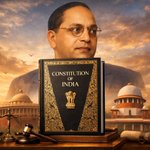
The original Constitution was never typed or printed; it was meticulously handwritten in a flowing italic style by calligrapher Prem Behari Narain Raizada.
2- Artistic Masterpiece
Each page of the original document was intricately decorated by artists from Shantiniketan, including Nandalal Bose and Beohar Rammanohar Sinha, illustrating scenes from Indian history and mythology.
3- Helium Preservation
The original handwritten copies in both Hindi and English are kept completely perfectly preserved inside specially designed, temperature-controlled helium-filled glass cases in the Library of the Parliament of India.
4- The Exact Timeline
It took the Constituent Assembly exactly 2 years, 11 months, and 18 days of rigorous drafting, debating, and revising to finalize the supreme law of the land.
5-Signed by 15 Women
When the final draft was signed by 284 members of the Constituent Assembly on January 24, 1950, the signatories included 15 visionary women such as Sarojini Naidu, Hansa Mehta, and Rajkumari Amrit Kaur.
6-The Purna Swaraj Connection
While adopted on November 26, 1949, it came into effect on January 26, 1950—a date intentionally chosen to commemorate the Indian National Congress's 1930 declaration of "Purna Swaraj" (complete independence).
7-A Pragmatic "Bag of Borrowings"
The framers studied over 60 foreign constitutions, adopting the Parliamentary system from the UK, Fundamental Rights from the US, Directive Principles from Ireland, and the idea of a Republic from France.
8- Right to Property Downgrade
The Right to Property was originally guaranteed as a Fundamental Right under Article 31, but the 44th Amendment Act of 1978 removed it, reclassifying it as a simple legal right under Article 300A.
9-World's Longest Written Constitution
At its commencement, the document contained 395 Articles, 22 Parts, and 8 Schedules, making it the most exhaustive written national constitution in global history.
10-Amended Within a Year
The First Amendment was enacted in 1951, just over a year after the Constitution's adoption, primarily to protect agrarian reforms from judicial review and introduce the Ninth Schedule.
The secret cross-linking trick that guarantees a 270+ score in PSIR Optional.
Strategy used by Saksham Bhatia - AIR 83

1- Panchsheel Agreement (1954)
Formally the Agreement on Trade and Intercourse between the Tibet region of China and India, this pact established the "Five Principles of Peaceful Coexistence." It heavily influenced India's early post-independence diplomatic posture and formed the ideological foundation for the broader Non-Aligned Movement (NAM), emphasizing mutual respect for territorial integrity and non-interference.
2- Indus Water Treaty (1960)
Brokered by the World Bank, this resource-sharing agreement between India and Pakistan divided the rights to the Indus River system. Despite decades of bilateral hostility and multiple wars, the treaty has survived largely intact, serving as a globally recognized benchmark for resilient water diplomacy and conflict management.
3- Indo-Soviet Treaty of Peace, Friendship, and Cooperation (1971)
Signed shortly before the Bangladesh Liberation War, this treaty marked a pragmatic shift in India's strictly non-aligned foreign policy. It provided India with a crucial strategic deterrent against potential US and Chinese intervention during the 1971 conflict, solidifying a multi-decade defense and diplomatic partnership with Moscow.
4- Simla Agreement (1972)
Following the 1971 Indo-Pak war, this treaty formally established the Line of Control (LoC) in Jammu and Kashmir. Most importantly for India's modern foreign policy framework, it embedded the principle of bilateralism, mandating that all future disputes between India and Pakistan be settled through direct bilateral negotiations without third-party mediation.
5- India-US Civil Nuclear Agreement (2008)
Also known as the 123 Agreement, this landmark deal ended India's decades of nuclear isolation following its 1974 and 1998 weapons tests. It granted India access to global civilian nuclear technology without requiring it to sign the Non-Proliferation Treaty (NPT), effectively acknowledging India as a responsible nuclear power and cementing a defining strategic partnership with Washington.