

Performance Intelligence for men 35+. 75 peptide vendors screened, 4,606 COAs read, FDA letters checked. What's real, what works, who to trust.
Joined May 2026
- Tweets1.4K
- Following367
- Followers211
- Likes338




Pinned Tweet
2 years of injury hell… 2 surgeries on my L5/S1 vertebrae. The first surgery was a total failure. I rehabbed for 1 year, was selected to play in the 2024 World Cup but I knew my back still wasn’t right. I had to withdraw from the squad… Heartbroken.
On the day my team took to the field to play the world’s best teams in England, I was checking in to the St Vincent’s Hospital, Sydney to get my second surgery.
I diligently followed my rehab protocol but again my recovery plateaued at around the 6 month mark, which is when I had been expected to have been fully recovered.
I was frustrated and still physically nowhere near where I needed to be to return to the field.
I started to look into research peptides after I started seeing them pop up in my social media feed. BPC-157 seemed too good to be true but I was so desperate I jumped in and did very little research. I found a supplier in UK, bought a batch of vials and got started.
No, this isn’t a post about what a miracle outcome I got… quite the opposite! You see, I had no idea what I was doing, I had no plan, not protocol, no structure, hell I hadn’t even heard of a COA 🤦♂️. I got started, injected as often as I remembered to, guessed my doses and hoped for the best. WASTED a chunk of change, go no results to speak of.
I wasn’t educated about peptides and how I should approach them. I wasn’t educated still struggling with my recovery, so I went away to do proper research learn how to plan and execute a protocol under the guidance of a sports clinician who helped me out a proper plan in place. That’s when the game changed for me. BPC-157 daily and TB-500 twice weekly. Incremental dose increases every few weeks under guidance!
I started the new protocol in January 2025, by end February, I saw noticeable improvements in pain reduction, mobility and my scar tissue seemed to be improving.
By the end of March I was on the grass / Astro again, training and playing games again. I wasn’t in my main position in the middle but I was on the field which after 18 months out felt like a miracle.
Whilst I still had a long road ahead within 6 months I was trialing for the national team again and while not playing in my preferred position, I was selected for a 3 test series vs Hong Kong.
We won the series 3-0, I was the top scorer for our team with 6 tries and the recovery was complete. I achieved what I set out to do, which was to regain selection and play for the national team again. That was my final representative appearance before I retired.
I set up @UndergroundBio to help guys like me, who had heard about peptides but had no idea how to get started, didn’t understand how they work or couldn’t find reliable information I could trust.
That’s what I am here for, to learn from my own experiences, work with the top industry professionals and pass on all my knowledge to those that need it.
I’m building an app next and I’d love you to join my journey as I build what I hope will be the best education, tracking and monitoring app in the market. I want people to really understand what works for them and not just follow the masses of misinformation flooding the internet.
I would love to hear your thought, opinions and suggestions too.

ALT Jersey presentation between Singapore Head Coach to player.
I read the HHS notice. Here's what it says:
• HHS says it doesn't intend to take enforcement action against state-licensed pharmacies, federal facilities and licensed doctors compounding the peptides on its list.
• It's a draft, interim policy while the 503A bulks list goes through rulemaking.
• It says it isn't binding on HHS or the public.
• HHS may revisit it if, among other things, a safety signal or quality issue comes up.
• Compounded drugs aren't FDA-approved, so FDA doesn't review their safety or quality first.
Comments run for 2 weeks on regulations.gov from the Federal Register publication, set for Fri 30 Oct, docket HHS-OASH-2026-0496.

🚨 All the hard work paid off!!!
The following 6 peptides will be able to be legally prescribed in the United States on Friday, October 30th:
BPC-157
TB-500
MOTS-c
Epithalon
Semax
KPV
The future of medicine is here!!!
@StackHealth @peptavo @peptidemedicine

🚨 A doctor prescribed Richard Norton's peptide and says it came from a licensed pharmacy. An Australian coroner has found it triggered his death.
The martial artist and stuntman was 75. Coroner David Ryan says CJC-1295/ipamorelin caused anaphylaxis, a severe allergic reaction, which led to cardiac arrest. His asthma and a heart muscle disease contributed.
The consent form he signed listed anaphylaxis as a risk. He told a clinic nurse he was taking double the prescribed amount.
He had whole-body flushing for days. On the morning of 28 March, he had chest tightness and shortness of breath, which his asthma inhaler eased. He took his peptide again that evening and collapsed.
The TGA has had three other reports of anaphylaxis with CJC-1295 and ipamorelin. The coroner asks the TGA to review the peptides and weigh new limits, like a ban.
If a peptide leaves you flushed, tight in the chest or short of breath, stop taking it. See a qualified medical practitioner before you use it again.
🧪 The one muscle gain in a year-long rapamycin trial came from a group of 8 women.
In PEARL (Moel 2025), 114 healthy adults aged 50 to 85 finished 48 weeks of low-dose rapamycin or a placebo, once a week. Its main measure was visceral fat, the fat packed around the organs. That didn't change.
Lean mass rose in women on the higher dose, and only 8 women were in that group. They also reported less pain. The lower-dose group rated their general health higher. Side effects were similar across the groups.
AgelessRx ran it, and the authors are its employees and shareholders.
Would results from 8 women move you to start rapamycin?
🚨 FDA scientists would not back a rule calling BPC-157 safe, AP's sources say. So HHS set the rule aside for now and chose not to enforce it.
The HHS notice was published on 30 Oct from the Office of the Secretary, and Kennedy signed it.
AP's sources say most FDA scientific staff opposed the plan and had little say in it. By their account, HHS first wanted an FDA rule adding BPC-157 and others to the list pharmacies can compound from. When FDA scientists raised major safety concerns, HHS switched to telling the FDA not to enforce.
In a draft interim policy, HHS says it "does not intend to take enforcement action" against pharmacies and doctors compounding the listed peptides. It makes no finding that they are safe.
BPC-157 has only had early phase 1 trials in people. Most of the data is from animals.
AP's sources say HHS included safety measures FDA staff suggested: FDA-registered ingredient sources, an identity check, and side-effect reporting. Ask whether your pharmacy follows them.
The six are BPC-157, Epitalon, KPV, MOTS-c, Semax and TB-500. The policy itself says the FDA's drug centre recommended against listing every one, and the advisory committee voted to list them.
BPC-157 has been tested mostly in animals. The human data is limited and early. It isn't FDA-approved, and WADA has banned it in sport since 2022. TB-500 isn't FDA-approved either, and WADA bans it too.

🚨 HHS just told licensed pharmacies and doctors it doesn't plan to act against them for compounding certain peptides.
Robert F. Kennedy Jr. signed it. It was filed on 28 October and is scheduled to be published on 30 October. I read the notice. Here's what it actually does.
• It's a statement that HHS doesn't intend to enforce, for now. HHS "does not intend to take enforcement action" against a state-licensed pharmacy, federal facility or licensed physician using a listed peptide.
• It's a draft, interim policy, while the FDA builds its list of ingredients pharmacies can compound from.
• It's "not binding on HHS or the public".
• HHS may revisit it if a safety signal or quality issue comes up.
The notice also says compounded drugs aren't FDA-approved.
The notice names those three groups.
The peptide list sits in an appendix. Comments are open for two weeks after publication; docket HHS-OASH-2026-0496.
Anyone on a GLP-1 keep their gym numbers while the scale keeps dropping? Starting to think lifting through it does more for muscle than extra protein does. What did you find?
🚨 The White House has finished reviewing FDA's interim peptide compounding policy.
The official record shows OMB's review office received the "Interim Access Policy for Compounding Using Certain Peptides" from @US_FDA on 14 Oct and closed its review on 27 Oct, with the outcome listed as "consistent with change".
No publication date is listed yet. Until the text is out, we can't tell you which peptides it covers or when it would start.
Which peptide are you waiting to see on the list?
Doctors on here: when a patient tells you they use peptides, what do you want them to bring in? The vial, the certificate, recent bloods, or something else?
🧐 1 compound → how it got into people, per label or main study:
• Semaglutide → weekly shot under the skin (Wegovy label) or daily tablet (Rybelsus label).
• Tirzepatide → weekly shot under the skin (Zepbound label).
• Tesamorelin → daily shot into the belly (Egrifta SV label).
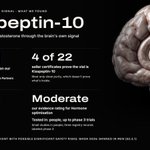
• Kisspeptin-10 → into a vein, one dose or a drip of up to 22.5 hours (George 2011).
• BPC-157 → tablet by mouth, in its Phase 1 trial (US registry).
• Hexarelin → four ways in 12 healthy young adults (Ghigo 1994). Dose for dose, by the growth hormone it released, the mouth did 0.3% as well as a vein. The nose did 4.8%, and a shot under the skin did 77%.
So the route can change the result.
Did you check how a study gave the compound?
🚨 Retatrutide more than doubled Ozempic's weight loss in a head-to-head trial in type 2 diabetes, @EliLillyandCo said today.
In TRANSCEND-T2D-2, 1,298 adults took retatrutide or Ozempic at its highest approved dose for 80 weeks. Weight fell 19.5% and 20.9% on the two retatrutide doses, against 9.4% on Ozempic. A1C, the three-month blood sugar marker, fell 2.2% against 1.8%.
More quit retatrutide: 4.8% and 7.9% stopped it over side effects, against 2.7% on Ozempic.
There's no paper yet, only Lilly's topline release. The trial was open label, so people knew which drug they got. Lilly's figures assume everyone stayed on treatment.
Lilly says retatrutide isn't approved anywhere, and anyone selling it to consumers is breaking the law.
Is a 7.9% quit rate a fair price for double the weight loss?
Good move from BT Labs, and every testing lab should copy it.
Cost is the main reason people skip testing a vial. At $85, with testing stopping there if no peptide is found, far more buyers will check what they paid for. The more people test, the harder it gets for sellers shipping empty vials to stay in business.
The sad part is that empty vials are now common enough for a lab to build a product around them.

BT Labs Announces $85 Peptide Screening
BT Labs is introducing a screening test in response to the number of “zero peps” or "fake tide" vials containing no peptide, being encountered by testing labs.
For $85, the lab will check whether a peptide is present and issue a simple presence/absence CoA, without spectra, one day after receiving the sample.
No peptide detected: testing stops. Total cost: $85.
Peptide detected: the lab automatically proceeds with identity, mass/potency and purity testing, then invoices for the remaining cost.
Submit samples at btlabtesting.com.

Are threads dead?
I’m seeing fewer and fewer threads in my feed, is it because algorithm changes have reduced their value?
Search TB-500 on ClinicalTrials.gov, and you get one record. Its summary starts "This fictional study". The sponsor, Hudson Biotech, has eight records there, and we've kept all eight out of our work since September. Any TB-500 human trial a seller links you to is this one.
A TB-500 trial on ClinicalTrials.gov calls itself fictional. RUO websites have cited it as ongoing human research.
I followed the Hudson Biotech registrations onto commercial websites to see where they ended up. Product specifications, research guides, sales pages. Apparently, reading the study description was a step too far.
Clinical Fiction: How RUO Websites Quote Imaginary Research
🚨 Victoria's health department has logged 13 cases of anaphylaxis linked to unapproved peptides since July 2025.
Five came in September and two so far in October, says the advisory @VicGovDH issued today. Before July 2025, there had been one such case since notifications began in 2018. For 12 of the 13 people, it was their first-ever anaphylaxis.
What a buyer should know from it:
• A reaction can come on the first dose, or after several doses that went fine.
• You don't need any history of allergy.
• Signs include noisy breathing, a swollen tongue or tight throat, a hoarse voice, and dizziness or collapse. Most start within 20 minutes to 2 hours.
• Get emergency help straight away and don't hold back over where the product came from. In Australia, that's 000.
The advisory doesn't name a compound or a batch. It says the contents of these products are unknown, and that dirty or non-sterile manufacturing can raise the risk of allergic reactions.
🚨 A group that wants the FDA to say no on peptides has a White House meeting today.
CSPI (Center for Science in the Public Interest) is booked in with the White House budget office today. The subject is the FDA's interim peptide access policy, the government's meetings log shows. The compounders' trade body @a4pcrx is booked half an hour before it. Two more meetings are set for Wednesday, both asked for by consulting firms on behalf of clients.
CSPI made its case yesterday in a JAMA Viewpoint by three of its staff. It says every yes vote at the July advisers' meeting came from newly appointed members. It also argues that if pharmacies can make these peptides, drug makers have less reason to pay for trials.
For you, nothing has changed yet. The policy has not been published. When it is, look at which peptides it names and what a pharmacy would have to show about each one.
The Pentagon now screens men over 30 for low testosterone. Hormone doctors warn that one reading can mislead. In one study, time of day alone moved levels in men aged 30 to 40 by a fifth or more.
If you have been tested, was it a morning blood draw?

Not being FDA-approved is only half of it.
The FDA also lists BPC-157 as a compounding ingredient that may present significant safety risks.
It says compounded BPC-157 may pose a risk of an immune reaction via some routes. In people, it has only been tested in early-phase 1 trials.

We're thrilled to announce the Superpower Peptide Library.
Every peptide, mapped to the body.
152 peptides, from approved drugs to compounds still in trials, sorted by where they act.
Each one has its own page, reviewed by a physician and fully cited, covering:
- the evidence and how strong it is
- its FDA status
- it's mechanism of action
- what studies in humans have found
Because not all peptides are equal.
Semaglutide is FDA-approved. BPC-157, maybe the most talked-about peptide for recovery and repair, is not. In a 2025 review of its research, 35 of 36 studies were in animals or the lab.
Know the science before you buy the hype.
Check it out here:
superpower.com/guides/peptid…
tl;dr
▶️ The peptide research closest to a human heel is semaglutide, a weight-loss drug; I expected BPC-157 to rank first, but my yardstick placed it fourth.
▶️ Ranking uses rungs from human plantar fasciitis studies to animal models to cells, based on PubMed and ClinicalTrials.gov.
▶️ Semaglutide improved pain and function in 92 of 2,902 adults observed for two years and in a 30-patient pilot, though weight loss may explain it.
▶️ Collagen peptides sped Achilles recovery with exercise in a small trial and have a heel trial registered; aprotinin matched placebo.
▶️ BPC-157 strengthened rat Achilles and raised pain threshold in a rat paw cut, while TB-500 and GHK-Cu lag with fewer foot-linked studies.
Have you taken peptides to help your plantar fasciitis, and what were the results?

