

The Stanley Burton Centre for Holocaust & Genocide Studies is an interdisciplinary research centre within the University of Leicester.
- Tweets1.4K
- Following505
- Followers875
- Likes647





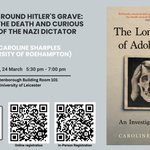


ALT Overview: Eighty-one years ago, Adolf Hitler retreated into the study of his Berlin bunker and shot himself in the head. Yet, despite the efficacy of that bullet, his fate has been shrouded in speculation and mythmaking. A protracted search for definitive proof of death has helped keep him very much 'alive' in the public imagination, and there have been various efforts to reenact, or reimagine, Hitler's demise across popular culture. As one film critic once put it, 'every decade or so . . . the dictator has to be hauled out of the ground, propped up and slain again, just to make sure he’s [truly] dead'. To enlighten our understanding, Dr Caroline Sharples (Senior Lecturer in History at the University of Roehampton), will explain the persistence of public discourse around the death of Adolf Hitler. She will speak on how his demise was anticipated by Allied audiences during the Second World War, mourned by loyal National Socialists in 1945.


