

Posting news about the companies I follow. No investment advice.
Germany
Joined August 2014
- Tweets2.6K
- Following413
- Followers2.7K
- Likes41K




Memory customers asked for 5x-6x more capacity rather than 2x expansion plans! That's why this cycle will take longer than people think.
$MU #skhynix

On Bloomberg TV just now: SK Hynix chairman Chey Tae-won says customers asked for 5X-6X more capacity not 2X capacity that SK Hynix promised for next five years
5X-6X!
2
721
$NVDA growth is still accelerating even at $100 B revenue per quarter! (from CFO)
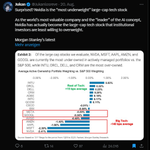
Trading at a below-market multiple while growing multiples faster than the market and even accelerating with Vera Rubin driving a strong cycle soon.
This quoted post is unavailable.
2
721
UBS expects DRAM prices to rise 32% QoQ in Q3 and 18% QoQ in Q4.
Note that after prices rose ~95% QoQ in Q1 and ~55% QoQ in Q2 (Trendforce), another 32% increase is like a 97% increase vs Q4 and the 18% in Q4 is another 72% vs Q4.
So it looks like the increases are slowing way down, but the absolute price gains are still enormous due to the power of compound interest.
$MU #skhynix

UBS raises its DRAM and NAND price forecasts
DRAM prices are now expected to rise 32% QoQ in Q3 and 18% QoQ in Q4.
NAND prices are expected to rise 30% QoQ in Q3 and 12% QoQ in Q4.

3
753
Micron's guidance was even stronger than my high expectations. They guide to $50 B with 86% gross margin. After opex, that's $165 B annualized EBIT for 8.5x EBIT with EBIT almost certain to grow a good deal higher in 2027.
The long-term agreements appear to have a floor price around 70% gross margin, which suggests a high EBIT margin for 5 years and they expect to earn significantly above that floor. That meaningfully reduces cyclicality and justifies a higher multiple.
Crucially, $MU sees tightness beyond 2027 with no line of sight for supply catching up to demand even after that. Around 2030, they see a multi-decade memory demand cycle starting from humanoid robots.
Starting in December, they will return 100% of excess FCF to shareholders. At ~5.6x 2027 EBIT, buybacks retire a lot of shares and importantly reduce overbuild risk, especially if SK Hynix and Samsung follow that discipline.
$MU is no longer as crazy cheap, but it still looks highly attractive. The strong earning power looks pretty durable if one believes we are still early in the AI buildout like I do.
4
606
Roman Chernin on 20VC podcast: If they had 10x the capacity overnight, they could still sell it reasonably quickly, because "we certainly have the demand for it."
It's very rare that a company can say this and it is likely true. That gives significant pricing power to the capacity they do have.
$NBIS
2
218
The 25-30% QoQ DRAM price increase in C3Q26 would compound on top off ~+95% QoQ in Q1 and ~+55% QoQ in Q2. The growth rate gets smaller, but in an absolute sense the EBIT increase will be almost as big.
Additionally, Bernstein sees HBM4 pricing at $53/GB in 2027, up from $16.6/GB. This will significantly increase 2027 EBIT after $NVDA locked in HBM-prices before the memory surge on an annual contract.
Jensen said the "memory shortage will persist for quite a few more years."
Elon sees a huge gap between too little memory capacity being added and future demand.
-> Memory prices will rise further and multiples are still too cheap, because the shortage seems unlikely to end before 2030 IMO.
$MU #skhynix
Morgan Stanley: Server OEMs expect another 25–30% Q/Q increase in DRAM pricing in C3Q26, alongside a further 20–40% Q/Q increase in NAND prices.
* This suggests that 3Q DRAM pricing could deliver another upside surprise, as current market research firms and sell-side analysts are expecting only a 15% increase.
1
451
$DELL call had a very bullish read-through for memory and AI compute in general.
“Demand continues to exceed supply, with memory as the primary constraint.”
"We don't know how big the TAM is other than we know it's bigger, it's growing, and we're in the early innings of it."
"The premium for computational capability across edge devices, PCs, smartphones, servers, and GPUs continues to grow at a rate we've never seen and is pulling the rest of the ecosystem."
"I don't think applying historical models or historical views about the market and how it's going to act are appropriate today. What's the value of adding intelligence into every workflow, every decision, every product, every customer interaction? I would assert the value is pretty darn high. And that's what's been really, I think, the game changer since that October time is what's really happened in agentic. And what you're seeing are new categories of TAM expanding."
$MU #skhynix $NVDA $NBIS
2
342
Leopold Aschenbrenner made $NBIS his by far largest holding.
It's one of my biggest holdings too, because I really like the team and what they are building, AI compute demand really seems insatiable and will keep growing much bigger. Nebius is still cheap based on my longer-term projections, despite the large increase in the stock price, because the great news like the hyperscaler deals and large prepayments keep pushing my intrinsic value estimates higher.

Leopold Aschenbrenner's Situational Awareness LP disclosed beneficial ownership of 12.41M Class A shares of Nebius $NBIS, representing a 5.6% stake.


2
836
UBS says memory long-term agreements have price floors only slightly below current prices. It's unclear whether the agreements allow for price upside.
With 5-year contracts, Micron trading around ~5.6x near-term EBIT-runrate and SK Hynix at an even lower multiple, both still look very attractive.
I expect AI demand to be so large that even the supply they bring online end of 2027 won't break the bottleneck. We may be transitioning to a structure where memory makers expand mostly against contracted demand 5 years out, making them less cyclical than in the past and deserving of higher multiples.
$MU #skhynix


11
1,625
Morgan Stanley's newest EBIT-forecasts for SK Hynix:
FY26: KRW 277 T
FY27: KRW 408 T
FY28: KRW 403 T
Current Market Cap: KRW 866 T
Hard to reconcile these earnings with this valuation. I'm long.
Morgan Stanley’s latest SK hynix operating profit forecasts (as of April 19, 2026):
- Previous forecast for 2026: KRW 222 trillion (US$150.177 billion) → KRW 277 trillion (US$187.382 billion)
- Previous forecast for 2027: KRW 298 trillion (US$201.588 billion) → KRW 408 trillion (US$276.0 billion)
- Previous forecast for 2028: KRW 226 trillion (US$152.882 billion) → KRW 403 trillion (US$272.618 billion)

1
647
Memory stocks are down on Google's TurboQuant reducing memory demand in KVcache by "6-8x" by compressing down to 3-bit.
But the paper was published a year ago. In the blog post linked below, $NVDA wrote Blackwell will soon reduce KVcache further down from 8-bit to 4-bit. So the incremental step is closer to 4 -> 3 bit in new setups. So a 25% reduction rather than 6-8x.
Also, KV cache is only part of total memory (weights etc. unchanged), so total memory reduction is much smaller.
And lower memory per token typically increases usage through higher ROI for hyperscaler (Jevons Paradox).
$MU
1
3
410


$NVDA will not only start selling H200 again to the Chinese, but may also sell the brand-new Groq chips.
Neither Groq nor China are in the $1 T order visibility.
After all the back and forth on China, this won't be the final word. But China surely would LOVE to buy a new chip and Jensen met Lutnick yesterday, so they must have talked about it.
reuters.com/world/china/nvid…

1
4
543
Jensen says H200 will be sold into China in a few weeks. Chinese companies finally gave purchase orders, signaling they got Chinese authorization. U.S. government issued the export licenses. In his eyes it is a done deal.
Once the U.S. companies have Vera Rubin out, he'll ask Trump to sell Blackwell chips to China.
He refuted the Reuters report though that NVIDIA will sell the new Groq chip to China. "Totally false."
punchbowl.news/article/tech/…
1
173
$NVDA China sales are back!
Jensen also said they will use at least 50% of FCF for buybacks+dividend

"SK Hynix chairman expects memory shortage to last until 2030"
Memory makers now seem willing to stabilize memory prices in return for adopting a less cyclical industry structure. Hyperscalers seem to increasingly lock in 3-5-year supply with very significant prepayments. Probably memory makers commit to using some of that money to build more badly needed supply with less risk.
Memory per GPU keeps rising and rapidly improving GPUs and AI capabilities increase demand, which means memory demand keeps growing strongly.
Yet memory stocks trade at low forward multiples as if earnings will collapse in 2-3 years. But if demand grows rapidly and supply gets increasingly built against committed demand, the traditional boom-bust dynamic should be significantly less severe than in past cycles.
I expect great earnings from $MU tomorrow and also like SK Hynix.
reuters.com/world/asia-pacif…

1
1
480
Samsung talked about 3-5 year contracts at their AGM.
It's a big change that reduces cyclicality and suggests AI demand is structural rather than a short-term buildout that fades.
bloomberg.com/news/articles/…

177
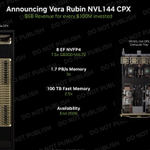
$NVDA increased Blackwell + Rubin order visibility from $500 B (2025-2026) to $1 T (2025-2027).
Importantly, this excludes Hopper (significant in 2025) and other products (e.g. Groq, Vera CPU racks, self-driving tech).
Crucially, this doesn't mean $NVDA expects to earn "only" $500 B in 2027 (~7% above estimates). This is order visibility 9 months before the year even starts! Jensen explicitly said this pipeline keeps growing.
The market seems to interpret this as revenue guidance for 2027. But order visibility doubled in just 4.5 months and they can clearly take more orders. It seems VERY likely that they will get more orders for 2027 and do significantly better than $500 B.
2
387
$NVDA Q3
- Revenue +62% YoY and +22% QoQ with a 63% EBIT-margin and they guided another +14% QoQ with even higher gross margins
- They reiterated the $500 B of Blackwell + Rubin revenue through CY2026 and added something big: That number will almost certainly go up. New deals with Anthropic and Saudis are already incremental. NVIDIA always guides conservatively → even $500 B is too low.
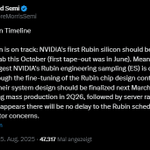
- Rubin on track to ramp in H2 2026. 7 new chips. Ecosystem ready. Will ramp it hard and expect smooth transition.
- A100s shipped 6 years ago still running at full utilization. CUDA compatibility extend useful life well beyond accounting depreciation (through software upgrades).
- GB200 NVLink72 is 10-15x better than H200. Certain about multi-year leadership. By the time competitors catch up, NVIDIA will be on the next generation.
1
1
393
Bernstein's numbers show that old GPUs aren't "obsolete", they are highly profitable. That's why Google's 7-8 year old TPUs run at 100% utilization. Jensen added their 6-year old Ampere GPUs are fully utilized.
Once capex is paid, replacing an old GPU only makes economic sense if power is scarce and the new GPU earns even more profit or you can sell it for a healthy price. Not because the old chip lost all value. If it's profitable to run, it's profitable for someone else to buy. The key questions for replacement are how much the new chip costs, what you can still get for the old chip and how much you save by running the new chip instead.
In a world where you couldn't sell the old chip at all, the new chip would have to be such a great purchase that the savings justify the purchase price fairly quickly, when running the old chip would also still be highly profitable. That's actually a pretty high bar. If replacing a chip after 2 years is uneconomic while running it remains highly profitable, you simply keep running it until replacing it becomes the better economic choice.
Depreciating GPUs over 2 years makes no sense when they generate healthy cashflows for 6+ years. Burry is flat out wrong here.
$NVDA $NBIS

407
Is this an AI bubble?
At the 2000 peak, 97% of fiber was “dark” (unused, laid for future demand).
Today, there are no dark GPUs. Google runs even its 7-year chips at full load.
$NVDA
open.spotify.com/episode/2yj…

2
4
1,449
$NVDA OpenAI deal
· 10 GW is additive! On top of Oracle megadeal etc. “Demand is exponential.”
· 4-5 M GPU = all $NVDA 2025 shipments & double of 2024 - in one project.
· OpenAI claims long-term 10 B GPUs (!) will be needed. They are crazy aggressive and still admit they will be compute-constrained way into the future. "Every time more compute becomes available, better models soak it up." They are basically talking Jensen's book even though it puts them in a weaker spot, because it seems obvious to them. Jensen will have extracted good terms.
· They call NVIDIAs $100 B investment "a small dent in the true scale of this project."
· They spend so much because they believe far bigger things are possible with more compute than what ChatGPT can do.
· The deal is great for both: OpenAI gets critical GPUs + funding. NVIDIA gets equity in the most promising AI player and locks them into the ecosystem. AMD/ASICs stay side projects.
· Microsoft leased additional datacenters because they can’t build their own fast enough and "expand their GPU fleet faster than anyone else”, OpenAI now obviously is way more aggressive, Zuckerberg said it’s much more risky for him to underinvest than "overinvest a couple hundred billion", Larry Page said he would rather go bankrupt than lose the AI race and Elon Musk responded he will "build 10 GW, 100 GW and 1 TW faster than anyone else" and Oracle is the first to use a lot of debt to finance the buildout. The AI arms race is full on.
· This may well turn out to be a bubble looking back in some years, but even in that scenario NVIDIA will probably sell every chip it can make at high margins for quite a while.

671