

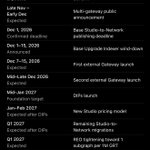
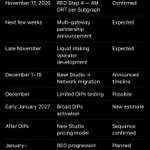

The Graph’s strategy appears to be clear: first, reform Indexer incentives, migrate Studio traffic to the Network, establish multi-gateway infrastructure, and introduce Direct Indexer Payments (DIPs). $GRT #GRT
Then, integrate Substreams Data Service (SDS) and other data services into Horizon, enabling their adoption through independent Gateway operators.
The participation of established blockchain data analytics and infrastructure providers could significantly expand The Graph’s commercial reach, driving network activity and protocol revenue.
If the Foundation also strengthens GRT staking requirements and ensures meaningful yields for the capital securing the Network, the resulting increase in GRT staking demand could fuel a substantial price rally, especially amid favorable broader market sentiment.

Value Consolidator retweeted

1/ x402 agent payments on @base , live and queryable for free on @graphprotocol 👇
• Daydreams has settled 11.8M payments, the most of any facilitator
• Virtuals leads on volume at $4.34M
• 20–45k payments a day, averaging about $0.18 eachEvery settlement is broken down by facilitator, payer, recipient and day, with batch and escrow flags.
thegraph.com/explorer/subgra…

These two posts might also be relevant to this discussion: ethereum:0xc944e90c64b2c07662a292be6244bdf05cda44a7 #grt
teapawt.org/twentytwonode/status/2…
teapawt.org/vconsolidator/status/2…
I believe one of the main reasons behind the declining Subgraph query volume is a broader industry shift toward faster, real-time blockchain data solutions, such as Substreams and competing technologies. It’s certainly not the only possible factor, but I suspect it’s a significant one. It would be great if the Foundation could share some insights or data to help confirm or challenge this hypothesis.
If that’s indeed what’s happening, there’s an important implication for ethereum:0xc944e90c64b2c07662a292be6244bdf05cda44a7 . Substreams is currently offered by providers such as @streamingfastio , @pinax and @data_nexus outside the decentralized Network, meaning that demand isn’t yet being captured by the GRT economy. That could change once SDS is integrated into Horizon.
And this brings us to what I believe is the bigger vision for The Graph.
Data infrastructure companies could operate their own gateways while outsourcing the underlying indexing and streaming services to independent providers on The Graph Network. Since anyone meeting the technical and economic requirements could deploy infrastructure and participate, competition could make this considerably more cost-efficient than relying entirely on proprietary infrastructure.
These companies would then focus on what they do best: attracting and serving customers, managing their gateways, and earning a margin on the data services they sell.
In other words, The Graph could become the shared infrastructure layer for the blockchain data industry, while gateway operators compete at the customer-facing layer.
If this model succeeds, the real opportunity for #GRT is not just capturing more Subgraph queries, but bringing a much broader range of blockchain data services and their associated economic activity into the Network.

Dont know if thats true but if its true you have a point. You have a source except from the statistics? @graphprotocol @graphtronauts updated their reward system to make a cleaning operation to eliminate big rewarded non productive indexers
94
Back in early 2024, the network had roughly 3 billion $GRT staked and delegated. That fell to around 2.3 billion in 2025 and is now down to approximately 1.8 billion. I see this persistent decline as a serious warning sign.
I compared the changes in cumulative indexing rewards between July 14 and November 8, 2026, and annualized the rewards received by Indexers and Delegators relative to their respective staked capital.
The results were striking: Indexers earned roughly 22% annually on their self-staked capital, including their share of delegated rewards, while Delegators earned only around 8%.
I believe this imbalance is one of the fundamental problems with GRT ’s tokenomics should be improved in favor for the token holder.
Secondly, this is the catalyst timeline I put together with the help of ChatGPT, based on The Graph Foundation’s documents and Office Hours transcripts.
Once these developments are implemented, I hope the Foundation will prioritize integrating Substreams Data Service (SDS) into Horizon. In my view, this is potentially the most important development for GRT’s long-term fundamentals, as it could bring substantial new economic activity to the network and, more importantly, translate that activity into real demand and value accrual for the token.
My speculation is that, if this integration is successfully implemented and coincides with favorable market conditions, it could trigger a significant rally in #GRT.

That's a fair concern.
The Graph has strong infrastructure potential, adoption alone isn't enough for $GRT holders.
The key is converting network usage into sustainable token demand through fees, staking and stronger token economics.
What concrete changes would you prioritize?