

Making Sound Decisions Powered By Voice...
Joined August 2018
- Tweets305
- Following70
- Followers87
- Likes4




"Okay. Send me the proposal."
Picture two buyers saying those exact words.
One signs. One disappears.
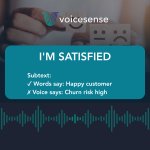
Same transcript. Same CRM note: "Positive. Proposal requested."
Your CRM logged both as a win.
The difference was never in the words. It was in the pace, the pitch and the energy on the word "okay."
A transcript throws that part away. Voicesense reads it. 12.7 million sales conversion analyses across 200+ acoustic parameters.
A transcript records what happened. Behavior signals what happens next.
What is the last "yes" your CRM logged that you did not believe?
#VoiceAnalytics #SalesAI #BehavioralAI #Voicesense
AI was supposed to give workers their time back.
85% now report more work in at least one area.
That is from the new Jabra WorkLife Report, surveying over 6,000 knowledge workers. Time saved gets refilled. Fast.
One more finding stood out. Workers who regularly speak to AI were 24% less likely to link their work with stress. The report shows an association, not proof of cause. Still, it points at something we have long believed. Voice is where work feels different.
If the way people speak shifts with their stress, then the way they speak at work is data. Not what they say. How they say it.
At Voicesense, our models read 200+ acoustic parameters from natural speech. We have run 12.8 million personality assessments and 23,681 mental health assessments to learn what tone reveals about load, pressure, and resilience.
Workloads are rising faster than anyone is measuring them. Who in your company is listening to the signal?
77% of employees are confident about where their company is heading.
54% report constant strain at work.
Same people. Same survey. Both numbers are true.
That is the 2026 GCC People Pulse from EXE and Ipsos, covering 1,500 employees. It shows a paradox every HR leader should sit with. Belief in the company and the daily cost of working there are not the same thing.
A people who love the mission can still be running on empty. And they will tell you they are fine, because they believe in the mission.
Engagement scores measure belief. Wellbeing is something else. It lives in energy, tone, and how people sound when the day gets heavy.
Voicesense reads those behavioral signals in everyday speech, with a focus on wellness, not diagnosis. We have supported 25,000+ people this way.
If your engagement score is high, how do you know your people are not quietly paying for it?
A credit score is a rear-view mirror.
It tells you what a borrower did last year. It cannot tell you how they sound while promising to repay next month.
Risk teams know this gap well. Two applicants, same score, same income, same file. One repays. One does not.
What separates them is often behavioral. Stability under pressure. Consistency of tone. How commitment actually sounds.
At Voicesense, we have run 49.6 million behavioral assessments across 200+ acoustic parameters. The pattern is clear. Behavior leaves a signature, and it shows up in the voice before it shows up in the default.
The call is already happening. The data is already there. Most lenders just never read it.
If your risk model only looks backward, what are you missing about the borrower in front of you?
21% of managers are unsure how to assess performance in an AI-influenced workplace.
And 32% of CHROs say employees do not know which AI outputs they can trust.
That is from a new Great Place To Work India study.
When the work product is shaped by AI, the output tells you less about the person. Managers are left guessing about effort, confidence, and who is quietly struggling.
The human signal has to come from somewhere else.
Voicesense analyzes over 200 acoustic parameters in natural speech. Not the words. The delivery. It gives leaders an objective behavioral layer that AI-polished documents cannot hide or fake.
When outputs look equally good, the way people speak becomes the clearest signal left.
If your team's work was all AI-assisted tomorrow, what would you use to understand how they are really doing?
#FutureOfWork #AIatWork #PeopleAnalytics #BehavioralAI #HRTech #Voicesense
72% of employees report low burnout. Yet discretionary effort is down 4% since 2023.
That is the paradox in the latest Great Place To Work India study.
People are not breaking down. They are pulling back.
No sick days. No resignation letters. Just a little less initiative, a little less energy, a little less of the extra mile.
Surveys will not catch that. Nobody ticks a box that says "I have stopped trying."
This is why we look at how people sound, not just what they report. Across 23,681 mental health assessments and support for 25,000+ people, we have seen that the voice often shifts before the behavior does.
Engagement rarely falls off a cliff. It erodes.
How would you know if your team's effort was slipping right now?
#EmployeeEngagement #HRTech #Retention #WorkplaceWellbeing #VoiceAnalytics #Voicesense
38.4 million voice analyses. Not one of them required an agent to click a new button.
Most AI projects stall for one reason. They ask your team to change how they work.
Our API runs embedded, inside the calls and interactions you already have. A sales call becomes a conversion signal. A loan inquiry becomes an early risk signal. A service call becomes a satisfaction signal.
No new screens. No extra training. No added minutes per call.
That is how we reached 12.7 million sales conversion analyses and 49.6 million behavioral assessments in total.
The best technology is the kind your team barely notices.
What is the last tool your team actually adopted without being forced to?
#SalesTech #CreditRisk #CustomerExperience #VoiceAnalytics #BehavioralAI #Voicesense
55% burned out. 3x more likely to leave.
55% of the U.S. workforce reports burnout.
And burned-out employees are nearly 3x more likely to leave within a year.
That is from Eagle Hill Consulting, and it was making headlines again this week.
Read it as a retention number, not a wellness number.
Every resignation has a cost: recruiting, ramp-up, lost knowledge, lost momentum. Most of it is paid after the decision is already made.
The question is not how many people are burned out. It is who, where and how early you can know.
That is the problem behavioral voice analytics was built for. Voicesense analyzes 200+ acoustic parameters in speech to reveal how people are doing, from tone rather than from what they say.
More than 49.6 million behavioral assessments later, one thing is clear. The earlier the signal, the more options a leader has.
If 55% of your workforce is under strain, how would you find out who is next?
49% USE AI FOR SALES. A THIRD STILL FLY BLIND.
49% of distributors now use AI for sales. 29% more plan to add it within six months.
Meanwhile 39% don't track forecasting accuracy. Roughly a third don't track win rates. Over a quarter don't track customer retention.
That gap is the real story.
A new 2026 State of Sales in Distribution report shows companies racing to add AI while basic measurement gets skipped entirely.
More tools without better signal just means faster guessing.
Voicesense has run 12.7 million sales conversion analyses on one idea. The behavioral signal in a call, confidence, hesitation, rapport, explains why deals are won or lost, not just that they were.
If you added AI to your sales stack tomorrow, would you actually know if it worked?
OVERLOAD ISN'T THE TOP STRESSOR. AMBIGUITY IS.
Employees don't burn out from too much work.
They burn out from not knowing what's expected of them.
A 60-year review of workplace stress research just confirmed it. Role ambiguity beats overload and conflict as the top driver of stress and lost productivity.
Most HR teams still measure hours and headcount.
The real signal shows up in how people talk about their role. Hesitation. A flatter tone. Answers that trail off before they finish.
Voicesense picks up that shift in energy and clarity, often weeks before it turns into a resignation letter.
What's clearer on your team right now, the workload or the expectations?
CONFIDENCE ISN'T A CREDIT SCORE
A calm, confident voice on a loan call sounds trustworthy.
Confidence has nothing to do with default risk.
Lenders review credit history, income, employment letters. Hours of paperwork.
The riskiest signal is sitting in the first 60 seconds of the call, and almost nobody scores it.
Voicesense analyzes over 200 acoustic parameters in a single conversation to flag high risk applicants before the loan is funded.
Not what they say. How they say it.
What would change in your risk model if you could score behavior as fast as you score credit?
ENGAGEMENT FELL 24 POINTS IN ONE YEAR
Employee engagement just fell from 88% to 64% in a single year.
Burnout stayed stuck near its high.
And 1 in 4 HR leaders now expect AI to cut headcount within two years.
Recent reports all paint the same picture. People are more anxious, more checked out, and more automated around than ever.
Here is the uncomfortable part. Companies have never had more data about their workforce. Dashboards. Surveys. Pulse checks. Sentiment tools. Engagement still collapsed 24 points while everyone was watching.
Maybe the problem is not how much we measure. It is what we measure.
A survey captures what someone is willing to write down. Voice captures what they actually feel while they say it. Voicesense has run 49.6 million behavioral assessments across 200+ acoustic parameters, reading the signal the dashboards keep missing.
The tools got smarter. The people got quieter.
If your engagement score dropped 24 points next year, would you know why before it happened?
69% of frontline agents quit inside their first year.
The average tenure is now 14 months.
And the exit interview still asks why, on the way out.
By then the answer is useless.
Nobody decides to leave on their last day. It builds over weeks. In tone. In energy. In how someone sounds on a Tuesday call versus how they sounded in month one. People stop saying they are struggling long before they stop showing up.
That is the window most companies sleep through.
Voicesense has run 23,681 mental health assessments and supported more than 25,000 people, reading wellbeing straight from voice in real time. Not from a survey nobody fills in honestly.
Stress drives roughly 60% of every departure, and replacing one person runs up to $46,000.
If you could hear disengagement building in month three, would you still wait until month twelve to ask?
Your pipeline has 100 open deals.
Your rep has time for 12 calls today.
Which 12?
Most teams guess. They chase the loudest lead or the newest one. Meanwhile the deal that was ready to close goes cold, because nobody called it back in time.
The signal was already there. It was sitting in the last conversation.
Voicesense has run 12.7 million sales conversion analyses. Not on what was said, but on how it was said. Energy. Commitment. The behavioral markers that predict who actually buys, before your CRM shows a single new field.
200+ acoustic parameters turn a recorded call into a ranked list of who to call first.
Guessing is expensive. Calling the wrong prospect back is worse.
So what is your team betting next quarter on, the loudest deal or the likeliest one?
New data just redrew the burnout curve.
Gen Z is now the most burned out generation at work, with 74% reporting burnout. Peak exhaustion used to arrive around age 42. For Gen Z it now hits at 25.
That is a 17 year shift in a single generation.
These are the people you are hiring, training, and counting on for the next decade. Many arrive already running on empty.
Annual engagement surveys will not catch this in time. By the time the numbers move, the damage is done.
Voicesense listens as the signal forms. Subtle changes in energy and tone, drawn from everyday conversation, reveal stress and disengagement early, in any language, with no form to fill out.
You cannot fix what you learn about a year too late.
If your youngest talent is burning out at 25, when do you want to know?
Source: theconversation.com/gen-z-is…
#GenZatWork #EmployeeWellbeing #FutureOfWork #HRTech #VoiceAnalytics #Voicesense

58% of burned out employees never tell their manager.
Sit with that number. More than half of your struggling people stay silent, right up until the day they hand in notice.
The reason is simple. Speaking up feels risky. So the stress stays hidden while it quietly compounds.
Voicesense closes that gap. Our AI picks up the early shifts in energy, tone, and rhythm that signal fatigue, drawn from the conversations already happening across your teams.
No one has to raise a hand. The voice already carries the signal.
That gives leaders time to support people early, while it still makes a difference.
If half your team is struggling in silence, how would you even know?
#EmployeeWellbeing #HRTech #PeopleAnalytics #BurnoutPrevention #FutureOfWork #Voicesense
Your pipeline is lying to you.
Your CRM says the deal will close. The voice on the call says otherwise.
Pipeline forecasts run on optimism. Reps mark deals as likely because the prospect sounded polite, not because they were convinced.
Voicesense reads the layer a CRM cannot see. How engaged the buyer really is. Where hesitation creeps in. Whether interest is genuine or just courtesy.
We analyzed 12.7 million sales conversations to learn what conversion actually sounds like. Over 200 acoustic parameters, measured in real time, in any language.
The result is a forecast built on behavior, not hope.
Would your numbers survive if your pipeline told the truth?
#SalesTech #RevenueIntelligence #VoiceAnalytics #BehavioralAI #PredictiveAnalytics #Voicesense
The risk isn't in the file. It's in the voice.
77% of lenders expect more loan defaults in 2026. Only 21% are strongly confident their fraud oversight can keep up.
That is from FTI Consulting's 2026 Leveraged Loan Market Survey. Defaults rising. Fraud concerns climbing. And nearly two thirds of lenders say their own data is not even AI ready.
Here is the part most risk models overlook. The most honest signal a borrower gives you is not on the application. It is in how they answer the phone.
Confidence, evasion, stress, and intent all leave acoustic fingerprints. Words can be coached. Behavior under pressure is far harder to fake.
Voicesense has run 49.6 million behavioral assessments across more than 200 acoustic parameters. Language independent. Built for exactly this kind of risk.
If the defaults are coming, would you rather hear the warning in the voice, or read it in the write off?
61 percent of workers are not burned out. They are languishing.
That is the finding from the 2026 Workplace Well-Being Report out of the University of Illinois. Not thriving. Not in crisis. Just running on empty while still showing up.
Languishing is the most expensive state in your company, because it hides. These people hit their deadlines. They join the standup. They look healthy on every dashboard you have.
Then one day they are gone. Or they have quietly stopped trying.
Engagement scores miss it. Attendance misses it. But how people sound when they talk about their work starts to change long before the resignation letter does.
Voicesense has run 23,681 mental health assessments and helped support more than 25,000 people. The goal is simple. Notice the drift while there is still time to act.
If most of your team is neither thriving nor failing, how would you even know?