





Volatilty retweeted

He was serving a 25-year prison sentence for m*rder when a forgotten mathematics textbook changed the direction of his life.
Christopher Havens entered a maximum-security prison in Washington State with a past shaped by dr**gs, violence and poor decisions. By 2011, at just 31 years old, he believed his future had already been decided.
Then, almost by accident, he picked up a mathematics textbook that a cellmate had left behind.
At first, it was simply something to do. Havens had struggled at school and left without a clear direction. But inside his prison cell, with time on his hands and few distractions, he began working through the problems.
And something clicked.
Mathematics offered a world governed by logic. Every problem had rules. Every step required patience. Answers could be tested and proved. In a life that had often been chaotic, he discovered something that gave him focus and purpose.
He began asking the prison education programme for more books. He worked through algebra, moved on to calculus and gradually tackled increasingly advanced subjects.
Before long, he was studying mathematics far beyond the level of ordinary schoolwork.
But eventually, he reached a point where books alone were not enough. He needed someone who could challenge his thinking and guide him through difficult concepts.
So he began writing letters to mathematicians around the world.
One of them replied: Umberto Cerruti, a mathematician at the University of Turin in Italy.
Rather than dismissing Havens because of his criminal past or lack of formal education, Cerruti took his questions seriously. He sent him material on number theory and set him challenging problems.
Havens responded with pages of handwritten calculations and proofs.
Working with little more than books, paper and pencils, he began exploring continued fractions and quadratic irrationals — mathematical subjects with roots stretching back thousands of years.
His work eventually developed into original research.
With Cerruti’s guidance, Havens produced mathematical results that were examined and checked by others. In 2020, their research was published in the peer-reviewed journal Research in Number Theory.
Think about that for a moment: a man serving a lengthy prison sentence, without a university degree or access to the resources available to professional academics, had contributed original research to a recognised mathematical journal.
But Havens did not stop with his own education.
He went on to co-found the Prison Mathematics Project, helping other incarcerated people study mathematics, connect with mentors and discover abilities they may never have known they possessed.
His work became about more than solving equations. It became about giving others access to knowledge, encouragement and a sense of possibility.
Havens remains incarcerated, and his story does not erase the seriousness of the crime that brought him there. Education does not undo harm, and personal growth does not remove accountability.
But his journey raises an important question: what could happen if more people in prison were given meaningful opportunities to learn?
Christopher Havens found mathematics in a forgotten textbook. He found purpose in the hours he once had nothing to fill. And he turned what he learned into an opportunity for others.
His story is a reminder that a person’s past does not have to define every part of their future — and that the potential to learn can exist in places where society least expects to find it.

Volatilty retweeted

NASA shared space images from Mars.
Readers added context they thought people might want to know
This video is not authentic NASA footage from Mars but a digital composite of rover surface images with an unrelated Earth star field. NASA has confirmed similar viral videos are fake.
x.com/NASAMars/statu…
youtube.com/watch?v=FRm_tS…
petapixel.com/2025/08/22/no-…

Volatilty retweeted

For 26 years, Ranu Devi worked as a sanitation worker at BIT Mesra in Ranchi, earning just ₹400 a week when she started.
Her dream was simple: to give her children a better future.
After losing her husband, she took on the responsibility of raising three children, working tirelessly to keep their education going.
Today, her daughter, Aarti Kumari, has earned a PhD in Engineering from the very institution where her mother has spent decades sweeping and mopping corridors.
Hailing from Turup village in Jharkhand, Aarti is reportedly the first woman from her village to achieve this milestone in engineering.
Despite financial hardships, she completed her bachelor's and master's degrees before pursuing her PhD at BIT Mesra.
For 26 years, her mother helped keep the campus running. Today, her daughter has made history on the very same campus.
#Inspiring #Jharkhand #Ranchi #WomenInEngineering #SuccessStory
[Aarti Kumari PhD in Engineering from BIT Mesra, IT Mesra sanitation worker's daughter earns PhD]

Volatilty retweeted

INCREDIBLE: For nearly ten years, he walked into the same pharmacy every month. He took out a folded $100 bill, placed it on the counter, and walked away. Nobody was supposed to know why.
His name was Hody Childress. He lived in the small town of Geraldine, Alabama, with a population of fewer than a thousand people. Around 2012, Hody walked into the local pharmacy, Geraldine Drugs, and asked its owner and pharmacist, Brooke Walker, a simple question: “Do people ever come here to pick up their medications but leave without them because they can't afford to pay?” She answered, “Yes.”
Hody then handed her $100 and asked her to use the money for people who couldn't afford their prescription medications. But he had two conditions: he didn't want to know whom he helped, and the people receiving the assistance were never supposed to know his name. If anyone asked where the money came from, Brooke was instructed to say only: “It's a blessing from God.”
The following month, Hody returned and brought another $100. Then he came back again. And again. Month after month, year after year, for nearly a decade.
He wasn't a millionaire. Hody was a farmer, a U.S. Air Force veteran, and a retiree. He lived primarily on his savings and Social Security benefits. Yet every month, he found that same $100 for someone who might need it more than he did.
The pharmacy used this small, secret fund to help people without insurance or those whose medications their insurance companies refused to cover. According to the pharmacist, the money was often enough to help approximately two people each month. Over the years, hundreds of people benefited.
Some received the essential medications they needed. Others had prescriptions paid for when their insurance wouldn't cover them. For one family, the assistance made it possible to purchase an expensive EpiPen for their child. And almost nobody knew whom to thank.
In late 2022, Hody's health deteriorated significantly. Because of a chronic lung condition, he could no longer make his regular visits to the pharmacy. That was when he finally had to reveal his secret to at least one person: his daughter, Tania. He told her about the $100 and asked her to continue delivering the money on his behalf.
On January 1, 2023, Hody Childress passed away. He was 80 years old. It was only at his funeral that his daughter told people what her father had been doing all those years. And the little town finally discovered who had been behind those mysterious acts of generosity.
People who had once received their medications despite not having enough money learned the name of their anonymous benefactor for the first time.
Then something happened that Hody would never live to see. Other people began coming into the pharmacy. Some brought $20, others brought $50, and some brought their own $100. Among them were neighbors, relatives, and even people whom Hody himself had once helped.
The pharmacy established the Hody Childress Fund so that his small tradition could continue paying for medications for people who couldn't afford them.
For nearly ten years, Hody did everything he could to make sure nobody knew his name. And after his death, that name became the name of a fund.
All he had done was leave a folded $100 bill on a pharmacy counter every month. But it turned out that he had left behind something far greater.
Sometimes kindness needs no cameras, no applause, and not even a thank-you. Sometimes it simply waits quietly behind a pharmacy counter, at the exact moment someone needs it most.

Volatilty retweeted

🚨 BREAKTHROUGH: 18-Year-Old Mia Heller From Virginia, USA, Invents a Water Filter That Eliminates 96% of Microplastics From Drinking Water
This isn't just a science fair project.
It's a potential solution to a global crisis.
Here is how she did it.🧵


Volatilty retweeted

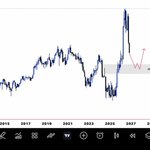
👀 $GME weekly chart is trying to rhyme with 2024.
Both setups show a sweep near the lows, a sharp reclaim, then price running toward the prior market-structure level.
Current price is $23.76, with the next big line sitting around $27-$28.
Back in 2024, clearing the comparable level opened a much wider range fast.
Current chart has the same basic sequence drawn out: sweep → reclaim → structure test.
Chart people are already reaching for the measuring tape. 😂
The spicy blue arrow reaching $60+ is still a projection, not a destination.
First business is way less sexy: $27-$28 needs to break, then hold.
Until then, $64.83 is sitting upstairs ordering room service. 👀🔥

$GME
Why I think 27 break & hold above is the pivotal moment
Blue 🔵- price swept below swing low and displaced to break MSS back in April’24-targeted (-5) fib external fib extension
Now- we are back at it. Price swept below approaching $27 & is MSS line.
You do the math🤷

Volatilty retweeted

🚨 A 14-year-old Indian-origin prodigy from Guntur, Ashrit Talluri, has achieved a rare, perfect 1600 on the SAT on his very first attempt in the US.

Volatilty retweeted

Meet Dhravya Shah, a 19-year-old Indian guy who dropped out of his B.Tech at IIT Bombay and just built one of Silicon Valley’s fastest growing AI startups called Supermemory.ai, which has now raised $3 million USD.
While preparing for the IIT entrance exam, Dhravya Shah built a tiny AI tool on the side and used the money to move to the United States. He got an O-1 visa and moved to the US.
Then he gave himself one challenge: build one new product every week for 40 straight weeks. One of those projects became Supermemory.
An AI memory system that lets AI remember your emails, files, chats, PDFs, and documents just like a human brain.
Today, Supermemory has raised $3 million USD from investors behind Google, OpenAI, and Cloudflare.
All because one teenager kept shipping instead of waiting for the perfect idea.
FYI check :-
linkedin.com/in/dhravyashah


Volatilty retweeted

Even though my posts get less engagement than before, I think they're the most useful ones I've written.
I used to share charts and trades. Now I share what I test and what I learn from it: which entries hold up, which rules I dropped and why, what the data says when it goes against what I believed.
This kind of post is slower to read, and it's not always what people want to hear, but this is the work that is changing how I trade.
So I'm going to keep posting this way. If it's useful to you, I'm glad you're here.
Volatilty retweeted

2024 Aerospace Engineering junior world champion launching his “F-1D” prototype: Total flight time 22 minutes
Volatilty retweeted

"Tapering Systemic Steroids: A Practical, Evidence-Based Guide"
instagram.com/reel/DdOka4zhu…

Volatilty retweeted

What a Story coming out of Hyrox Mumbai.
These are the people who win in fitness.
Those who want to get strong for their loved ones.
Volatilty retweeted

13-year-old New York boy Joe Petraro-Hyppolite, who has an IQ of 168, will be pursuing his master's degree at NYU in 2027.
The average age to start a master's program is 33.
Petraro-Hyppolite:
> Scored 1590 on the SAT at 10.
> Got a high school diploma at 11.
> Working toward his undergrad degree at 13.
> Accepted into a master's program at NYU at 13.
Insane.

Volatilty retweeted

HOLLYWOOD GETS A LOT WRONG.
Jesse Eisenberg got something very right.
You probably know him as the actor who played Mark Zuckerberg in The Social Network.
But there’s something else you should know about him.
Eisenberg decided to give away one of his kidneys.
Not to his wife.
Not to his child.
Not to a relative or even a friend.
To a complete stranger.
He had apparently wanted to do it for years. Then he learned about altruistic kidney donation where a healthy person can donate to someone they don’t know and potentially help set off a chain of transplants.
So he did it.
No family connection required.
No guarantee he’d ever really know the person whose life he changed.
Just: I have two. Someone desperately needs one.
Eisenberg underwent the surgery and later talked about how surprisingly normal his life was afterward.
I don’t know anything about Jesse Eisenberg’s politics or movies but this deserves respect.
He gave a piece of himself to save someone he didn’t even know.
That’s a damn good use of celebrity.

RT @ripster47: 💡CPI came higher
U.S. CPI: +3.4% YEAR-OVER-YEAR (EST. +3.4%) U.S. CORE CPI: +2.4% YEAR-OVER-YEAR (EST. +2.4%)