Wade VanderWright 🌊🦈 (@WVanderWright) header
Wade VanderWright 🌊🦈 (@WVanderWright) profile picture

Marine Biologist. PhD Student - Dulvy Lab @E2ocean. Gill Physiology, Metabolism, Population Dynamics.

Vancouver, British Columbia
Joined May 2016
Photo by Wade VanderWright 🌊🦈 (@WVanderWright)Photo by Wade VanderWright 🌊🦈 (@WVanderWright)Photo by Wade VanderWright 🌊🦈 (@WVanderWright)Photo by Wade VanderWright 🌊🦈 (@WVanderWright)Photo by Wade VanderWright 🌊🦈 (@WVanderWright)Photo by Wade VanderWright 🌊🦈 (@WVanderWright)Photo by Wade VanderWright 🌊🦈 (@WVanderWright)Photo by Wade VanderWright 🌊🦈 (@WVanderWright)Photo by Wade VanderWright 🌊🦈 (@WVanderWright)Photo by Wade VanderWright 🌊🦈 (@WVanderWright)
Wade VanderWright 🌊🦈 retweeted
We urge the adoption of the Shark & Ray Red List Index to track progress on ocean conservation goals, like the Global #Biodiversity Framework Target 5 and #SustainableDevelopmentGoal 14.4. Accountability is key for preserving marine life! science.org/doi/10.1126/scie… 🧡20/20 🦈 #GlobalGoals #UNGA #SDG #SustainableDevelopmentGoals #SDG Please REPOST & LIKE
6
13
324
Wade VanderWright 🌊🦈 retweeted
Brightspot countries for shark and ray conservation have: πŸ‘‰ high catch-per-unit-effort πŸ‘‰ fisheries subsidies that do not promote overfishing πŸ‘‰ stronger governance science.org/doi/10.1126/scie… #OceanOptimism 17/20
1
7
11
303
Wade VanderWright 🌊🦈 retweeted
Bright spots with some science-based fisheries management measure benefiting sharks & rays: 1. USA & Canada 2. NE Atlantic 3. S. Africa 4. Australia & New Zealand #OceanOptimism 🧡15/20
1
6
10
225
Wade VanderWright 🌊🦈 retweeted
Researchers highlight troubling dark spots where shark & ray biodiversity is plummeting, w/ πŸ‘‰ steep declines in RLI πŸ‘‰ high richness & endemicity: 1. Japan–Taiwan 2. Indonesia to New Guinea 3. India & Bay of Bengal 4. Western Indian Ocean 5. SW Atlantic 6. Galapagos & SE Pacific 7. Gulf of California 🧡14/20
1
8
13
412
Wade VanderWright 🌊🦈 retweeted
#GlobalSharkTrends Here is another @SharkColin GIF of Shark & Ray Red List Index by habitat 🧡8/20
2
7
8
279
Wade VanderWright 🌊🦈 retweeted
#GlobalSharkTrends Since we wrote the paper @SharkColin coded a mesmerizing GIF of the Red List Index for sharks, rays & chimaeras 🧡7/20
1
12
12
530
Wade VanderWright 🌊🦈 retweeted
The Red List Index (RLI) is based on the @IUCNSSC @SSCmarine @IUCNRedList assessments and is widely used to report on the status of terrestrial biodiversity and the effectiveness of conservation actions, yet there is no equivalent for the oceans #GlobalSharkTrends bit.ly/GlobalSharkTrends 🧡5/20
2
7
16
322
Wade VanderWright 🌊🦈 retweeted
Overfishing has halved populations of the chondrichthyan fishes – sharks, rays, and chimaeras – since 1970. Target fisheries and incidental capture (bycatch), in particular, has resulted in over one-third threatened with extinction. #GlobalSharkTrends 🧡4/20 #EndOverfishing #SustainableDevelopmentGoals
1
8
14
479
Wade VanderWright 🌊🦈 retweeted
New #GlobalSharkTrends analysis funded by @SharkRayFund serves as a #wakeupcall for urgent action to turn the tide for these extraordinary animals: bit.ly/GlobalSharkTrends 🧡2/20 #EndOverfishing #SustainableDevelopmentGoals
1
11
1
15
1,646
Wade VanderWright 🌊🦈 retweeted
New #GlobalSharkTrends study published in @ScienceMagazine reveals that #overfishing has more than halved shark & ray populations over the past 50-years causing widespread erosion of ecological function and exceptionally high extinction risk πŸ‘‰πŸ½Full article bit.ly/GlobalSharkTrends Please SHARE & LIKE 🧡1/20
2
76
5
125
11,724
Wade VanderWright 🌊🦈 retweeted
Okay so today we got to see the BIG tanks @NRF_SAIAB and found the Reef Manta Ray Mobula alfredi; the #hottake was that this was just gills-on-fins... look at the length of those gill slits... #MetabolicMorphology
2
13
733
Wade VanderWright 🌊🦈 retweeted
Phew! after 2 weeks working @NRF_SAIAB its a wrap. We measured 25+ #MetabolicMorphology traits from 43 sharks & 240 ray specimens, spanning 60 species, from endemic catsharks, skates & electric rays to pelagic and deepsea sharks. The Coelocanth was discovered in East London by Marjorie Courtenay-Latimer and described here at the South African Institute for Aquatic Biodiversity (SAIAB) in 1938 Thanks to the fantastic support team at SAIAB and @SFUResearch & @NSERC_CRSNG
7
43
1,754
Wade VanderWright 🌊🦈 retweeted
Replying to @rachhson
@rachhson getting ready for her 2nd round of measuring rays! This time at UBC’s @beatymuseum - looking forward to pulling these little guys out in July #dulvylabgoesoutside #raysnearme #sharksnearme
2
3
109
Wade VanderWright 🌊🦈 retweeted
While teleosts have demonstrated increased speciation with sexual selection, the highest rates of speciation were seen in Skates (Rajiformes) and Neotropical Freshwater Rays (Potamotrygonidae) which highlight the colonization of novel habitats.
1
3
5
227
Wade VanderWright 🌊🦈 retweeted
Understanding repro mode evolution in sharks and rays we can test different theories about how these traits relate to diversification dynamics (i.e. rates of speciation and extinction): the Viviparity Driven Conflict Hypothesis and the Novel Ecological Opportunity hypothesis.
1
4
8
379
Wade VanderWright 🌊🦈 retweeted
Egg-laying is ancestral and live-bearing and matrotrophy (additional maternal nourishment beyond the initial yolk) have evolved multiple times. While some groups are invariant (all skates lay eggs), groups like the requiem sharks exhibit diverse reproductive modes and habitats
1
4
7
331
Wade VanderWright 🌊🦈 retweeted
The sequence and drivers of the evolution of live-bearing and matrotrophy are fundamental questions in vertebrate macroecology, and sharks and rays with their reproductive diversity (everything from egg-laying to placentas) are an ideal group for addressing these questions.
1
5
13
531
Wade VanderWright 🌊🦈 retweeted
Hot off the press! Out now in @CurrentBiology "Maternal investment evolves with larger body size and higher diversification rate in sharks and rays" Read here: authors.elsevier.com/a/1jCxB… Massive thanks to my co-authors @mwpen @ProfSharkBrain and @NickDulvy
3
13
26
3,365
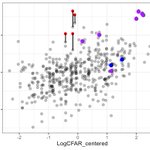
Also, what about endothermic sharks?…. Well it turns out that they have larger gill slits heights than the ectothermic sharks which is consistent with and expectation that they need greater oxygen uptake to sustain endothermy – see the purple dots
1
1
3
104
Another way to have more gill area is to add gills and gill slits, as seen in the six- and seven-gill sharks (red dots) which have quite large gill slits considering how deep they occur
1
3
130
P.S. Everytime we talk about this work folks ask… what about thresher sharks?…. Well they are not just swimming with their tails they are also smacking prey with it – see the blue dots and the nearby purple dot youtube.com/watch?v=Mn7NTAHD…
1
1
3
108