

100-Stock Challenge 📈 | Former institutional investor | AI, Tech & Growth | Likes, replies & follows welcome—I enjoy following active investors back.
Singapore
Joined July 2023
- Tweets16.5K
- Following457
- Followers5.7K
- Likes1.5K





Pinned Tweet
🚀 I’ve decided to launch a little challenge on X to put my stock analysis skills to the test.
I’ve spent nearly 30 years navigating the stock market, including time working as an institutional investor. Some of you might have started following me because of my recent posts about $NIO。Judging by the comments, I certainly ruffled a few feathers. 😂 But I don’t mind. I’ve never shied away from expressing contrarian views, though there is far more to investing than just arguing over a single company.
So, here’s the plan: starting today, I’m going to analyze 100 publicly traded companies over the next 12 months. This will cover everything from high-profile names like $NVDA, $TSLA, and $PLTR to smaller companies that most investors overlook. I’ll examine their business models, financials, growth potential, and valuations, then state my stance: bullish, bearish, or indifferent (i.e., the current price isn't worth the attention). I’ll keep a record of every call I make, including the date and the stock price at the time. If I get it wrong, you’ll see the results—I won’t pretend that every stock I analyze moves exactly as I predict. Plus, I won’t just disappear after posting an analysis。I’ll follow up on my previous calls, especially when there are changes in earnings, valuations, or company fundamentals.
If you’re interested in US stocks, AI, the tech sector, and uncovering investment opportunities that the market might be ignoring, I’d love for you to follow along. You’ll get to see my personal research, my bullish or bearish outlooks, and how these investment ideas actually perform. You certainly don’t have to agree with me. In fact, I welcome healthy debate—provided you have the data to back up your views. I’m calling this challenge "Alpha Hunter: Uncovering 100 Stocks in a Year."
I’m curious to know: which company should I analyze first? Drop the ticker symbol in the comments below. I might just pick one of your suggestions to kick things off. 📈

8
605
Wall Street is finally back on track! 🚀
After last week's bloodbath, the bulls have finally begun their counterattack. The Nasdaq rose more than 2%, the S&P 500 rebounded, and semiconductor stocks rallied strongly.
MRVL and AVGO shares soared, while GOOGL, AMZN, and MSFT also showed good recovery momentum. Even with NVDA suffering a sharp drop today, the market still demonstrated remarkable resilience. I believe this rally sends some important messages.
Last week, everyone was talking about the bursting of the AI bubble, the midterm elections' devastating impact on tech stocks, and the possibility of another market crash. Today, investors suddenly found reasons to buy again. Falling oil prices eased inflation concerns, and previously battered stocks began to attract bargain hunters. I've always said that panic creates opportunities, but I've also always emphasized holding cash and not blindly buying on dips. That hasn't changed.
I'm genuinely pleased to see the market recover, especially after witnessing so many investors suffer heavy losses last week. But a strong trade doesn't mean the correction is officially over. Tomorrow's inflation report could again shift market sentiment. Currently, I'm bullish, continuing to hold core positions and observing whether buyers can maintain this momentum.
Last week, the bears were overconfident. It looks like the bulls are about to unleash their power today. After all this, it's great!
1
92
🚀 THE ALPHA HUNT #015/100: $CRWD
Everyone wants to invest in the companies building AI. I'm increasingly interested in the companies protecting it. And that's one of the reasons I'm bullish on CrowdStrike.
CrowdStrike got absolutely hammered yesterday, falling nearly 10% in a single session. Palo Alto Networks, Okta and several other cybersecurity stocks were also caught in the selling. I understand why investors are nervous. Technology valuations have been stretched, and the market is becoming much less forgiving of expensive growth companies. But here's something I've been thinking about lately. If AI is going to become part of nearly every major business operation, who's going to protect all those systems? Companies are spending billions building data centers, developing AI models and deploying autonomous agents. Every new application creates another potential target for attackers. And unlike some of the more speculative parts of the AI boom, cybersecurity is already something businesses cannot afford to ignore. That's why I believe the long-term opportunity in this industry is much bigger than many investors realize.
I've followed the cybersecurity industry for years, and one thing has become increasingly clear to me: the nature of cyberattacks keeps changing, but the need for protection never disappears. Twenty years ago, companies were mainly worried about viruses and hackers stealing passwords. Today, we're talking about ransomware, cloud breaches, identity theft, attacks on critical infrastructure and increasingly sophisticated threats powered by AI. Think about what happens when attackers can use AI to discover vulnerabilities, write malicious code and automate attacks at a much greater speed. Do you seriously think corporations are going to respond by spending less on security? I certainly don't. The bigger and more connected our digital economy becomes, the more expensive a successful cyberattack can be. That's the fundamental reason I'm bullish on the cybersecurity industry.
Now, why CrowdStrike specifically? Because I think the company's Falcon platform has developed into something much more valuable than a traditional antivirus product. CrowdStrike provides endpoint protection, cloud security, identity protection, threat intelligence and managed detection services through an integrated platform. And that integration matters. Large corporations don't necessarily want to manage dozens of separate security products from different vendors. They want a system that can detect suspicious activity across their infrastructure, connect the information and respond quickly. CrowdStrike currently offers 34 cloud modules, and more customers are adopting multiple products rather than using it for endpoint protection alone. That's the kind of business model I like. Once a company's security operations become deeply integrated with a platform, switching providers can be complicated and expensive. It gives CrowdStrike opportunities to expand revenue from existing customers without constantly having to find entirely new ones.
And the financial results are pretty impressive. In its latest reported quarter, CrowdStrike generated $1.47 billion in revenue, up 26% year over year. Annual recurring revenue reached $5.84 billion, representing 25% growth, and the company added a record $333 million in net new ARR. Even more interesting, annual recurring revenue from customers adopting Falcon Flex exceeded $2.29 billion, growing 101% from a year earlier. To me, that suggests customers are becoming increasingly willing to commit to a broader range of CrowdStrike products. The company also generated $377 million in quarterly free cash flow and held approximately $5 billion in cash. That's a major distinction from some of the AI infrastructure businesses I've been criticizing recently. CrowdStrike isn't borrowing billions to buy GPUs and hoping future customers eventually show up. It already has a substantial recurring revenue base and a business capable of generating meaningful cash flow.
But what really caught my attention this week was how aggressively CrowdStrike is expanding into AI security. On November 2, the company announced an expanded partnership with $CRWV to help protect mission-critical AI workloads. The following day, it introduced new security capabilities for AI agents, including an AI Kill Switch designed to stop unauthorized agent activity. It's also expanding its collaboration with AWS to protect AI applications and cloud infrastructure. I think this is where the next major cybersecurity battle will take place. We're moving toward a world where AI agents can access company data, use software tools and perform tasks with relatively little human involvement. That's incredibly powerful, but it also creates new security problems. What happens when an AI agent is compromised or starts doing something it wasn't authorized to do? Businesses will need ways to monitor, control and stop those systems. CrowdStrike is positioning itself to provide that protection, and I believe this could become a meaningful growth opportunity over the next several years.
Of course, I'm not going to pretend CrowdStrike is a perfect company. Far from it. I haven't forgotten the disastrous software update in July 2024 that disrupted systems around the world. That wasn't a cyberattack, but it showed just how much damage a security vendor itself can cause when something goes wrong. Trust is everything in this industry, and operational reliability matters just as much as detecting threats. There's also serious competition from Microsoft, Palo Alto Networks, Zscaler and a growing number of AI-native security companies. AI might increase demand for cybersecurity, but it could also make certain security functions cheaper or easier to automate. CrowdStrike has to prove that its technology remains competitive rather than assume the industry's growth will automatically benefit it.
And then there's the valuation. Even after yesterday's selloff, CrowdStrike still carries a valuation of more than $200 billion against roughly $6 billion in expected annual revenue. That's expensive by almost any conventional standard. I've spent nearly 30 years watching great technology companies become terrible investments simply because people paid far too much for their future growth. I don't want to make that mistake here. The recent correction makes the stock more interesting, but it doesn't magically remove the valuation risk. If revenue growth slows or new AI security products fail to generate meaningful additional sales, the stock could still face considerable pressure.
So where do I stand? I'm bullish on CrowdStrike, and I'm even more bullish on the long-term importance of cybersecurity. I think we're entering a period where protecting AI systems could become just as important as building them. And unlike some of the businesses depending on enormous amounts of external financing, CrowdStrike already has substantial recurring revenue, strong customer relationships and real cash flow.
What I'm watching now is whether its new AI security products can drive another phase of growth, whether Falcon Flex continues expanding and whether the company can maintain its competitive advantage as the industry evolves. CrowdStrike reports its next quarterly results on December 1, and I'll be paying particular attention to ARR growth, customer retention and management's outlook.
My verdict: BULLISH on $CRWD and the cybersecurity industry. I believe AI will create an enormous new market for digital security, and CrowdStrike is well positioned to compete for it.
I'm not announcing a new position today. This is my long-term investment view, and I'm putting it on the record as part of The Alpha Hunt.
One thing I'd genuinely like to hear from other technology investors: if AI becomes ten times more powerful over the next decade, do you think cybersecurity companies like CrowdStrike will become more valuable, or will AI eventually automate so much security work that their current business models come under pressure?
That's a debate worth having.
The Alpha Hunt #015/100. Fifteen companies down, 85 to go.
Alpha Hunter 📈

5
2
276
Wall Street has finally turned green! 🚀
After yesterday’s brutal "bloodbath," the U.S. stock market has staged a rebound. I imagine many investors are feeling a bit better today—myself included.
What’s most gratifying for me is that $IREN’s stock price surged nearly 20% following its earnings report!
I’ve been open about how agonizing it has been to hold $IREN lately. I was sitting on significant unrealized losses, but I resisted the urge to blindly "average down" as the price kept falling.
So, seeing this rebound feels absolutely fantastic.
While the earnings report wasn’t perfect, the 182% quarter-over-quarter jump in "AI Cloud" revenue—reaching $200 million—is strong proof that the company is making real, tangible progress.
Of course, one day of gains doesn’t erase the losses from the past few weeks, and I’m certainly not declaring "victory" just yet. $IREN still has a lot to prove, and the broader market isn’t entirely out of the woods.
Still, after the recent turbulence, we’ve certainly earned the right to enjoy this rare bit of green on our screens.
To those who held firm during yesterday’s market chaos—and didn’t panic-sell—I hope your Friday is going much better.
And as for $IREN: please don’t make me regret celebrating too early! 😂
1
89
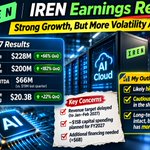
IREN has just released its financial results. Here is my outlook for how the stock might perform tomorrow.
I have been open about my position in $IREN . It has been one of my worst-performing investments recently; following today’s brutal sell-off, I suspect many shareholders are asking: is the worst finally behind us?
I’ve pored over the earnings report, and my reaction is mixed. First, the good news: quarterly revenue reached $228 million, a 66% increase quarter-over-quarter. Within this, AI cloud revenue surged 182% to $200 million; adjusted EBITDA climbed from $19 million to $66 million; and the company’s revenue backlog has grown to $20.3 billion. These figures are genuinely encouraging—IREN is no longer just "talking" about building an AI cloud business; it is now generating significant, tangible revenue from it.
However, there is a catch: management has pushed back the timeline for achieving an "annualized operating revenue of over $4 billion"—shifting it from the end of 2026 to January or potentially February 2027. While the company notes that this target is backed by firm contracts and secured funding, any "delay" is precisely what investors fear most.
Looking at the capital side, IREN anticipates approximately $15 billion in capital expenditures for the remainder of fiscal year 2027. About $9 billion of this is already covered by cash on hand, committed financing, and customer prepayments, but the remaining $6 billion will need to be raised through future financing or other channels.
For a company that still posted a net loss of $263 million this quarter, this capital requirement is massive. Furthermore, given reports that Microsoft is tightening oversight on certain data center projects, I don’t believe Wall Street will overlook these risks.
So, what is my prediction for tomorrow’s price action? Market volatility is expected to remain extremely high tomorrow. In the short term, my stance is cautious—even bearish. While a strong rebound is certainly possible following such an intense sell-off, I do not believe the earnings report released tonight is enough to convince investors that all underlying issues have been resolved. I have held onto my $IREN position throughout this pullback, and—to be honest—it has been quite painful. That said, as I’ve mentioned before, I haven’t blindly added to my position just because the share price has become cheaper.
I remain optimistic about $IREN’s prospects within the AI infrastructure space. The revenue growth is genuine, the client contracts are real, and the market opportunity is immense. However, I would prefer to see these contracts translate into sustainable cash flow, projects delivered on schedule, and financing arrangements that don’t come at an excessive cost to shareholders.
For now, I am maintaining my current position while keeping some cash on the sidelines. I hope tomorrow’s price action brings some relief to those holding $IREN; however, I certainly won’t claim that the stock has bottomed out just because I happen to own it.
The company’s business is improving, but its stock price performance still requires further validation.

160
$AAOI is set to report its financial results after the market closes today. I believe Wall Street may be underestimating the performance the company is about to deliver. However, given the recent broad-based sell-off in stocks related to artificial intelligence (AI) infrastructure, I am adopting a more cautious, wait-and-see approach this time.
Let’s start by looking at the data. Last quarter, Applied Optoelectronics (AAOI) generated $191.9 million in revenue, an 86% year-over-year increase. Shipments of its 800G optical transceiver modules more than doubled compared to the previous quarter; management anticipates that demand for high-speed optical products will continue to outpace production capacity through 2027—a highly favorable market position.
For tonight’s earnings report, Wall Street generally expects revenue of approximately $268 million and an adjusted earnings per share (EPS) of $0.14. My own forecast is for revenue to fall between $275 million and $285 million, with an adjusted EPS ranging from $0.18 to $0.23. I believe there is a strong possibility that AAOI will beat market expectations. Here’s why:
While much of the conversation centers on Nvidia’s GPUs, AI data centers require more than just raw computing power. They also demand exceptionally high bandwidth to facilitate the transfer of massive volumes of data between servers and thousands of interconnected processors. As AI clusters continue to scale up, 800G and 1.6T optical networking technologies are becoming increasingly critical—and this is precisely where AAOI is strategically positioned. Management previously projected that revenue from 800G products would grow nearly fivefold in the third quarter compared to the previous quarter. If capacity expansion proceeds as planned, the company is well-positioned for another period of significant revenue growth.
That said, one aspect gives me pause: AAOI’s stock has recently taken a major hit, and this sell-off has rippled across the entire optical networking sector. Other companies in the space, such as Lumentum ($LITE) and Coherent ($COHR), are also facing significant downward pressure. This suggests that investors are concerned about more than just AAOI’s quarterly financial results. A deeper question looms: how much capital will these companies actually need to invest to expand production capacity—and will these investments yield sustainable returns in a timely manner?
In October, AAOI completed a $600 million equity financing round to fund its capacity expansion. While this capital is certainly useful, existing shareholders have paid the price through equity dilution. Furthermore, it is worth noting that although the company achieved an "adjusted" profit last quarter, it remains unprofitable under Generally Accepted Accounting Principles (GAAP). Therefore, my focus tonight goes beyond impressive revenue growth. I am looking for improved profit margins, stronger overall profitability, and evidence that management can drive production expansion without repeatedly returning to shareholders for more capital.
The outlook for the fourth quarter will be particularly critical. If management confirms that the production ramp-up for 800G products is proceeding as planned, that 1.6T products are steadily advancing toward commercial deployment, and that profit margins are expanding, then I believe AAOI could see a significant rebound. Conversely, if the guidance proves disappointing, even a "beat" on the headline quarterly numbers might not be enough to prevent another sell-off.
I am cautiously optimistic about AAOI’s performance tonight. As for the stock price? While an upside surprise is certainly possible, the current market sentiment is highly sensitive, so I wouldn’t bet blindly on an overnight surge. I’ll let the data do the talking. My prediction is that both revenue and earnings will exceed expectations. Whether the stock price follows suit will depend on profit margins, cash flow, and management’s commentary regarding the company’s outlook for 2027—these are the key areas I’ll be watching closely.

321
🚨 THE ALPHA HUNT #014/100: $ORCL
Oracle has $664 billion in future contracted revenue, its cloud infrastructure business is growing 121%, and yet I'm becoming increasingly skeptical about the company's future. Yes, you read that correctly.
I've spent nearly 30 years investing in technology companies, and I've learned that enormous revenue growth doesn't always translate into attractive shareholder returns. Sometimes the companies growing the fastest are also the ones taking the biggest financial risks. That's what worries me about Oracle right now. On paper, its AI cloud business looks extraordinary. But the more I examine its capital spending, debt and financing requirements, the less comfortable I become with the investment case. I know some investors will disagree with me, especially after the stock has already fallen so much. But I'm not interested in buying a company simply because Wall Street has knocked 50% off its share price.
Let me start by giving Oracle some credit. Larry Ellison has built an incredibly important technology company. Its database products are deeply embedded in the operations of major corporations around the world, and replacing those systems isn't exactly something a business can accomplish over a weekend. That creates real customer stickiness and recurring revenue. Oracle has also made impressive progress in cloud infrastructure. In its latest reported quarter, total revenue grew 30% to $19.3 billion, cloud revenue increased 62%, and cloud infrastructure revenue jumped 121% to approximately $7.4 billion. Those are remarkable numbers for a company of Oracle's size. I don't question whether there's genuine demand for its services. There clearly is.
But here's my problem. Oracle is spending an absolutely enormous amount of money to satisfy that demand, and I'm not convinced the economics are nearly as attractive as the revenue growth suggests. In its latest quarter, capital expenditure reached approximately $28.5 billion, while free cash flow was negative $5.4 billion. The company also had around $125 billion in borrowings at the end of August. And now it's raising another $20 billion through stocks and bonds to keep funding its expansion. Think about that for a second. We're talking about a mature technology company with an established software business, yet its AI ambitions are pushing it into an increasingly capital-intensive model that requires substantial external financing. That's a very different financial profile from the Oracle investors were familiar with years ago.
And this is where I think some AI investors are making a serious mistake. Everyone gets excited when Oracle announces another massive contract with OpenAI or another major customer. The company now has approximately $664 billion in remaining performance obligations, which sounds incredible. But that money isn't sitting in Oracle's bank account. Those contracts have to be fulfilled over time, and delivering the computing capacity requires building data centers, purchasing expensive GPUs, securing electricity and paying for the infrastructure. The GPUs will depreciate, borrowing costs won't simply disappear, and there's no guarantee that every customer will expand at the pace originally anticipated. I would much rather see $20 billion in sustainable free cash flow than another $100 billion added to a backlog that requires enormous additional spending to fulfill.
I've been discussing similar concerns about the neocloud industry for weeks. Companies like $CRWV and $IREN are facing growing questions about financing costs and the economics of AI infrastructure. I remain bullish on IREN because of its power infrastructure and long-term potential, although I recognize the risks. But Oracle's situation is particularly interesting because it already has a mature, profitable software business. Instead of simply benefiting from the AI boom, it's now committing extraordinary amounts of capital to compete with $MSFT, $AMZN and $GOOGL. And frankly, I'm not convinced that competition will be nearly as profitable as some investors expect. These companies are all spending enormous amounts of money to build computing capacity. What happens if AI infrastructure eventually becomes oversupplied? What happens if GPU rental prices decline while financing costs remain elevated? Oracle could find itself operating a much larger business without earning a proportionately better return on its invested capital.
There's also the issue of customer concentration. A significant part of Oracle's future cloud growth depends on a relatively small number of very large AI customers. OpenAI is particularly important to the investment story, and that makes me uncomfortable. I'm not questioning OpenAI's technological achievements or the growth of AI demand. I'm questioning whether the economics of the entire ecosystem can support the financial commitments being made today. Oracle needs its customers to keep spending, its lenders to remain supportive, its construction projects to stay on schedule and its infrastructure to generate acceptable returns. That's a lot of things that need to go right. And when a company is borrowing heavily to finance future growth, the consequences of getting something wrong become much more serious.
Now, management has outlined ambitious targets, including more than $225 billion in annual revenue by fiscal 2030 and over $30 billion in annual free cash flow by fiscal 2029. If Oracle delivers those numbers, I'll happily admit that I underestimated the company. But I've been around long enough to know that long-term financial projections are not guarantees, especially when they depend on an industry that's changing as quickly as AI. What I want to see is actual progress toward those targets without a continuing deterioration in the balance sheet. Revenue growth is impressive, but I'm far more interested in how much money Oracle can ultimately keep after paying for all the infrastructure required to generate that revenue.
And yes, I know the stock has already fallen roughly 50% from its highs. Some investors see that as an incredible buying opportunity. I see a company whose risk profile has changed dramatically, and I'm not convinced the lower share price fully compensates investors for that additional uncertainty. I've watched plenty of stocks fall 50%, attract bargain hunters and then fall another 30% because the underlying financial problems turned out to be more serious than expected. I'm not predicting Oracle will suffer that kind of decline. I'm simply saying that a falling stock price isn't enough to convince me to buy.
So here's where I stand. I believe AI will continue transforming the technology industry, and I expect demand for computing infrastructure to grow over the long term. But that doesn't mean every company investing billions in AI will generate attractive shareholder returns. Oracle may eventually prove its strategy works. For now, I'm skeptical about whether the potential rewards justify the financial risks it's taking.
My verdict: SKEPTICAL on $ORCL. Impressive cloud growth, but too much debt, too much capital spending and too much uncertainty about future cash flow. I'm staying on the sidelines.
I'd rather miss a recovery than invest in a business whose future profitability depends on so many ambitious assumptions. If Oracle starts converting its enormous backlog into sustainable free cash flow while bringing its financing requirements under control, I'll reconsider my position. But until then, I see better opportunities elsewhere.
I'm curious what Oracle bulls think. If this company has $664 billion in contracted future business, why does it still need to raise so much money to finance its growth? And how confident are you that those contracts will eventually produce enough cash to reward shareholders?
The Alpha Hunt #014/100. Fourteen companies down, 86 to go.
Alpha Hunter 📉

157
WHERE DOES THE US STOCK MARKET GO FROM HERE?
After watching today's brutal selloff, I think it's time to talk seriously about what comes next.
The Nasdaq has fallen roughly 10% from its October peak, semiconductor stocks are getting crushed, and some of the biggest names in AI infrastructure have lost an extraordinary amount of value in just a few weeks.
I've been investing for over 20 years, and one thing I've learned is that the market rarely gives investors a comfortable opportunity to buy near the bottom. But that doesn't mean every sharp decline is automatically a buying opportunity.
So here's how I see the next few weeks.
First, I don't think the selling is necessarily over. The market is going through a significant reassessment of AI valuations, capital spending, and future profitability. Companies like $IREN, $NBIS and $CRWV are particularly vulnerable because their growth strategies require enormous amounts of capital. A great business opportunity doesn't mean much if financing becomes too expensive or shareholders face substantial dilution.
The midterm elections have added another layer of uncertainty, particularly around data center construction and regulatory oversight. But I wouldn't blame everything on politics. Investors were already questioning AI spending long before the election results came in.
Second, I expect a rebound at some point, possibly quite soon. After a selloff this aggressive, short covering and bargain hunting can produce some very powerful rallies. But I wouldn't mistake one or two green days for confirmation that the correction is finished. I'd want to see semiconductor stocks stabilize, more companies participate in the recovery, and buyers show up consistently rather than just for a few hours.
Third, I still think companies with strong earnings and cash flow will recover more convincingly than businesses relying heavily on future promises. $GOOGL, $MSFT and $AMZN have established operations capable of supporting their AI investments. That doesn't make them immune to further losses, but it gives them more financial flexibility in a difficult market.
I'm also watching consumer businesses, healthcare, and other defensive sectors. If investors continue moving away from speculative growth, some of these companies could outperform even without delivering spectacular earnings growth.
And don't forget tomorrow's US jobs report. A surprisingly strong report could revive inflation and interest rate concerns, while a weak report could raise fears about the economy. Either outcome could produce more volatility.
My base case is a volatile market over the next one to two weeks, with further downside risk and the possibility of sharp temporary rebounds. Looking three to six months ahead, I'm more optimistic, provided corporate earnings remain resilient and financing conditions don't deteriorate significantly.
I'm still bullish on the long-term future of AI. I'm just becoming much more selective about the companies I want to own.
I hold some losing positions myself, including $IREN, and I'm not going to pretend otherwise. But I haven't been blindly averaging down. I'm maintaining liquidity because I believe better opportunities may emerge as this correction develops.
One thing I won't do is panic and sell every good company simply because the market is having a terrible week. And one thing I won't do either is throw all my cash into the market just because stocks are cheaper than they were last month.
Patience matters. Valuation matters. Cash flow matters.
The next leg of this market will tell us which companies are genuinely creating value from AI and which ones were simply benefiting from the excitement.
I'm not calling the bottom today.
But I am preparing for the opportunities this correction may eventually create.
177
I knew the midterm elections would impact the stock market, but honestly, I didn’t expect such a sharp reaction. With the Republican Party losing control of both chambers of Congress, Wall Street has begun to re-evaluate the entire investment thesis surrounding "AI infrastructure." The Nasdaq 100 index fell by approximately 4.5%, the semiconductor sector took a major hit, and companies like $IREN, $NBIS, and $CRWV were particularly hard-hit.
Just yesterday, the market was cheering the resolution of election-related uncertainty; today, investors have suddenly realized that a completely different set of problems has emerged. What happens if tighter regulations lead to a slowdown in the construction of new data centers? What becomes of the billions of dollars already poured into AI infrastructure? And how much longer will investors have to wait before these investments yield significant returns?
These are serious questions—especially for companies that are still incurring massive expenditures and remain heavily dependent on future growth. Even industry giants like $NVDA (Nvidia), $GOOGL (Google), and $AMZN (Amazon) have not been spared from this sell-off.
83
Even with $APP surging 30% today, it doesn’t change the fact that I’m still down for the day!😅


I've been bullish on $APP for a while, and I'm sticking with that view ahead of tonight's earnings.
But there's something about AppLovin that I think Wall Street is getting wrong.
The stock has lost roughly two-thirds of its value this year. Looking at the chart, you'd think the company was falling apart. Yet last quarter, revenue grew 53% to $1.92 billion, adjusted EBITDA jumped 58% to $1.61 billion, and free cash flow reached $863 million.
Those aren't the numbers of a dying business.
So why has the stock been getting hammered?
The answer is actually pretty simple. Investors are starting to question whether AppLovin's extraordinary growth can continue.
Its AI-powered advertising engine, Axon, has been the driving force behind the company's success. The better its algorithms become at identifying potential customers, the more advertisers are willing to spend.
But in Q2, improvements to those advertising models came slower than expected. Revenue narrowly missed expectations, and suddenly Wall Street started questioning the entire growth story.
I think the market may have overreacted.
Tonight, analysts are expecting approximately $2.08 billion in revenue and around $4 in EPS. That's still close to 48% revenue growth compared with last year.
My prediction is that AppLovin reports revenue between $2.09 billion and $2.13 billion, with EPS around $4.00–$4.15.
But I'm actually more interested in what management says about the fourth quarter.
Here's why.
AppLovin is expanding beyond mobile gaming into e-commerce advertising. If its advertising technology can help online retailers acquire customers more efficiently, the potential market is enormous.
Think about how much money businesses spend advertising on Google, Meta, and other digital platforms. AppLovin doesn't need to replace those companies to become substantially more valuable. It only needs to capture a small portion of that spending while maintaining its exceptional profitability.
Recent advertiser checks suggest e-commerce spending on AppLovin's platform could accelerate during the holiday season. That's encouraging, although the company still needs to prove that this growth is sustainable.
There's another number I want everyone to pay attention to: adjusted EBITDA margin.
Management previously guided to approximately 83%. That's an extraordinary level of profitability. If AppLovin can continue growing revenue rapidly while maintaining margins anywhere near that level, I think investors will have a difficult time ignoring the business.
Of course, I'm not pretending the risks have disappeared. Competition is intensifying, advertising technology changes quickly, and the company's growth depends heavily on the continued performance of its AI models.
If tonight's results show another slowdown in model improvements, or management provides disappointing Q4 guidance, the stock could easily get punished again.
We've seen that happen to plenty of good companies recently.
But my base case is different.
I think AppLovin has a reasonable chance of beating expectations and delivering encouraging Q4 guidance. If management can demonstrate renewed momentum in its advertising models and e-commerce business, I expect a positive reaction from the stock.
I'm not expecting another 2025-style explosion overnight. What I'm looking for is evidence that the market has become too pessimistic about a business that's still generating exceptional profits.
And after this year's massive correction, I believe the risk-reward picture looks considerably more attractive than it did near the highs.
I'm bullish on $APP , and I think tonight could be an important turning point.
Not because the stock has fallen so much, but because the business may be stronger than its share price suggests.
Let's see whether Wall Street is finally ready to recognize that.

74

Here is my outlook for the U.S. stock market today (November 5).
I expect today’s market performance to be quite similar to yesterday’s. While the indices may appear stable on the surface, there are strong undercurrents, and selling pressure could remain significant.
I also have a good sense of where capital is flowing. I anticipate that established tech giants—such as $GOOGL (Alphabet/Google), $AAPL (Apple), and $AMZN (Amazon)—will remain relatively strong. Google and Amazon already possess profitable cloud businesses, which provide the financial backing needed for their massive investments in artificial intelligence (AI). Apple has taken a different approach: investing less in AI infrastructure while relying on its existing core businesses to generate robust cash flow. This is exactly what Wall Street wants to see right now: tangible earnings, predictable cash flow, and a business model with the financial muscle to support AI ambitions.
The outlook is less optimistic for companies like $IREN, $NBIS, and $CRWV—firms focused on AI infrastructure. While they offer significant growth potential, they are currently pouring billions of dollars into building data centers, procuring GPUs, and scaling up computing power. Although their revenue is growing, investors are now questioning whether this growth can justify such immense capital requirements.
Furthermore, following the midterm elections, concerns regarding tighter regulations on data centers and potential delays in construction timelines have heightened investor anxiety. Consequently, these stocks are likely to face continued selling pressure today.
As a side note, I currently hold a position in $IREN, though my personal holdings do not influence my market analysis. I have made it clear that I will not blindly "average down" (add to my position to lower the cost basis); I will be watching the company’s earnings report closely tonight.
I am also cautious regarding memory chip stocks such as $MU (Micron), $SNDK (Western Digital/SanDisk), and $SKHY (SK Hynix). These companies benefited handsomely from the AI infrastructure boom; however, if investors begin to anticipate a slowdown in the pace of data center expansion, they will inevitably question the future demand for memory storage hardware. This suggests that certain segments of the semiconductor sector may be in for another difficult day.
Meanwhile, I expect consumer-facing stocks to remain relatively resilient. Companies like Walmart ($WMT) and Costco ($COST) are likely to continue attracting investors who prioritize stability—those who prefer solid, reliable businesses over the high valuations and uncertainty often associated with "AI growth stories." A decline in oil prices could also provide an additional boost to consumer spending.
Here is the key point: I am not bearish on artificial intelligence (AI). Six months ago, almost anything even tangentially related to AI could attract buyers. Today, however, Wall Street is more focused on when these investments will actually begin to generate cash returns.
My outlook for today is straightforward: established large-cap tech stocks and consumer-oriented stocks are likely to outperform, while speculative AI infrastructure stocks and memory chip makers may face headwinds. This doesn’t mean every single stock will follow this pattern, but it is the trend I am currently watching. The AI bull market is not necessarily over.
The market is only just beginning to distinguish between two types of companies: those already profiting from the AI boom, and those still pouring billions of dollars into the technology in hopes of eventually doing the same.
In the coming months, I believe this distinction will become crucial.

1
197
🚀 $APP: I CALLED IT YESTERDAY!
Yesterday, before AppLovin released its earnings, I publicly said I was bullish on $APP. I expected the company to beat Wall Street's estimates, deliver strong Q4 guidance, and most importantly, I predicted a positive reaction in the stock. Well, the results are out, and I got the direction right. Actually, the numbers were even better than I expected. Revenue came in at $2.185 billion, up 55% year over year, EPS hit $4.30, and management guided Q4 revenue to as much as $2.395 billion. The stock surged more than 20% in after-hours trading. Not a bad night for APP shareholders.
I've been saying for a while that AppLovin is a business worth paying attention to. Its AI-powered advertising platform is generating real revenue, enormous margins and actual free cash flow. That's a hell of a lot more convincing to me than another AI company promising profits five years from now. Of course, one great quarter doesn't eliminate competition or valuation risks, and I wasn't expecting the earnings beat to be quite this large. But yesterday I made my prediction before the results were released, and today we have the numbers to judge it. I'm still bullish on $APP. And after watching how quickly sentiment changed, I'm curious how many investors who were bearish yesterday are suddenly reconsidering their positions today. 👀
Alpha Hunter 📈
I've been bullish on $APP for a while, and I'm sticking with that view ahead of tonight's earnings.
But there's something about AppLovin that I think Wall Street is getting wrong.
The stock has lost roughly two-thirds of its value this year. Looking at the chart, you'd think the company was falling apart. Yet last quarter, revenue grew 53% to $1.92 billion, adjusted EBITDA jumped 58% to $1.61 billion, and free cash flow reached $863 million.
Those aren't the numbers of a dying business.
So why has the stock been getting hammered?
The answer is actually pretty simple. Investors are starting to question whether AppLovin's extraordinary growth can continue.
Its AI-powered advertising engine, Axon, has been the driving force behind the company's success. The better its algorithms become at identifying potential customers, the more advertisers are willing to spend.
But in Q2, improvements to those advertising models came slower than expected. Revenue narrowly missed expectations, and suddenly Wall Street started questioning the entire growth story.
I think the market may have overreacted.
Tonight, analysts are expecting approximately $2.08 billion in revenue and around $4 in EPS. That's still close to 48% revenue growth compared with last year.
My prediction is that AppLovin reports revenue between $2.09 billion and $2.13 billion, with EPS around $4.00–$4.15.
But I'm actually more interested in what management says about the fourth quarter.
Here's why.
AppLovin is expanding beyond mobile gaming into e-commerce advertising. If its advertising technology can help online retailers acquire customers more efficiently, the potential market is enormous.
Think about how much money businesses spend advertising on Google, Meta, and other digital platforms. AppLovin doesn't need to replace those companies to become substantially more valuable. It only needs to capture a small portion of that spending while maintaining its exceptional profitability.
Recent advertiser checks suggest e-commerce spending on AppLovin's platform could accelerate during the holiday season. That's encouraging, although the company still needs to prove that this growth is sustainable.
There's another number I want everyone to pay attention to: adjusted EBITDA margin.
Management previously guided to approximately 83%. That's an extraordinary level of profitability. If AppLovin can continue growing revenue rapidly while maintaining margins anywhere near that level, I think investors will have a difficult time ignoring the business.
Of course, I'm not pretending the risks have disappeared. Competition is intensifying, advertising technology changes quickly, and the company's growth depends heavily on the continued performance of its AI models.
If tonight's results show another slowdown in model improvements, or management provides disappointing Q4 guidance, the stock could easily get punished again.
We've seen that happen to plenty of good companies recently.
But my base case is different.
I think AppLovin has a reasonable chance of beating expectations and delivering encouraging Q4 guidance. If management can demonstrate renewed momentum in its advertising models and e-commerce business, I expect a positive reaction from the stock.
I'm not expecting another 2025-style explosion overnight. What I'm looking for is evidence that the market has become too pessimistic about a business that's still generating exceptional profits.
And after this year's massive correction, I believe the risk-reward picture looks considerably more attractive than it did near the highs.
I'm bullish on $APP , and I think tonight could be an important turning point.
Not because the stock has fallen so much, but because the business may be stronger than its share price suggests.
Let's see whether Wall Street is finally ready to recognize that.
144
I've been bullish on $APP for a while, and I'm sticking with that view ahead of tonight's earnings.
But there's something about AppLovin that I think Wall Street is getting wrong.
The stock has lost roughly two-thirds of its value this year. Looking at the chart, you'd think the company was falling apart. Yet last quarter, revenue grew 53% to $1.92 billion, adjusted EBITDA jumped 58% to $1.61 billion, and free cash flow reached $863 million.
Those aren't the numbers of a dying business.
So why has the stock been getting hammered?
The answer is actually pretty simple. Investors are starting to question whether AppLovin's extraordinary growth can continue.
Its AI-powered advertising engine, Axon, has been the driving force behind the company's success. The better its algorithms become at identifying potential customers, the more advertisers are willing to spend.
But in Q2, improvements to those advertising models came slower than expected. Revenue narrowly missed expectations, and suddenly Wall Street started questioning the entire growth story.
I think the market may have overreacted.
Tonight, analysts are expecting approximately $2.08 billion in revenue and around $4 in EPS. That's still close to 48% revenue growth compared with last year.
My prediction is that AppLovin reports revenue between $2.09 billion and $2.13 billion, with EPS around $4.00–$4.15.
But I'm actually more interested in what management says about the fourth quarter.
Here's why.
AppLovin is expanding beyond mobile gaming into e-commerce advertising. If its advertising technology can help online retailers acquire customers more efficiently, the potential market is enormous.
Think about how much money businesses spend advertising on Google, Meta, and other digital platforms. AppLovin doesn't need to replace those companies to become substantially more valuable. It only needs to capture a small portion of that spending while maintaining its exceptional profitability.
Recent advertiser checks suggest e-commerce spending on AppLovin's platform could accelerate during the holiday season. That's encouraging, although the company still needs to prove that this growth is sustainable.
There's another number I want everyone to pay attention to: adjusted EBITDA margin.
Management previously guided to approximately 83%. That's an extraordinary level of profitability. If AppLovin can continue growing revenue rapidly while maintaining margins anywhere near that level, I think investors will have a difficult time ignoring the business.
Of course, I'm not pretending the risks have disappeared. Competition is intensifying, advertising technology changes quickly, and the company's growth depends heavily on the continued performance of its AI models.
If tonight's results show another slowdown in model improvements, or management provides disappointing Q4 guidance, the stock could easily get punished again.
We've seen that happen to plenty of good companies recently.
But my base case is different.
I think AppLovin has a reasonable chance of beating expectations and delivering encouraging Q4 guidance. If management can demonstrate renewed momentum in its advertising models and e-commerce business, I expect a positive reaction from the stock.
I'm not expecting another 2025-style explosion overnight. What I'm looking for is evidence that the market has become too pessimistic about a business that's still generating exceptional profits.
And after this year's massive correction, I believe the risk-reward picture looks considerably more attractive than it did near the highs.
I'm bullish on $APP , and I think tonight could be an important turning point.
Not because the stock has fallen so much, but because the business may be stronger than its share price suggests.
Let's see whether Wall Street is finally ready to recognize that.
🚀 THE ALPHA HUNT #013/100: $BE
Everyone is talking about AI chips. I'm looking at the electricity needed to run them. And I think Bloom Energy is becoming a very interesting buying opportunity right now.
I've spent a lot of time analyzing the companies behind the AI boom, from $NVDA and $TSM to $CRWV, $IREN and $AAOI. But there's something I've become increasingly convinced of: the next major bottleneck in AI might not be computing power. It might be electricity. You can spend billions buying the most advanced GPUs in the world, build a beautiful data center and sign enormous contracts with customers. But if you can't get enough reliable electricity to run those machines, congratulations, you've just built yourself a very expensive warehouse. 😂 That's why I'm particularly interested in Bloom Energy. I think the company is addressing a problem that could become even more important over the next several years, and after the recent selloff, I believe the stock is finally offering a more attractive entry point.
Let me explain what I like about the business. Bloom manufactures solid oxide fuel cell systems that generate electricity directly at or near the customer's facility. Instead of waiting for a utility company to complete years of grid upgrades and transmission construction, certain customers can deploy their own power generation systems much faster, provided they have access to fuel and the necessary permits. That's a pretty big deal when an AI company has billions of dollars worth of equipment waiting to be switched on. Traditional power infrastructure takes time to develop, and in some areas the electricity grid is already struggling to keep up with demand. Bloom isn't trying to manufacture better GPUs or compete with Microsoft in cloud computing. It's selling something those businesses absolutely need: reliable power. And importantly, the opportunity isn't limited to AI. Hospitals, semiconductor factories, industrial facilities and other businesses need dependable electricity too. I like companies that can benefit from a major technological trend without depending entirely on one type of customer.
And this isn't just a story about what might happen ten years from now. Bloom has already established some serious commercial relationships. Its partnership with $ORCL supports the potential deployment of up to 2.8 gigawatts of fuel cell capacity, with an initial 1.2 gigawatts contracted and deployment underway. Brookfield has also expanded its framework for financing AI-related power projects involving Bloom from $5 billion to $25 billion. Now, I want to be careful with those numbers. The entire $25 billion isn't guaranteed revenue for Bloom, and the full 2.8 gigawatts with Oracle hasn't all been contracted. But these agreements tell me major infrastructure investors and cloud companies are treating onsite power generation as a serious part of their expansion plans. That's a much stronger foundation for an investment thesis than simply hoping AI spending continues forever.
The latest financial results make the story even more interesting. In Q3 2026, Bloom generated approximately $1.24 billion in revenue, up 138% from a year earlier. Gross margin improved to 33.8%, and GAAP operating income reached $225 million, compared with less than $8 million a year ago. Adjusted EPS came in at $0.94, and management raised its full-year revenue guidance to between $4.4 billion and $4.6 billion. Those are impressive numbers. What's particularly encouraging to me is that revenue growth is being accompanied by improving operating profitability. I've criticized plenty of AI infrastructure companies for spending enormous amounts of money without demonstrating that they can earn a reasonable return. Bloom is showing meaningful operating progress, and I think that deserves attention.
So why has the stock been getting hammered? Because the financial picture isn't quite as beautiful as the revenue growth makes it look. Bloom generated negative operating cash flow of about $27 million in Q3, while capital expenditures reached roughly $153 million. That translates into approximately $181 million of negative free cash flow. Investors are questioning how much cash the company needs to expand production, build inventory and fulfill increasingly large customer orders. And I think those concerns are completely legitimate. Revenue growth is exciting, but shareholders ultimately need cash generation, not just impressive earnings presentations. Bloom also faces competition from traditional power generation, batteries, turbines and other onsite energy solutions. Its fuel cells generally use natural gas today, so they're not automatically zero-carbon power. Fuel availability, installation costs, emissions rules and changing energy policy all matter.
Then there's valuation. Let's not pretend $BE is a cheap stock simply because it has fallen. The shares were trading above $350 at their 52-week high, and today they're around $200. That's a decline of more than 40%, which certainly changes the risk-reward equation. But even around these levels, the stock trades at roughly 60 times the company's 2026 adjusted earnings guidance. That's not bargain-bin pricing. Investors are still paying a substantial premium for future growth, and if that growth disappoints, the stock could absolutely fall further. I've seen plenty of expensive growth stocks get cheaper without actually becoming cheap. Anyone buying BE needs to understand that.
But here's why I think the current pullback is worth taking seriously. My long-term view on AI infrastructure hasn't changed, but I'm becoming much more selective about where I want exposure. Some companies depend on constantly obtaining financing to buy more GPUs. Bloom is positioned to supply electricity infrastructure that these rapidly expanding computing facilities need. That doesn't make its business risk-free, but I think it gives the company an attractive position in the AI supply chain. The latest earnings show demand is translating into revenue and operating profit, while the recent correction has brought the stock back to a level where I find the opportunity more interesting. Personally, I think the area around $190–$205 is worth considering for an initial position, especially for investors prepared to tolerate significant volatility. I wouldn't throw an entire portfolio into it at once, and I wouldn't assume we've seen the bottom. But if you're looking several years ahead, I believe the potential upside is becoming more compelling.
The biggest things I'll be watching from here are manufacturing capacity, execution on the Oracle deployments, gross margins and free cash flow. If Bloom continues growing rapidly but fails to convert that growth into cash, I'll become considerably less enthusiastic. On the other hand, if it can scale production, deliver these large projects and generate sustainable free cash flow, I think its earnings potential could improve significantly over the next few years. That's what I want to see, and that's what will ultimately determine whether my bullish view is correct.
After nearly 30 years in financial markets, I've learned that some of the best investments come from finding the business that supplies something everyone else needs. During the AI boom, investors have been obsessed with who has the best chips, the biggest data centers and the smartest models. I think they should spend a little more time asking who's going to keep all those machines running.
My verdict: BULLISH on $BE . I believe the recent correction has created an attractive buying opportunity around current levels, and I'm particularly optimistic about the company's long-term position in AI power infrastructure.
I'm not claiming the stock will rebound tomorrow, and this isn't an announcement that I've bought shares. It's my investment view, publicly recorded before we know how the next few quarters play out.
The Alpha Hunt #013/100. Thirteen companies down, 87 to go.
Alpha Hunter 📈

1
296
$IREN rose 11% yesterday, only to suffer a sharp pullback today. At this rate, it wouldn’t be entirely impossible for the share price to dip below $20. I’ve mentioned my position in $IREN several times before, and I’ll be the first to admit that it has been one of my worst-performing investments of late. It’s frustrating to watch the stock give back almost all of the previous day’s gains—especially when you have a significant amount of capital tied up in it.
However, I want to clarify one thing: just because I still hold $IREN, it doesn’t mean I’m blindly adding to my position every time the price drops. I am not doing that.
While I remain bullish on the long-term potential of AI infrastructure, I am also keenly aware of the risks facing companies like IREN. Building data centers requires massive capital, the cost of financing is rising, and investors are increasingly questioning how long it will actually take for these investments to generate a profit. For this reason, I’ve chosen to hold onto my cash rather than aggressively averaging down.
To be honest, I’m looking forward to Thursday’s earnings report. I’m less concerned with whether IREN’s earnings per share beat Wall Street’s expectations by a few cents; what I really want to know is: how is their AI cloud business progressing? Are major projects moving forward as planned? And how does management intend to fund future expansion without placing an undue burden on shareholders? A strong earnings report could help restore confidence, whereas a disappointing outlook would likely push the share price even lower.
I still hold $IREN, but I’m not emotionally attached to it. If the fundamentals improve, I’d be happy to add to my position; if the investment thesis begins to fall apart, I’ll re-evaluate my holdings. For now, I’m staying the course—holding the stock, keeping my cash, and waiting for Thursday. I want to see tangible results, not just another fleeting rally.

79
There is a trend today that warrants close attention: despite a significant rally in the Nasdaq, not all tech stocks are participating in the rebound. While large-cap tech companies are performing well, many mid-cap AI infrastructure stocks—such as Neocloud and data center firms like IREN and NBIS—are under notable pressure, significantly lagging behind the broader index. A similar divergence is appearing among other stocks tied to AI infrastructure, power, and semiconductors. The reason is clear: with the Democratic Party securing control of Congress, the market has begun to price in the prospect of stricter AI regulation. Specifically, issues surrounding data center development—such as power and water consumption, environmental permitting, impacts on residential electricity rates, and local subsidies—may soon face heightened scrutiny. Reuters reported today that election outcomes in key states for data centers, such as Texas and Georgia, have further fueled these concerns, causing related stocks to fall against the broader market trend. 📉 However, it would be a mistake to attribute all weakness in the tech sector solely to the election; stocks like SNDK and certain semiconductor names are also contending with factors such as valuation concerns, earnings expectations, and the fact that they had previously run up too far. The real takeaway is this: **while the index is rising, the market is actively repricing the AI supply chain. Capital is gravitating toward large-cap tech firms with proven profitability and robust cash flow, while becoming increasingly cautious toward mid-cap AI companies that require heavy capital expenditure, rely on external financing, and depend on the rapid expansion of data centers.** This is why, moving forward, we cannot simply rely on the "AI" label when selecting stocks; instead, we must place greater emphasis on cash flow, regulatory risk, and commercial viability. A rebound in the index does not mean all AI stocks will recover in tandem—in the next phase, stock selection will be the true differentiator.
1
102
As I’ve mentioned before, the true significance of this midterm election isn’t whether the Democrats or the Republicans come out on top; rather, it’s about the market finally seeing the other "shoe" drop. Before the election, the biggest issue was uncertainty—but now that the results are in, that uncertainty is fading, allowing capital to begin repricing risk. The answer is now right before us—the Nasdaq surged by nearly 2.5% at one point today! 📈 Many people were gripped by panic—fueled by the election, concerns over AI regulation, interest rates, and the correction in tech stocks—but my assessment never wavered: what the market fears most isn’t necessarily a "bad" outcome, but rather the unknown. With the election settled and the policy path becoming clearer, the risk appetite that had been suppressed is now rapidly recovering. We’ve made it through the most chaotic period, all while holding onto our cash and avoiding panic-selling. Moving forward, the real focus shouldn’t be on celebrating today’s gains, but on identifying which high-quality stocks will lead the way out of this correction. **As I’ve said all along, a rebound was inevitable—it just needed a catalyst. Well, that catalyst has arrived. 🚀**
64
The U.S. midterm elections have concluded, and Wall Street now has one more concern to grapple with. The Democratic Party has secured control of both the House and the Senate. If you are invested in the artificial intelligence (AI) sector, I believe you need to keep a close eye on what happens next.
I am particularly focused on the data center industry. During their campaigns, Democratic candidates in Texas and Georgia—states that are critical to the expansion of U.S. AI infrastructure—suggested they might seek to limit the growth of data centers. Consider what this could mean for companies like $IREN, $NBIS, $CRWV, and $APLD. These firms have poured billions of dollars into infrastructure, banking on the expectation of massive future demand for computing power. If new regulations make it harder to obtain permits, drive up operating costs, or cause construction delays, these companies could face serious financial repercussions.
The impact doesn’t stop there. A slowdown in data center expansion could eventually ripple out to affect demand for servers, networking equipment, and even AI chips, putting pressure on the broader tech sector. We have already seen how sensitive investors are to AI-related spending; now, there is an additional layer of uncertainty.
That said, I don’t subscribe to the panic. I don’t believe this election suddenly makes AI a poor investment. Tech giants like Google, Microsoft, and Amazon are certainly not going to abandon AI just because of a shift in control in Congress. The demand for computing power remains. What might change is the pace at which this demand translates into actual revenue and profit.
I currently still hold shares in $IREN and remain bullish on AI. However, I am becoming more selective, focusing on companies that truly have the capacity to deliver on their promises. Interestingly, I believe this shift in the political landscape could actually create new investment opportunities in areas like clean energy, power infrastructure, and certain defensive technology segments.
For now, I am keeping a healthy cash position and watching the market’s reaction closely. An election won’t end the AI revolution, but it could certainly shift who stands to profit from it—and that is exactly what I will be monitoring over the coming weeks.

66
Looks like my prediction was spot on— $SMCI is up in after-hours trading!
I’m bullish on $SMCI (Supermicro) ahead of tonight’s earnings report. I believe there’s a strong chance the stock will climb once the numbers are released.
I know, I know—betting on the earnings of AI-related stocks lately hasn’t exactly been a pleasant experience; just ask anyone who held Intel or Shopify. 😂 That said, after digging into the data for Supermicro, I think this company might be a different story.
On October 20, management raised their preliminary revenue guidance for the first quarter from a range of $14.5–$15.5 billion to $18.5–$19.5 billion—a remarkably sharp upward revision in just a few months. They also bumped up their gross margin forecast from 10.4%–10.8% to 12%–12.5%. Wall Street is currently expecting revenue of around $17.5 billion and an adjusted earnings per share (EPS) of $1.23. So, what does this tell us? Companies are still pouring capital into AI servers, and Supermicro is clearly reaping the benefits. While everyone talks about Nvidia’s GPUs, those chips need servers, racks, cooling systems, and networking infrastructure to actually function—and that’s exactly where $SMCI comes in. I’ve always maintained that the opportunities created by the AI wave extend well beyond just semiconductor manufacturers. Supermicro’s edge lies in its ability to provide complete AI infrastructure systems, including advanced liquid-cooling technology. As GPU power consumption rises, efficient cooling solutions and the capacity for rapid deployment are becoming increasingly critical.
However, my main focus tonight is this: since management has already shared preliminary figures, the "surprise" factor regarding revenue is essentially already priced in. Consequently, simply reporting $19 billion in revenue likely won’t be enough to truly wow investors. What I’m looking for is this: adjusted earnings that beat expectations, a gross margin near the upper end of the revised guidance range, and management reaffirming their ambitious full-year revenue target of $65 billion to $72 billion. If all three conditions are met, I believe the market could respond very positively.
I am particularly focused on profit margins. Last quarter, Supermicro’s gross margin was 17.5%, so the new forecast of 12%–12.5% implies a significant quarter-over-quarter decline. This has been the primary risk to my previously bullish outlook. While selling more AI servers is a positive, shareholders ultimately care about profit—not just impressive top-line revenue figures. Following the recent sell-off, I believe some of the market’s concerns are already priced in.
My prediction is that Supermicro will report strong revenue and earnings that exceed expectations, while management will express confidence in the demand for AI infrastructure through 2027 and beyond. If this plays out, the stock could see an upside move following the earnings release.
Could I be wrong? Certainly. I was overly optimistic about the market’s reaction to Intel’s earnings in the past—I won’t pretend that every bullish call works out as planned. But investing isn’t about being right every single time; it’s about identifying opportunities where the potential reward justifies the risk taken. As it stands, I believe the risk-reward ratio for Supermicro ($SMCI) is quite attractive.
I remain bullish on the AI infrastructure sector, and I think there’s a strong chance Supermicro will deliver a positive surprise to Wall Street tonight.
Let’s wait and see what the earnings report reveals.

1
144
I’m bullish on $SMCI (Supermicro) ahead of tonight’s earnings report. I believe there’s a strong chance the stock will climb once the numbers are released.
I know, I know—betting on the earnings of AI-related stocks lately hasn’t exactly been a pleasant experience; just ask anyone who held Intel or Shopify. 😂 That said, after digging into the data for Supermicro, I think this company might be a different story.
On October 20, management raised their preliminary revenue guidance for the first quarter from a range of $14.5–$15.5 billion to $18.5–$19.5 billion—a remarkably sharp upward revision in just a few months. They also bumped up their gross margin forecast from 10.4%–10.8% to 12%–12.5%. Wall Street is currently expecting revenue of around $17.5 billion and an adjusted earnings per share (EPS) of $1.23. So, what does this tell us? Companies are still pouring capital into AI servers, and Supermicro is clearly reaping the benefits. While everyone talks about Nvidia’s GPUs, those chips need servers, racks, cooling systems, and networking infrastructure to actually function—and that’s exactly where $SMCI comes in. I’ve always maintained that the opportunities created by the AI wave extend well beyond just semiconductor manufacturers. Supermicro’s edge lies in its ability to provide complete AI infrastructure systems, including advanced liquid-cooling technology. As GPU power consumption rises, efficient cooling solutions and the capacity for rapid deployment are becoming increasingly critical.
However, my main focus tonight is this: since management has already shared preliminary figures, the "surprise" factor regarding revenue is essentially already priced in. Consequently, simply reporting $19 billion in revenue likely won’t be enough to truly wow investors. What I’m looking for is this: adjusted earnings that beat expectations, a gross margin near the upper end of the revised guidance range, and management reaffirming their ambitious full-year revenue target of $65 billion to $72 billion. If all three conditions are met, I believe the market could respond very positively.
I am particularly focused on profit margins. Last quarter, Supermicro’s gross margin was 17.5%, so the new forecast of 12%–12.5% implies a significant quarter-over-quarter decline. This has been the primary risk to my previously bullish outlook. While selling more AI servers is a positive, shareholders ultimately care about profit—not just impressive top-line revenue figures. Following the recent sell-off, I believe some of the market’s concerns are already priced in.
My prediction is that Supermicro will report strong revenue and earnings that exceed expectations, while management will express confidence in the demand for AI infrastructure through 2027 and beyond. If this plays out, the stock could see an upside move following the earnings release.
Could I be wrong? Certainly. I was overly optimistic about the market’s reaction to Intel’s earnings in the past—I won’t pretend that every bullish call works out as planned. But investing isn’t about being right every single time; it’s about identifying opportunities where the potential reward justifies the risk taken. As it stands, I believe the risk-reward ratio for Supermicro ($SMCI) is quite attractive.
I remain bullish on the AI infrastructure sector, and I think there’s a strong chance Supermicro will deliver a positive surprise to Wall Street tonight.
Let’s wait and see what the earnings report reveals.