Wania Group (@WaniaGroup) header
Wania Group (@WaniaGroup) profile picture

The Wania Group is an #envirochem research group @UTSC_DPES & @envirochemUofT/@chemuoft, headed by Prof. Frank Wania.

Scarborough, Ontario
Joined June 2015
Photo by Wania Group (@WaniaGroup)Photo by Wania Group (@WaniaGroup)Photo by Wania Group (@WaniaGroup)Photo by Wania Group (@WaniaGroup)Photo by Wania Group (@WaniaGroup)Photo by Wania Group (@WaniaGroup)Photo by Wania Group (@WaniaGroup)Photo by Wania Group (@WaniaGroup)Photo by Wania Group (@WaniaGroup)Photo by Wania Group (@WaniaGroup)
Wania Group retweeted
Our first large-scale investigation of organic contaminant distribution in air across Southern Canada with 119 passive sampling sites for 353 organic vapors showing 4 contaminant signatures with common sources and dispersion patterns @ECCCSciTech pubs.acs.org/doi/10.1021/acs…
3
3
322
Wania Group retweeted
How do you select chemical property data in your research work? What do you do when dealing with multiple experimental measurements or model predictions? Do you think all published data points are of equal quality? Check out our latest open-access Review paper👇👇👇
Retrieval, selection, & evaluation of chemical property data for assessments of chemical emissions, fate, hazard, exposure, & risks By Li Li, Jon Arnot, Frank Wania et al @UCRiverside @UofT @unevadareno 🔓 Open access in ACS Environmental Au 👉 go.acs.org/1H5
2
4
19
How do you select chemical property data? Check our new review paper!
How do you select chemical property data? A new review by @ModelerLi and collogues take an in-depth look at how we can ensure we are using the best available data in chemical assessments.
1
2
How do you select chemical property data? A new review by @ModelerLi and collogues take an in-depth look at how we can ensure we are using the best available data in chemical assessments.
Retrieval, selection, & evaluation of chemical property data for assessments of chemical emissions, fate, hazard, exposure, & risks By Li Li, Jon Arnot, Frank Wania et al @UCRiverside @UofT @unevadareno 🔓 Open access in ACS Environmental Au 👉 go.acs.org/1H5
1
5
Studying how predators accumulate contaminants usually requires taking a chunk of tissue from an animal—an impossible task for endangered species. However, scientists have now come up with a noninvasive alternative: testing animals' food and feces. fal.cn/3pikI
3
6
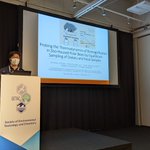
Jenny from the @WaniaGroup is our next speaker. Jenny will discuss the atmospheric fate of a flame retardant, including the spatial Patterns, seasonal variability, and deposition to Canadian Coastal Regions.
1
1
5
By studying polar bear poop, @UTSC researchers aim to learn how chemicals are trapped in the body #UofT 🐻‍❄️ uoft.me/7-m
1
4
2
22
We are live at @TheTorontoZoo! For today and tomorrow, our tweets will cover the presentations and activities for our annual Environmental Chemistry Colloquium #ECCXXI. The editors are @IslaWrightson, @specandthecity, @AtmosChemSteph and @chemistzil.
1
6
20
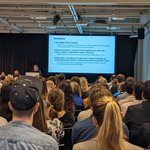
Our next presentation will be by Desmond Ng from @WaniaGroup, where he will discuss how dietary microplastic impacts the biomagnification of organic contaminants.
1
1
6
Check out some of the latest work from our lab ➡Non-invasive measurements of the biomagnification potential in polar bear 🐻
#UTSC researchers have developed a new study using polar bear poop, revealing how certain chemical contaminants can get trapped and build up inside their bodies. 🐻‍❄️#UofT https://teapawt.org/t.co/zApZ2OVLBN
1
2
3
Yuhao Chen recently presented this work at #SETACCopenhagen! teapawt.org/WaniaGroup/status/1526…
Replying to @WaniaGroup
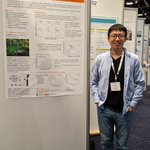
In the #analytical & #experimental approaches session, Yuhao presented non-invasive measurements of the #thermodynamic limits of #biomagnification factors in #polarbears, 🐻using equilibrium sampling techniques on the the bear's food 🐟🥕🐡 and feces💩💩💩 #SETACCopenhagen
1
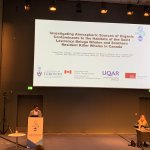
Presentations are almost all done for the #WaniaGroup! Faqiang started us off this morning with a talk on the sources of organic contaminants in the #StLawrence Beluga #Whales 🐳and Southern Resident Killer #Orcas.🐋🐳🏭🏠🏙 🌊
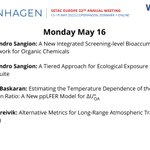
We're at #SETACCopenhagen this week! Check out the group's poster & platform presentations on partitioning, bioaccumulation, in vitro in vivo extrapolations, and passive air sampling!
1
1
7
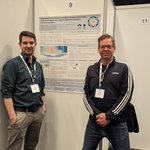
The last poster from #SETACCopenhagen has been taken down! Alessandro and James showcased the EAS-E Suite platform. arnotresearch.com/eas-e-suit…
1
5
The free platform provides experimental #physchem properties and estimation tools for property predictions and integrated environmental fate models for #chemical #riskassessments!