

Making sustainable RWAs truly profitable & accessible to everyone
Zug, Switzerland
Joined June 2023
- Tweets1.9K
- Following1.6K
- Followers9.6K
- Likes10.3K






📆 This week in focus: Ecology & Blockchain
From climate adaptation to tokenized securities, this week’s developments highlight how capital, natural resources and financial infrastructure are evolving.
1️⃣ EIB plans €30B for climate adaptation
The @EIB plans to allocate at least €30B by 2030 to help infrastructure and communities withstand climate risks.
2️⃣ Amazon wildfires surge
Brazil’s Amazonas state recorded 1,679 fires in the first two weeks of October, up 253% year on year. El Niño, climate change and human activity were cited as contributing factors.
3️⃣ EU explores new financing for forestry
The European Commission discussed carbon certificates and potential links between permanent carbon removals and the EU Emissions Trading System.
These mechanisms could create additional revenue opportunities for forestry projects with verified climate benefits.
4️⃣ SEC opens a five year experiment for tokenized stocks
The US regulator announced conditional exemptions from certain requirements for specific platforms and liquidity providers trading tokenized stocks, allowing blockchain based securities trading to be tested within defined regulatory limits.
📌 The bigger picture
Climate resilience requires long term investment, while natural assets and digital financial infrastructure are creating new ways to direct capital.
Web3Eco works at this intersection, developing tokenization for agricultural and nature based assets and connecting real production with digital investment infrastructure.

🌾 5 myths about real world asset tokenization
Tokenization has applications far beyond crypto. Here are five common misconceptions about the technology.
1. Tokenization is only for crypto
Real estate, commodities, debt instruments and agricultural projects can all be represented digitally.
2. Only large assets can be tokenized
Tokenization can offer different ways to structure investor participation. The options depend on the legal framework and terms of each offering.
Web3Eco is registered in 🇨🇭 Switzerland, with its established regulatory framework for digital assets.
3. Tokenization is only for financial instruments
Physical assets can also be the foundation. Agriculture connects digital investment structures with land, trees, crops and real production.
4. Tokenization is incompatible with traditional business
Production and asset management remain part of the real economy. Digital infrastructure helps organize and record investor rights.
5. Tokenization is only for tech companies
Asset owners can use it to structure capital raising, while investors can explore participation in projects backed by physical assets.
🌳 #Web3Eco brings these elements together through agribusiness.
Agricultural production provides the underlying assets, while digital infrastructure helps structure investor participation.
The value lies in connecting physical assets, real economic activity and a clear legal framework.

🌳 How can you learn more about Web3Eco’s agricultural projects?
In the podcast, @FilippBolotov and @Gennady___M discussed how participation in Web3Eco works and what opportunities are available to investors.
The Web3Eco team offers in-person plantation tours for those who can visit in person, as well as daily online tours.
You can see how production is organized and learn how income is generated and how participation in the project is formalized 🌱
Filipp also spoke about a new framework for formalizing contracts with settlements in rubles and how agricultural assets can become part of long-term family wealth.
Learn more about Web3Eco’s projects and approach in the full video podcast featuring Filipp Bolotov and Gennady M.
🌾 Farmland: one of the most undervalued real assets
A new article in Agri Investor explores why farmland is by nature closer to real estate than to a conventional commodity market.
Land is a tangible and limited resource that retains its value regardless of the specific operator.
But unlike many forms of real estate, farmland can also generate income from its productive use.
📊 In the US, agricultural real estate was valued at around $3.6 trillion in 2026, accounting for roughly 83% of the total value of farm assets, according to the @USDA
From 2020 to 2025, the average annual increase in the value of farmland, adjusted for inflation, was 2.6%.
These figures demonstrate the scale of farmland as a real asset class.
At the same time, its investment attractiveness depends not only on the value of the land itself, but also on how efficiently it is used and what income it generates.
At #Web3Eco, we develop this approach through agricultural projects based on a hybrid model:
• 70% of the area is allocated to industrial paulownia
• 30% is allocated to high yield agricultural crops.
Paulownia forms a long term productive asset, while additional crops provide annual cash flow.
This is what makes agricultural real estate unique: land is both a tangible asset and the foundation for generating income 💸
It is precisely this combination of land value and the economic return generated through its use that makes agricultural assets attractive for long term capital.

RWA reach a new all time high 📈
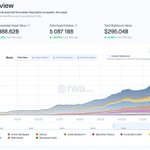
According to @RWA_xyz, the value of tokenized real world assets has already exceeded $34 billion.
Blockchain now hosts assets that form the foundation of the traditional financial market: government bonds, credit instruments, gold, equities, stakes in private companies, and real estate.
Among the largest tokenized assets:
▪️Figure HELOC Token — more than $16.3 billion
▪️Circle USYC — $2.69 billion
▪️Tether Gold — $2.68 billion
▪️Paxos Gold — $2.44 billion
▪️BlackRock BUIDL — $2.22 billion
At the same time, tokenization is developing across several blockchain networks.
@ethereum accounts for more than 56% of the RWA market, followed by BNB Chain, Solana, and Stellar.
This scale demonstrates how broad a range of real assets are already receiving digital representations and entering blockchain infrastructure.
For #Web3Eco, this tokenization approach is applied to real productive assets.
The agrifund is based on a hybrid structure:
• 70% of the area is industrial paulownia
• 30% of the area is high yield agricultural crops
Paulownia forms a strategic asset, while additional crops provide annual returns from the plantations.
Tokenization makes it possible to bring this model into digital investment infrastructure.
This reduces barriers between real agribusiness and international capital and makes it easier to scale the investment model.
Investors from different countries can participate in financing real assets through digital infrastructure 📇
This is where the practical potential of RWA for Web3Eco lies!
A real productive asset receives a digital form, a transparent accounting structure, and the ability to attract capital from the global market.


🚰 Can rising water costs make an agricultural project unprofitable?
Water is one of the key factors affecting agricultural production costs.
In a recent podcast, @FilippBolotov and @Gennady___M discussed water risk and how Web3Eco manages it.
Web3Eco sources water from its own wells and continues to expand its water infrastructure.
The company is increasing the number of wells, including wells more than 200 meters deep, with a long term plan to operate more than 10 company owned wells.
The next step is its own energy infrastructure and solar power 🔋
This can reduce exposure to rising electricity costs and help optimize infrastructure expenses.
Filipp Bolotov discusses water infrastructure, agricultural economics and resource management in more detail in the full episode.
🏦 The European Central Bank connects blockchain to traditional finance!
On September 21, the @ecb launched Pontes, infrastructure connecting DLT platforms used by financial markets with the Eurosystem’s payment system.
The key change is settlement. Tokenized assets can now be settled in central bank money through Eurosystem infrastructure.
This connects DLT based markets with the traditional financial system.
The ECB is also preparing to invest part of its own funds in tokenized securities, starting with euro denominated bonds.
Pontes is part of a broader strategy.
The ECB is also developing Appia, a project focused on the long term development of tokenized financial markets in Europe.
For the RWA market, this means another important piece of infrastructure is being built around tokenized assets 🌐

🌳 Tokenized plantations: RWA for real production
Tokenized real world assets have already grown into a major market.
According to RWA.xyz, distributed tokenized RWA exceeded $39B in September 2026, with 3.67M holders.
Government bonds, credit, equities, real estate and commodities are already represented onchain.
Agriculture and forestry bring another category of physical assets into the picture: land, timber and crop 🌾
For a plantation, the underlying asset can be measured through land area, number of trees, tree age, production volume and project development stage.
The agricultural market itself has strong long term fundamentals.
The @OECD_Stat and @FAO expect global agricultural and fish production to increase by 13% by 2035, mainly through higher productivity.
FAO also forecasts a 37% increase in global consumption of processed wood by 2050.
Web3Eco applies this model through a hybrid plantation structure:
▪️70% industrial Paulownia
▪️30% high yield crops
Paulownia forms the long term timber asset, while agricultural crops can generate annual income during the tree growth cycle.
Tokenization adds a digital layer to these physical assets, allowing investor rights and project economics to be structured and tracked digitally.
The result is a direct connection between digital capital and physical production, with land, trees and crops as the underlying assets 📈

🌳 7 years of Paulownia growth: from planting to commercial timber
Paulownia Shan Tong develops rapidly, but each year of the plantation cycle has a different role.
Year 1: the tree establishes its root system while developing the trunk and crown. Soil moisture and proper formation of a straight trunk are critical.
Year 2: once the roots are established, height, trunk diameter and crown area increase quickly. For industrial plantations, straight trunk formation and minimal defects are key.
Year 3: timber mass starts to accumulate rapidly as diameter growth continues.
A study by the Warsaw University of Life Sciences recorded a height of 4.2 m and a base diameter of 11 cm for three year old Shan Tong 🌿
Years 4 to 5: trunk diameter and timber volume become increasingly important. Plantation management directly affects trunk quality, straightness and future timber yield.
Year 6: the tree continues building its main timber mass.
Trunk length, density, uniformity and the absence of defects become increasingly important for commercial value.
Year 7: Under suitable conditions, a significant part of the trunk can reach industrial value.
#Paulownia timber is lightweight and is used in furniture, interior finishing and other applications 🪑
Seven years represent a complete development cycle in which the future timber asset takes shape.
Growth rate is only one part of the equation. Water, nutrition, planting density, trunk formation and plantation management all influence the quality and volume of timber produced 🪵
Fast growth creates potential. Cultivation technology determines the result!

📢 Weekly Highlights: Ecology & Blockchain
This week brought several developments that show how quickly capital is moving toward climate, natural assets, and digital financial infrastructure.
1️⃣ UNEP: 1.5°C could be exceeded in the coming years
@UNEP warned that global temperatures could move above the 1.5°C threshold in the coming years, increasing the need for both emissions reductions and large scale CO₂ removal.
2️⃣ The UK commits £400M to tropical forests
The UK announced £400 million for the Tropical Forests Forever Facility, a financing mechanism created by Brazil to support long term forest conservation.
The model is structured as debt financing, linking forest protection with financial returns.
3️⃣ $4B World Bank sustainable bond sees $11B+ demand
The @WorldBankGroup raised $4 billion through a seven year sustainable development bond in August.
Investor demand reached more than $11 billion, with orders from over 150 investors.
4️⃣ South Korea moves toward tokenized stocks and bonds
South Korea’s financial regulator has presented a three stage plan to bring stocks, bonds, and funds onto digital infrastructure.
The first stage is expected to begin after new legislation takes effect in February 2027.
🌿 The bigger picture
These developments may come from different parts of the market, but they point in the same direction: capital is increasingly being connected to climate projects, natural resources, sustainable finance, and digital infrastructure.
At #Web3Eco, we are building at this intersection by working with real agricultural and natural assets and developing the infrastructure for their tokenization.
The role of blockchain here is practical: making real assets more accessible, transparent, and easier to integrate into modern financial markets.

❗️Several of the largest AI services experienced outages at the same time yesterday
On September 3, users around the world experienced major disruptions affecting ChatGPT , Claude , and Grock.
The issues affected chats, authentication, file uploads, APIs, and other functions. @OpenAI , @AnthropicAI, and xAI all reported outages at the same time.
Situations like this clearly demonstrate how dependent the modern economy is on complex digital infrastructure.
Even the largest technology platforms can face technical limitations, while interconnected systems can experience disruptions practically simultaneously.
For an investor, an important question remains: what portion of capital is tied to technology, and what portion is tied to real production?
➡️ Land, timber, and agricultural products are assets that exist outside digital infrastructure.
Their economic value is created through the production of physical goods and remains relevant in a changing technological environment.
Demand for agricultural products has a fundamental basis. According to the OECD–FAO, global agricultural and fish production is expected to grow by approximately 14% by 2034.
Another factor is the limited availability of quality land and water resources.
FAO notes in its 2025 report that land degradation is already affecting agricultural productivity and creating additional pressure on future production volumes.
This is why cultivation of trees and agricultural crops is attracting interest as a sector connected to a real production cycle 🪵
Land is used to produce goods, trees accumulate biomass, and the resulting raw materials are used in construction, furniture manufacturing, finishing materials, and other industries.
Technology will continue to develop, digital platforms will become an increasingly important part of the economy, and the infrastructure around them will become more complex.
At the same time, the fundamental demand for timber and food remains connected to the physical world 🌿
For long-term capital, this is an important principle: part of the value should be created not only within digital systems, but also directly in the real economy.
#agribusiness #investments

🌍 From Uzbekistan to new countries: where will Web3Eco develop its plantations?
Scaling industrial agribusiness requires a systematic approach to selecting new regions.
Climate, land quality, water availability, logistics and proximity to key markets directly affect the economics of future plantations.
In this podcast segment, @FilippBolotov talks about Web3Eco’s future development plans and the countries currently being considered for new projects.
Potential markets include Turkey, Serbia and Argentina. Each of these markets is being evaluated based on its natural conditions and opportunities for the long term development of agricultural assets 🌿
Web3Eco’s goal is to build an international plantation system across several countries and climate zones, with the potential to scale the project further.
📈Bitcoin at $80,000: where is tokenization heading?
$BTC has reclaimed $80,000, rising more than 22% in a week, while U.S. spot Bitcoin ETFs recorded over $1.9B in net inflows across five trading sessions.
At the same time, another part of the digital asset market is accelerating: #RWA
According to The Block, tokenized asset transfers reached $20B in August, more than doubling from July.
Tokenized equities also reached $2.8B, with their share of the market tripling since the start of the year to 15%.
The broader RWA market is growing even faster.
🔋The Block Research estimates that tokenized real world assets surpassed $730B, up 197% year over year as of March 2026. Excluding stablecoins, the market reached $29B, growing 246% over the same period.
The composition of the market is changing too.
Treasuries, money market funds and credit products still account for much of tokenization, but equities, ETFs and other capital market instruments are gaining ground quickly.
Securitize CEO @carlosdomingo recently estimated the potential market for tokenized stocks and ETFs at $5T.
That is a long term market projection, not today's capitalization, but it shows how large the opportunity could become!
For Web3Eco, this development is especially relevant. We are building at the intersection of blockchain and the real economy, bringing agricultural and natural assets into a digital investment infrastructure 🌿
As tokenization expands into real estate, private credit, infrastructure and agriculture, the connection between traditional capital and Web3 becomes increasingly direct.

🪵Global timber is entering a new growth cycle
After the sharp downturn of 2023, the global timber market showed clear signs of recovery in 2024.
According to FAO, global exports of wood and paper products reached $486 billion, up 1.4% year on year, while several key production categories returned to growth.
▪️wood based panels increased 5% to 393 million m³ ▪️international panel trade grew 6% to 90 million m³ ▪️industrial roundwood production reached 1.96 billion m³, up 2%
The demand behind these numbers is broad: construction, furniture, interiors, packaging and engineered wood products all rely on timber as a core industrial raw material.
🏗️ Engineered wood is adding another layer of demand.
CLT, Glulam, LVL and other mass timber products are gaining ground as construction methods evolve, with the global mass timber market estimated at more than $1 billion today and projected to continue growing.
At the same time, timber sourcing is becoming more transparent.
From December 30, 2026, large and medium sized operators placing relevant products on the EU market will face EUDR requirements, including due diligence on deforestation and forest degradation.
For timber producers, this puts greater emphasis on the origin of the resource, land use and the traceability of the entire production cycle.
This is also how we approach timber at #Web3Eco
Our Paulownia Shan Tong plantations are developed on designated agricultural land, with the production cycle managed from planting through harvesting and further processing 🌳
After harvest, paulownia can regenerate from its existing root system, allowing subsequent production cycles without replanting each tree.
For us, the long term opportunity in timber lies in combining renewable production, controlled land use and growing structural demand for wood across the global economy.

💰Сapital is moving into hard assets!
Assets that can be explained through the fundamentals of the real economy: land, agriculture, production and infrastructure.
#Web3Eco develops industrial plantations of fast growing timber and agricultural crops, creating a tangible asset with its own biological growth cycle, backed by the real economy.
The company is registered in Switzerland 🇨🇭 and operates under a model used by institutional real asset managers around the world.
📌4.65 hectares remaining
As of August 19, 2026, 0.35 hectares out of the available 5 hectares have already been acquired.
At the moment, 4.65 hectares remain available, with participation in the 2027 distribution. For more detailed information, contact us!

🌳 Multi-Plantation program: a new participation format!
Web3Eco is launching a new participation round with an updated contractual structure.
Investors will now be able to choose between two formats:
• participation in a specific plantation
• the multi-plantation program “Income-Generating Hectare”
The second format allows investors to gradually build a more diversified agricultural portfolio through Web3Eco’s projects across different countries and agricultural sectors.
The composition of each portfolio will depend on the specific plantation and region.
🇧🇬 In Bulgaria and Serbia, #Web3Eco is developing paulownia plantations and berry production, including blueberries.
Wholesale blueberry prices in the European market can reach €15–17 per kg, making blueberries one of the more profitable crops in modern berry production.
🇺🇿 In Uzbekistan, the company is developing one of the largest paulownia plantations in Central Asia, along with orchards and vegetable crops.
These agricultural areas generated their first income for investors this year.
New European projects are planned for 2027. The crops and projects included in these new directions will be announced separately.
The development of multiple agricultural projects across different countries forms the foundation of the Multi-Plantation Program and allows investors to gradually build a more diversified agricultural portfolio 📈
