Wei Hong retweeted
The three day Critical and Strategic Metals Symposium will bring together experts from academia, industry and government to discuss the latest research, opportunities and challenges in the field.
Join us next month: utas.au/symposium
@scimissionowen @geoSheree @WeiHong86
Wei Hong retweeted
One month til the CODES Critical and Strategic Metals Symposium @UTAS_! Session topics include Li, Sn, W, REE, Co, Cu, Ni and PGEs.
Still time to register your attendance, follow the instructions at utas.edu.au/codes/codes-crit… to register. We look forward to welcoming you to Hobart!

ALT Flyer for CODES CRITICAL AND STRATEGIC METALS SYMPOSIUM to be held at University of Tasmania, Hobart from Wednesday 10th to Friday 12th July. The poster has a black background with a picture of a scheelite-rich rock under ultraviolet light. Technical session topics are: Introduction to critical metals Lithium, Granite-related tin and tungsten, Rare earth elements, Cobalt and copper, and Nickel and PGEs.
#thinsectionthursday Massive pyrrhotite replacing garnet, or infilling along growth zones of garnet? Look at the fantastic pseudo-morphology after garnet growth zones! #oredeposit #skarn – at Hobart, Tasmania
Our paper titled ‘Metallogenic setting and temporal evolution of porphyry Cu-Mo mineralization and alteration in the Delamerian Orogen, South Australia’ is on line by Economic Geology! And our Fig 1 is adopted as the cover photo of the journal’ latest issue!
10.5382/econgeo.5012
This Hotel is built on Tertiary Basalt (ca. 13 Ma), that develops perfect column structures, from Burnie, NW Tassie. Dream hotel for geologists! – at Tasmania, Australia
Our very proud volcanologist A/Prof. RebeccaCarey did a fascinating talk regarding their latest research on super-eruption of the Hunga-Tonga volcano during last January. Very enjoying this seminar at CODES/Earth Sciences in @UTAS_ look forward to reading their paper soon
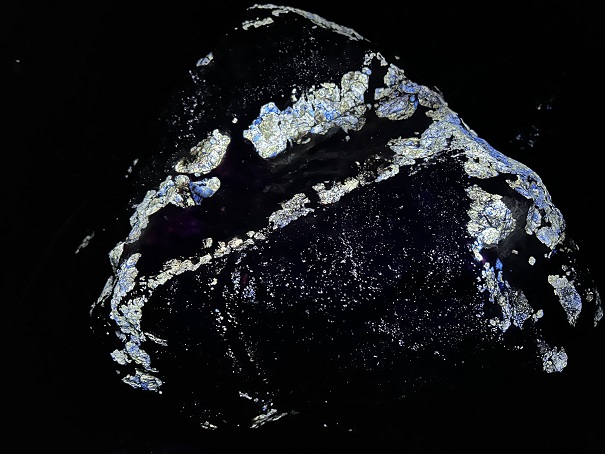
#thinsectionthursday It’s not a thin section image, but showing big chunk of light-yellow scheelite crystals under UV light. They are cemented by magnetite and epidote from the Kara mine of NW Tassie. We are doing a regional research collaboration project on #CriticalMinerals – at Hobart, Tasmania
This is we used a portable UV-light torch confirming scheelite veins within magnetite-epidote skarn at Kara, Tassie. from left: David C, Lejun Zhang, Yamila and me, a terrific image taken by @scimissionowen
Replying to @RNArmstrong1 @WeiHong86
I apologise it's not the most flattering angle, but here's the UV viewing under a jacket in action!
4
#criticalminerals
got a chance to hit the Kara magnetite-scheelite mine. Can you find the scheelite chunks in magnetite-epidote skarn background? They are quite obvious but one may need UV light to confirm
For those interested in volcanic processes and related hydrothermal mineralisation, have a check on Prof Dave Cooke’ LinkedIn live postings — he and A/Prof Rebecca Carey are leading a group of masters students having field-based shortcourse in New Zealand! linkedin.com/posts/david-coo…
1
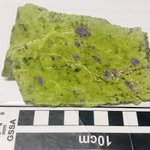
Robed a piece of rock from my supervisor’s office, characterised by stichtite (purple) in serpentine (yellow-green), from the Dundas field of western Tasmania. Stichtite is a rare chromium-magnesium carbonate with a standard formula: Mg6Cr2CO3(OH)16•4H2O. Look at the beauties!
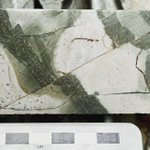
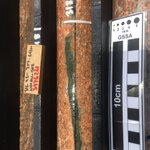
Chlorite vein cutting red, intermediate-grained granite from the newly drilled Delamerian NDI program. #minexcrc – at Adelaide, South Australia
3
Being friendly, encouraging and supportive to young or early-career researchers! – at Adelaide, South Australia
Yesterday, I received this email from a senior academic. It's about my first lead author paper. This kind of 'feedback' is discouraging and doesn't encourage the kind of constructive discussions I'd like to have about my work. It can't be acceptable to send emails like this.
1
Core viewing this afternoon and checking out amazing mineral textures and rocks in the planet. This rock from 1km below surface, has beautiful garnet laminations (red) interbedded with grey quartzites and minor greenish pyroxene layers, called as “Broken Hill Pb-Zn target zone” – at Broken Hill, New South Wales
It has been argued on how it formed: 1) synsedimentary origin, 2) replacement genesis due to metasomatic alteration. I prefer to the second one, as it reminds me of ‘self-organised texture’ defined by some economic geologists for skarn terminology. #uncovercurnamona
#Brokenhill – at Broken Hill, New South Wales
3
This piece of excellence challenges the recent application using Ce anomalies in zircon to estimate redox of magma, in which they found Ce anomalies may fluctuate largely while oxygen fugacity remain unchanged in the setting. What a finding!
Interested in zircon geochemistry and porphyry fertility? Matt Loader's new paper on Ce anomalies in zircon is now out online in GCA. Well done on a great piece of work Matt! sciencedirect.com/science/ar…
1