Pinned Tweet
Right now, a handful of Silicon Valley billionaires control the fate of our futures, making decisions about AI development and deployment without our input or our consent.
That's why we're launching Who Decides: to take back control of how this technology is governed, and to build a unified front on AI.
This is the defining issue of our future, and we need to act now. Join us to make a difference at whodecides.org
AI regulation is not a niche or partisan issue: two-thirds of Americans want more regulation on AI.
When a majority of Democrats, Republicans, and Independents all agree on an issue, the question is: Why isn’t our government listening to them?
Who Decides retweeted
The pace of AI development is unprecedented. But could it move even faster?
There’s good reason to believe it will. As AI is used more often to accelerate its own development, we could see exponential growth.
And since the majority of Americans say AI is already moving too fast, we need to take action now to slow this train before it's too late.
Who Decides retweeted
What’s different about the development of AI from other technological advancements, like the internet or the space race?
I spoke to @EzraKlein earlier this year about what makes this moment unique, and why we need a federal government that truly understands what’s at stake.
A majority of Americans want to be part of the conversation around AI development and regulation.
But only a quarter say their voices are being heard.
We’re working to erase that gap.
Who Decides retweeted
Anthropic is pitching a bill that closely matches its framework from June.
How can you watch Hugging Face, Coxon, & rogue AI swarms, and conclude that the bill you cooked up in June is sufficient?
This comes nowhere close to the speed of developments nor the speed we need to keep people safe.
Anthropic quietly pitches its own AI safety bill to lawmakers politi.co/4zxDFhl
Who Decides retweeted
Before the serious security incidents of this summer, I spoke to @jonfavs about the risks and benefits of AI.
In order to avoid the worst-case scenarios and make this technology beneficial for everyone, we need to give everyday people a say — not just a handful of Silicon Valley CEOs…
Who Decides retweeted
The AI industry wants us to think we have to focus on one risk at a time.
But the American people have multiple concerns that are all related: Jobs, safety for kids, privacy and security, accountability, and more.
We’re working to build coalitions around the country that listen to every concern people are feeling — and we’ll make sure Democrats are united in addressing them all.
Who Decides retweeted
A couple of big factors changed the conversation around AI risk in the past few months.
Security incidents and warnings from former industry employees showed everyone how urgent and serious this issue is.
Want to learn more about how we can give Americans a say in what happens next? Join us at @WhoDecidesAI.
A $3 million fine is nothing to these AI companies - it’s not enough to change their behavior.
We have to build a unified front on AI regulation around the country to truly hold them accountable for their actions.
The American people want a say in the development and regulation of AI.
Our goal at Who Decides is to give them that voice before it’s too late.
At the New York City Council hearing on AI, our co-founder @AlexBores spoke about the importance of taking action in New York City to hold the AI industry accountable.
Promises and voluntary commitments aren’t enough - it’s time to force these companies to take safety seriously.
2% of Americans think AI development is moving too slowly.
Our co-founder Anna Myers shared insights from our polling at the New York City Council hearing on AI to highlight the mismatch between what these companies are doing and what people want.
The fight for AI regulation is not going away, no matter how much money the industry throws at it.
As leaders like former President Obama call on Democrats to take AI seriously, we’re building coalitions to bring people together and establish a unified baseline on AI safety.
cnn.com/2026/09/30/politics/…

ALT Bores, who started a group meant to push the 2028 candidates to take more definitive regulatory positions, told CNN the politicians and advisers keep bringing up the cash. “‘What was it like having all that money spent against you?’ ‘How did you know they were going to come after you?’” Bores told CNN of the ways they’re “subtly and not so subtly asking, ‘Are there specific trip wires I can avoid?’ ‘How can I steer through these waters in a way that says the right thing about AI and not bring on the incredible amount of money from the other side?’”
“Self-regulation is very important.”
“The only control or 'guardrails' that AI needs is a STRONG AND SMART (High IQ!) PRESIDENT.”
“Congress can’t regulate this.”
What’s happening in Washington right now is clear and obvious regulatory capture.
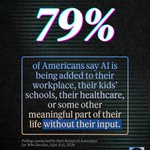
Voters across the political spectrum say that AI is becoming increasingly part of their lives without their input.
Who Decides will continue to poll Americans on their views about AI development and regulation to look at how people feel, and why they feel it.
Check out more findings from our first polling release:
mailchi.mp/82dd887abcad/poll…
Say it with us: regulatory capture.
Big @ashleyrgold scoop: Zuckerberg shaped the Trump AI pledge semafor.com/article/09/30/20…
Who Decides retweeted
Donald Trump says self-regulation is enough, but these companies are not acting in our best interests.
We need strong government regulation to protect people from the looming threats to our lives and livelihoods.
Who Decides retweeted
Self-regulation is not enough.
In order for us to hold these AI companies accountable, they need to be liable for harms.
Employees from the major AI companies continue to raise the alarm about the critical risks their employers are ignoring.
This is why we can’t let a few billionaire CEOs make all the decisions about our futures.
nytimes.com/2026/09/29/techn…