

The B2B ghostwriter behind 39+ founders, with 50M+ client impressions and $120K in pipeline. Sharing playbooks on content, personal branding & audience growth.
X and LinkedIn ghostwriter
Joined August 2026
- Tweets3K
- Following154
- Followers371
- Likes480




Pinned Tweet
At 17, @jayyanginspires sent Noah Kagan a 19-slide audit.
It got him hired as Head of Content.
Now Jay's hiring his first writer.
I'm using his own playbook on him.
Jay, I'll be the reason you can take on twice as many founders without doubling your workload. Here's my case:

William Salim retweeted
It's almost impossible to stay broke if you've truly mastered these 3 skills:
- Finding clients who need your service
- Convincing them you're worth paying
- Delivering results they gladly pay for again
At that point, you're practically a one-person revenue machine.
William Salim retweeted
People can read your X posts and learn a ton from you, but still have no idea why they'd hire you.
Your content is doing a great job of educating them.
But a terrible job of connecting your expertise to something they'd pay for.
And those are two very different jobs.
It's almost impossible to stay broke if you've truly mastered these 3 skills:
- Finding clients who need your service
- Convincing them you're worth paying
- Delivering results they gladly pay for again
At that point, you're practically a one-person revenue machine.
William Salim retweeted
You want an extra $10,000?
Show me your last 30 days:
- Potential buyers you pitched?
- Interested leads you reconnected with?
- Failed sales calls you learned from?
- Posts that gave buyers a reason to hire you?
The fastest way forward begins with looking backward.
William Salim retweeted
For 99% of you, X is just social media.
For me, X is the lifeboat I'm constructing.
So if my main source of income sinks tomorrow, my entire career doesn't go down with it.
Every time I open X, I'm making that lifeboat a little stronger.
- Every post puts my expertise in front of people who might hire me someday.
- Every comment introduces me to founders I'd probably never meet otherwise.
- Every case study gives potential clients proof of what I can actually deliver.
- Every new relationship is another person who might remember me when an opportunity comes up.
Because my income today isn't guaranteed to be there next year.
- Projects end
- Budgets get cut
- Businesses change direction
And if that happens, I'd rather have hundreds of people who already know my expertise than start cold pitching complete strangers from zero.
That's why I'm building my lifeboat while the waters are still calm.
Because the worst time to build a lifeboat is when your ship is already sinking.
You want an extra $10,000?
Show me your last 30 days:
- Potential buyers you pitched?
- Interested leads you reconnected with?
- Failed sales calls you learned from?
- Posts that gave buyers a reason to hire you?
The fastest way forward begins with looking backward.
William Salim retweeted

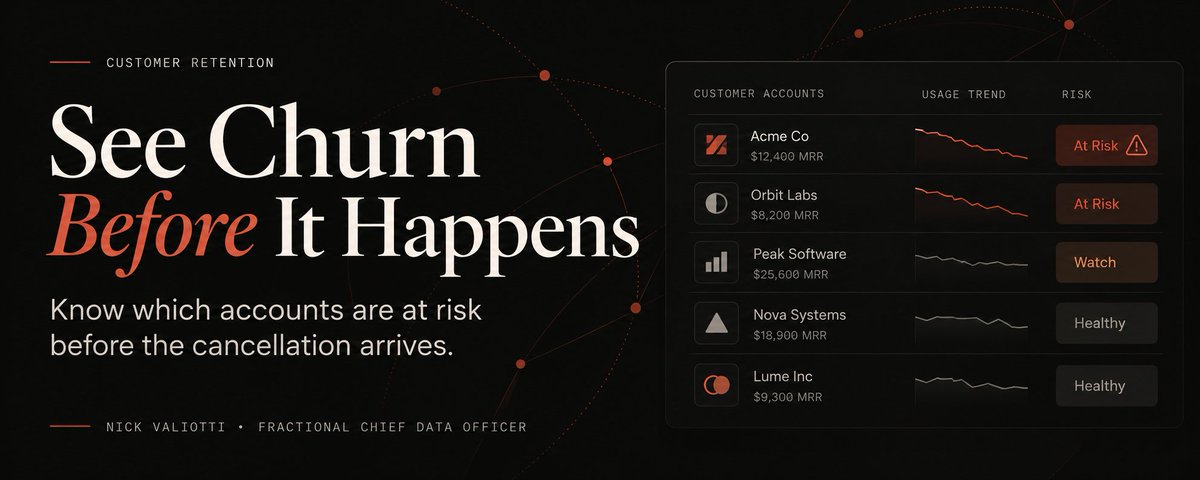
How early can your SaaS spot a churn problem?
I helped 2 SaaS companies set up a system that checks their key metrics every Monday at 9 AM.
Just 2 weeks later, it flagged a 22% increase in a key churn warning indicator.
This gave their teams an early warning, so they could investigate which customers might be at risk and take action before they cancel.
This is how we built it and how you can do the same for your SaaS:
We started with a simple script that automatically checked 5 key business metrics every Monday morning.
Whenever a metric changed by more than 15%, the system sent an alert directly to Slack. So when that 22% increase appeared, the team knew about it immediately.
By 9:15 AM, the data lead was already investigating what caused the change and which customers might be at risk of leaving.
And the entire system took about 20 minutes to set up.
If you're a SaaS founder, here's how to set up an early warning system that detects potential customer churn:
1. Pick 5 metrics linked to customer retention, such as product usage, activation, or cancellations.
2. Compare them weekly to spot unusual changes in customer behavior.
3. Set automatic alerts when a metric moves beyond a threshold you've defined.
4. Assign someone to investigate each alert and identify which customers might need attention.
Start with the metrics your company already tracks.
Even a simple weekly check can help your team catch warning signs before they turn into cancellations.
The earlier you spot customers at risk, the more time your team has to intervene, retain them, and protect your MRR.


William Salim retweeted
You're deciding where to spend your SaaS marketing budget next quarter.
Google Ads brings in 60% of your reported customers.
LinkedIn barely gets any credit.
Would you move more money into Google Ads? Be careful.
This is what I'd check before making that decision as a Chief Data Officer.
Let's say a potential customer:
- Monday: Discovers your SaaS through a LinkedIn post.
- Wednesday: Reads an article on your website.
- Friday: Clicks a Google ad and signs up.
Which channel gets credit for acquiring that customer?
In many marketing dashboards, Google Ads gets 100% of the credit.
That's called last-click attribution. The last marketing channel a customer clicked gets credited for the conversion.
When your SaaS was smaller, you might have relied on one channel to bring in customers.
But now you're investing in:
- Google Ads
- LinkedIn
- Content marketing
- Podcasts
- Referrals
And your customers might interact with several of them before signing up.
Where this can affect your marketing decisions:
Your dashboard shows Google Ads bringing in 60% of new customers. So you move more of your marketing budget away from LinkedIn and into Google Ads.
But LinkedIn might have introduced many of those customers to your SaaS in the first place.
If you reduce investment in the channels that introduce customers to your business, fewer people might search for your company later.
And your Google Ads could become more expensive per customer.
As your SaaS grows, you need a clearer picture of how your marketing channels work together.
Here's what I'd recommend tracking:
1. First touch: Which channel first brought the customer to your website?
2. Last touch: Which channel did they click before signing up?
3. Customer-reported source: What did they say when you asked, "How did you hear about us?"
Compare those 3 answers before deciding which channels deserve more budget.
If they consistently point to the same channel, you have more evidence to support that investment.
If they disagree, investigate how those channels contribute to customer acquisition before moving money around.
If you're a SaaS founder, here's one thing I'd check this week:
Does your signup form ask customers how they first heard about your company?
That one question could give you another piece of information before deciding where your next marketing dollar goes.
William Salim retweeted
Today, someone your age just died of cancer
Another is begging for a life-saving kidney transplant.
Another just buried their mom and would give anything to hear her voice again.
Yet, you're calling yourself a failure because you have 0 clients and $0 income on X.
Look, your worst day on X is still someone else's dream of getting another chance at life.
- You still have a heartbeat
- A future that hasn't been written
- An entire world of people you haven't met
- Opportunities you haven't discovered
YOU are a living, breathing miracle in a universe of billions of galaxies.
Even 1000 years from now, there will never be another you in the entire history of existence.
Please don't get so caught up chasing money that you forget you're already a miracle.
William Salim retweeted
Give a coward $1 million.
He's still a coward with $1 million.
Give him 100K followers on X.
Now he's a coward with an audience.
Build a character worth respecting before you build a personal brand worth following.
William Salim retweeted
If you want to beat 99% of your competitors at getting B2B clients on X, read this:
Your next client is a burglar deciding which house to rob. Yours or your competitor's.
They'll inspect both houses before breaking in. And once they're inside, they'll:
- Open every drawer.
- Search every cabinet.
- Dig through your belongings.
- Hunt for anything valuable.
Your X profile is that house. And your prospects are doing the same thing.
They will:
- Read your bio.
- Dig through your old posts.
- Inspect your replies.
- Check your client results.
- Look for testimonials.
- Compare you against competitors.
They're looking for proof you can solve their problem and deserve their money.
Except on X, burglars can break into your house, search every drawer, and leave without you ever knowing they were there.
In other words: a founder could spend 5 minutes investigating your profile, find nothing convincing, and disappear.
No DM. No sales call. No chance to explain yourself.
Meanwhile, your competitor's house is full of valuables:
- Case studies with real numbers.
- Client wins with specific outcomes.
- Posts showing how they solve problems.
- Testimonials from credible people.
- Answers to common buying objections.
Guess who gets the DM? So here's what I'd do:
1. Fix your front door.
Make your bio and pinned post explain who you help, what you solve, and why you're worth hiring.
2. Fill the drawers.
Publish case studies, client results, and lessons from real projects.
3. Put your valuables on display.
Make your strongest proof easy to find instead of burying it under hundreds of posts.
4. Remove suspicious stuff.
Vague claims, outdated positioning, and big promises without evidence give buyers reasons to leave.
Your prospects are inspecting your house AND your competitor's.
Stop decorating an empty house.
Fill it with proof worth paying for.
Give a coward $1 million.
He's still a coward with $1 million.
Give him 100K followers on X.
Now he's a coward with an audience.
Build a character worth respecting before you build a personal brand worth following.
William Salim retweeted
SaaS founders, what's one piece of business advice you completely disagree with?
Something you hear all the time.
Something that sounds good on X.
But your actual experience tells you otherwise.
I want to hear it.
William Salim retweeted
You're deciding where to invest your SaaS growth budget next quarter.
More marketing? More product features? More partnerships?
Which investment is actually bringing in customers who stay and pay?
I helped a company with 450,000+ daily active users answer a similar question using data. Here's how we approached it:
The company operated a platform with more than 1,500 games.
But despite having hundreds of thousands of daily users, it didn't have an in-house data team to help leadership understand which games and partnerships were performing best.
So decisions about which games to promote, which partners to renew, and where to spend marketing money often came down to gut feeling.
The company had plenty of user data. It needed a way to turn those numbers into investment decisions.
So we built a dashboard that tracked every game using 4 key metrics:
- Daily active users: How many people played each game.
- Session length: How much time users spent playing.
- Reward usage: How often players used the rewards.
- Revenue contribution: How much revenue each game generated.
Now the business development team could compare games using the same numbers.
They could see which games attracted active players, generated revenue, and deserved continued investment. And which partnerships needed a closer look before renewal.
Then we applied the same approach to marketing.
Instead of measuring success only by how many new players each channel acquired, we connected marketing spend to what those players actually did afterward.
That helped the team identify:
- Channels that attracted players who signed up but rarely returned.
- Channels that brought in players who continued using the platform.
With those numbers, leadership could decide where to increase spending and where to pull back.
The results:
- More than $50K in estimated annual savings from reallocating marketing spend.
- Leadership decisions became approximately 3X faster.
- Teams could evaluate game and partnership performance using consistent metrics.
Now, here's how I'd apply this to your SaaS.
Before deciding where to invest next quarter's growth budget:
1. Measure actual usage. Which features, integrations, or partnerships do your paying customers use regularly?
2. Connect usage to revenue. Which ones are associated with customers who stay longer, renew, or spend more?
3. Compare your options. Evaluate each investment using the same metrics instead of relying on requests or opinions.
4. Review where your money goes. Increase investment in areas with evidence of customer and revenue value, and investigate the ones that underperform.
You might discover that the features getting the most attention aren't necessarily the ones contributing the most to your business.
If you're a SaaS founder, make sure your next growth investment is based on what customers actually use, pay for, and keep coming back to.
That's how I'd decide where the next dollar goes.

William Salim retweeted
You're planning to expand your SaaS into 3 new countries.
But you only have enough budget to invest heavily in ONE.
How do you identify which market will bring in the most recurring revenue?
I helped a fast-growing company answer a similar question using customer data. Here's how we approached it:
The company was expanding into several Asian markets at the same time.
Each country had different customers, price sensitivity, and marketing channels.
But the company's data was spread across separate systems.
- Student sign-ups and course progress
- Customer payments
- Marketing performance
That made it difficult for leadership to compare markets and decide where to invest its expansion budget.
A country might bring in plenty of new sign-ups.
But how many of those students actually paid?
And how many continued using the product after signing up?
Those were the numbers leadership needed before deciding which markets deserved more investment.
So we built a system that brought data from 5+ sources into one place.
First, we connected student sign-ups, payments, and marketing data.
Then we made sure the system could handle different currencies and time zones, so leadership could compare performance across countries.
Now the team could track what happened in each market:
- How many people signed up
- How many became paying customers
- How much revenue each customer generated
- How students progressed through their courses
We also identified students whose activity suggested they might drop out.
This allowed the team to reach those students earlier, which helped improve course completion rates.
With these numbers, leadership could compare markets based on actual customer behavior and revenue.
And decide where its limited expansion budget had the best chance of generating returns.
Now, if you're a SaaS founder planning to expand internationally, here's what I'd recommend.
Compare these 4 numbers across every country you're considering:
1. Customer acquisition cost. How much does it cost to acquire one paying customer?
2. Trial-to-paid conversion. What percentage of free trials become paying customers?
3. Customer retention. How many customers are still paying after 3 months?
4. Revenue per customer. How much recurring revenue does each customer generate after currency conversion?
Use the same definitions and time periods for every country.
This gives you a clearer picture of which markets are bringing in customers who pay and stay.
Before committing your expansion budget, find out which country has the strongest evidence of profitable customer growth.
That's where I'd look first.

William Salim retweeted
On a road trip, you don't want till you reach your destination to enjoy the music.
So why wait until you're making $100K, have 10K followers, and a calendar full of clients before you let yourself enjoy life ?
There's a reason why we call today the "present."