
Single Dad, D&D, Dragonlance & Art Historian, Caldwell Approved. Chief Dragonlanceologist. Buy me a coffee 👉https://xitter.cf/t.co/WBou2nOFbv
Solamnia, Ansalon, Krynn
Joined January 2009
- Tweets116K
- Following24.9K
- Followers30.2K
- Likes295K






Pinned Tweet
TSR got REALLY weird in 1981. ❤️
That year, the company behind Dungeons & Dragons released an official Escape from New York board game based on John Carpenter’s film.
And look who was involved:
Design: Zeb Cook and Harold Johnson
Art credits include: Jeff Dee, Dave LaForce, Jim Roslof, Bill Willingham, and Erol Otus
Even better, the game featured what appear to be:
🛩️ Bill Willingham art on the instruction booklet title page
🧟 Erol Otus art of the Crazies emerging from the sewers
So yes, TSR really made a board game where players race through prison Manhattan to rescue the President and recover the tape before time runs out.
And the box proudly says:
“For 2 to 4 Adults Ages 10 and Up”
An R-rated John Carpenter movie.
Turned into a TSR board game for ages 10 and up. 😂
This is the kind of gloriously strange early 80s TSR history I live for.
Had you ever seen this one before?


YoDanno #DragonlanceDragonlance retweeted
Imagine buying an AD&D book called Charlemagne’s Paladins…
…and discovering you’re NOT ALLOWED TO PLAY A PALADIN. 😂
Seriously. TSR did exactly that in 1992.
Ken Rolston’s HR2 offered three ways to play:
⚔️ HISTORICAL: No paladins. No wizards. Just the brutal 8th century.
🛡️ LEGENDARY: Roland, enchanted swords, sorcerers, and hippogriffs!
🐉 FANTASY: Bring on the AD&D!
And Roger Raupp’s interior artwork? Fantastic.
God, I miss when TSR made books like this.
Who else remembers those beautiful green Historical Reference books?


This Day in Fantasy Gaming History, October 25, 1984
No DM. No party. Just you, a pencil, and some increasingly questionable decisions.
Ian Livingstone’s Caverns of the Snow Witch arrived in its expanded book form, sending adventurers into the Icefinger Mountains to stop a new ice age.
And LOOK at that Les Edwards cover. That’s trouble worth spending your pocket money on.
Of course, we ALL accepted our first death gracefully instead of keeping a finger on the previous page.
Right? 😂
Who else remembers these, and how many fingers did you need to “save” your game?


Imagine buying an AD&D book called Charlemagne’s Paladins…
…and discovering you’re NOT ALLOWED TO PLAY A PALADIN. 😂
Seriously. TSR did exactly that in 1992.
Ken Rolston’s HR2 offered three ways to play:
⚔️ HISTORICAL: No paladins. No wizards. Just the brutal 8th century.
🛡️ LEGENDARY: Roland, enchanted swords, sorcerers, and hippogriffs!
🐉 FANTASY: Bring on the AD&D!
And Roger Raupp’s interior artwork? Fantastic.
God, I miss when TSR made books like this.
Who else remembers those beautiful green Historical Reference books?
This was one of Parkinson's last projects before his death. He created the character designs and Giancola finished this piece for the project.
Giancola emulated Parkinson's style and included a character meant to be Parkinson in the center left with the long hair and cloak. It's a lovely tribute to one of the best fantasy artists of the century.
🖼️ Cover art for "Vanguard: Saga of Heroes" by Keith Parkinson and Donato Giancola.
Thanks to @cimerians

This Day in D&D History, October 24 🎲
Remember the fighter whose sword was smarter than he was? 😂
We lost Will McLean on this day in 2015, but he’s still making us laugh whenever we open those old books.
And that sword joke? Will said his own campaign actually had a fighter whose intelligence was lower than his weapon’s.
Of COURSE it did. Anyone who’s played D&D knows the table writes half the jokes for you.
Thanks for the laughs, Will. You were part of what made those pages feel like home. ❤️
Which of his cartoons stuck with YOU?


I was asked to do a write up about @GameholeCon for The Keep!
You can check it out here!
thekeep.events/articles/game…

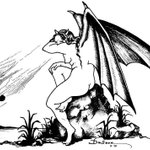
One of my favorite illustrations from the original AD&D Dungeon Masters Guide (1979) is Darlene’s wonderful succubus. ❤️
But did you know?
Take a look at the second image. That’s Gustave Doré’s depiction of Myrrha from Dante’s Inferno, published in 1861.
Look at the pose. The bent knee. The arm resting over her head.
118 years later, add a pair of bat wings, a black sun, and a little Darlene magic, and you’ve got a classic piece of AD&D artwork! 😈
I absolutely LOVE discovering connections like this in the art we grew up with.
Now I’m wondering… how many OTHER classic D&D illustrations have secrets like this hiding in plain sight? 👀


YoDanno #DragonlanceDragonlance retweeted
The roots of D&D art go back a LOT further than 1974. 👀
Recognize that pose?
On the left, Henry Justice Ford’s illustration from The Green Fairy Book (1892).
On the right, David Trampier’s Cloud Giant from the AD&D Monster Manual (1977).
85 years apart. The same casual lean, the same enormous club, even that wonderfully smug expression.
I LOVE discovering the artistic DNA of old school D&D.
Sometimes the monsters we grew up with had been lurking in fairy tales for nearly a century…

This Day in D&D History, October 23, 1990 📚
Before the reunion at the Inn of the Last Home, there were five years of adventures…
Today is the recorded publication date for Tanis, the Shadow Years, by Barbara and Scott Siegel, the final volume of Dragonlance’s Preludes II trilogy.
Clyde Caldwell on the cover. Valerie Valusek inside. And $4.95 bought you another trip to Krynn. ❤️
Anyone still have this one on their shelf?


Old-school D&D was gloriously weird.
In Dragon #138 (October 1988), Tom Moldvay introduced the callicantzari… shaggy, goat eared, man eating horrors from Greek folklore.
But Moldvay also tells how a woman outwitted them by making them count the holes in a SIEVE.
They were still counting when dawn arrived and they fled. 😂
Forget your +3 sword. Bring kitchen utensils.
🖼️ Jennell Jaquays, Dragon #138 (1988).

The roots of D&D art go back a LOT further than 1974. 👀
Recognize that pose?
On the left, Henry Justice Ford’s illustration from The Green Fairy Book (1892).
On the right, David Trampier’s Cloud Giant from the AD&D Monster Manual (1977).
85 years apart. The same casual lean, the same enormous club, even that wonderfully smug expression.
I LOVE discovering the artistic DNA of old school D&D.
Sometimes the monsters we grew up with had been lurking in fairy tales for nearly a century…
YoDanno #DragonlanceDragonlance retweeted
This Day in D&D History, October 21, 1985
Gary Gygax’s Saga of Old City was published, introducing readers to Gord the Rogue and the dark back alleys of Greyhawk.
Clyde Caldwell painted the unforgettable cover, and says he worked closely with Gary to develop it, before creating the book’s interior illustrations as well.
Gary supplied the rogue. Clyde supplied the swagger. ⚔️
Who followed Gord beyond the gaming table?
🖼️ Saga of Old City, Clyde Caldwell, TSR, 1985.


This looks like the perfect companion to any Dragonlance fan’s bookshelf. No idea when they’re being published, but no doubt they will command a high price.
@WeisMargaret
conversationtreepress.com/pa…

In 1988, Jeff Easley sent D&D fans a Halloween greeting.
Naturally, it involved an undead warrior kicking down your door with a battleaxe. 💀
“Halloween Greetings” graced Dragon Magazine #138 (October 1988). Believe it or not, this was Easley’s FIRST Dragon cover!
And it was so good, TSR reused it for Eye of the Beholder in 1991.
Now THAT’S how you celebrate Halloween…

This Day in D&D History, October 22, 1958 🎨
Keith Parkinson was born. He gave us worlds we’re still getting lost in.
Just LOOK at Lord Soth’s Charge.
Keith said he wanted those horsemen to come right out of the frame and demand attention.
Yeah. I’d say he nailed it. 🔥
Happy heavenly birthday, Keith. Thanks for making our imaginations such incredible places to visit. ❤️
What’s YOUR favorite Keith Parkinson painting?

YoDanno #DragonlanceDragonlance retweeted
Clyde Caldwell told me a wonderful detail about this dress… it actually existed.
He designed it for “Princess in Peril,” and model Jeanne Stanley made it herself. Then Jeanne posed in it again for this illustration inside Gary Gygax’s Saga of Old City.
Same model. Same handmade dress. Two pieces of classic Caldwell.
Now THAT’S a little piece of D&D and Greyhawk history. ❤️


This Day in D&D History, October 21, 1985
Gary Gygax’s Saga of Old City was published, introducing readers to Gord the Rogue and the dark back alleys of Greyhawk.
Clyde Caldwell painted the unforgettable cover, and says he worked closely with Gary to develop it, before creating the book’s interior illustrations as well.
Gary supplied the rogue. Clyde supplied the swagger. ⚔️
Who followed Gord beyond the gaming table?
🖼️ Saga of Old City, Clyde Caldwell, TSR, 1985.
