
Research Scientist@Nvidia | PhD from NUS
Singapore
Joined August 2022
- Tweets74
- Following327
- Followers320
- Likes471




Pinned Tweet
🚀 We are excited to announce the release of AnyFlow, the first any-step video diffusion on-policy distillation (OPD) framework. By leveraging Flow Map distillation, AnyFlow significantly enhances model inference efficiency by reducing sample steps. (Code, models, and demos are now open-source!)
Key Highlights:
⚡ Any-Step Generation: Unlike traditional distilled models tied to fixed step budgets, AnyFlow enables a single model to adapt to arbitrary inference budgets. It achieves high-quality few-step generation while providing stable improvements as more sampling steps are added.
🔀 Multiple Architectures: AnyFlow supports any-step distillation for both causal and bidirectional video diffusion models.
🎬 Multiple Tasks: AnyFlow supports Text-to-Video, Image-to-Video, and Video-to-Video generation within one causal video diffusion model.
📈 Scalable Performance: AnyFlow is validated from 1.3B up to 14B parameters.
📄 Paper: huggingface.co/papers/2605.1…
💻 Code: github.com/NVlabs/AnyFlow
🎨 Pre-trained Models: huggingface.co/collections/n…
🎬 Demo: nvlabs.github.io/AnyFlow/dem…
I will present our recent work on long-context video world modeling this Friday. Welcome to join and discuss.

✅ @YuchaoGu will present FAR (i.e., Frame AutoRegressive Models) - a new baseline for autoregressive video generation that achieves state-of-the-art performance on both short- and long-context video modeling.
teapawt.org/YuchaoGu/status/191420…
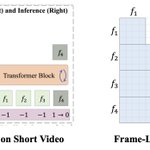
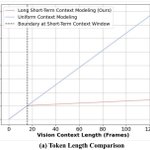
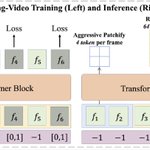
Our previous work, FAR, proposes a next-frame prediction paradigm based on long short-term context modeling with asymmetric patchification.
Paper: arxiv.org/abs/2503.19325
Code: github.com/showlab/FAR
Glad to see this idea adopted and extended in FramePack, demonstrating superior performance.
Here, we share some insights from FAR: (1/7)


Previous--Long Video Generation: The goal is to generate longer videos, but the model is not necessarily required to consistently utilize previously generated content.
Our Focus--Long-Context Video Generation: This not only requires generating longer videos but also demands continuous use of historical context information to ensure long-term temporal consistency.
The key to addressing long-context video generation lies in training efficiently on long videos. However, traditional autoregressive video modeling faces significant computational challenges — as the video length increases, the number of tokens grows rapidly.
(2/7)

1
148
EvolveDirector is a new paradigm that approaches the commercial model through post-training of open-source models, aiming to motivate advancements in post-training for visual generation.

EvolveDirector has been accepted to #NeurIPS2024. In this work, we investigate whether and how we can recover the powerful generation abilities of the advanced T2I models. Code and model weights have been released.
Code Repo: github.com/showlab/EvolveDir….
huggingface.co/papers/2410.0…

5
361
Thank @_akhaliq previous featured our work. Videoswap is now accepted by CVPR 2024. The code is now available at github.com/showlab/VideoSwap. Welcome to try!

VideoSwap: Customized Video Subject Swapping with Interactive Semantic Point Correspondence
paper page: huggingface.co/papers/2312.0…
Current diffusion-based video editing primarily focuses on structure-preserved editing by utilizing various dense correspondences to ensure temporal consistency and motion alignment. However, these approaches are often ineffective when the target edit involves a shape change. To embark on video editing with shape change, we explore customized video subject swapping in this work, where we aim to replace the main subject in a source video with a target subject having a distinct identity and potentially different shape. In contrast to previous methods that rely on dense correspondences, we introduce the VideoSwap framework that exploits semantic point correspondences, inspired by our observation that only a small number of semantic points are necessary to align the subject's motion trajectory and modify its shape. We also introduce various user-point interactions (\eg, removing points and dragging points) to address various semantic point correspondence. Extensive experiments demonstrate state-of-the-art video subject swapping results across a variety of real-world videos.
amazing work, can't wait to read technical report.

Introducing Sora, our text-to-video model.
Sora can create videos of up to 60 seconds featuring highly detailed scenes, complex camera motion, and multiple characters with vibrant emotions.
openai.com/sora
Prompt: “Beautiful, snowy Tokyo city is bustling. The camera moves through the bustling city street, following several people enjoying the beautiful snowy weather and shopping at nearby stalls. Gorgeous sakura petals are flying through the wind along with snowflakes.”
2
182
Welcome to try gradio demo of MotionDirector.
MotionDirector🏃 released the online demo @huggingface: huggingface.co/spaces/ruizha….
More MotionDirectors are on the way. Stay tuned! 🔥
For more details, please refer to our GitHub repo: github.com/showlab/MotionDir….
8
474
Thanks @_akhaliq for previous featuring our paper. We connect Mix-of-Show with Stable Diffusion Video and see interesting results in multi-character videos.
Feel free to try our codebase at: github.com/TencentARC/Mix-of… and visit our poster at the upcoming NeurIPS 2023.
Mix-of-Show: Decentralized Low-Rank Adaptation for Multi-Concept Customization of Diffusion Models
propose a new framework called Mix-of-Show that addresses the challenges of decentralized multi-concept customization, including concept conflicts resulting from existing single-client LoRA tuning and identity loss during model fusion. Mix-of-Show adopts an embedding-decomposed LoRA (ED-LoRA) for single-client tuning and gradient fusion for the center node to preserve the in-domain essence of single concepts and support theoretically limitless concept fusion. Additionally, we introduce regionally controllable sampling, which extends spatially controllable sampling (e.g., ControlNet and T2I-Adaptor) to address attribute binding and missing object problems in multi-concept sampling. Extensive experiments demonstrate that Mix-of-Show is capable of composing multiple customized concepts with high fidelity, including characters, objects, and scenes
paper page: huggingface.co/papers/2305.1…
Thanks @_akhaliq for sharing our work. VideoSwap can swap users' customized concepts into videos while preserving the background. The target swap will align the semantic point trajectory (extracted from the source video or edited by users through dragging).
VideoSwap: Customized Video Subject Swapping with Interactive Semantic Point Correspondence
paper page: huggingface.co/papers/2312.0…
Current diffusion-based video editing primarily focuses on structure-preserved editing by utilizing various dense correspondences to ensure temporal consistency and motion alignment. However, these approaches are often ineffective when the target edit involves a shape change. To embark on video editing with shape change, we explore customized video subject swapping in this work, where we aim to replace the main subject in a source video with a target subject having a distinct identity and potentially different shape. In contrast to previous methods that rely on dense correspondences, we introduce the VideoSwap framework that exploits semantic point correspondences, inspired by our observation that only a small number of semantic points are necessary to align the subject's motion trajectory and modify its shape. We also introduce various user-point interactions (\eg, removing points and dragging points) to address various semantic point correspondence. Extensive experiments demonstrate state-of-the-art video subject swapping results across a variety of real-world videos.
MotionDirector can learn transfer desire motion across a variety of applications. Welcome try our code.
Code and model weights of MotionDirector have been released 🔥: github.com/showlab/MotionDir….
Welcome to try it out and share your own customized MotionDirector! Unleash your imagination and creativity now!💡
7
557
Impressive work! Happy to see our Mix-of-Show (github.com/TencentARC/Mix-of…) power the storytelling. Feel free to drop by our poster at the upcoming NeurIPS to discuss more opportunities regarding multi-concept customization.

AutoStory: Generating Diverse Storytelling Images with Minimal Human Effort
paper page: huggingface.co/papers/2311.1…
Story visualization aims to generate a series of images that match the story described in texts, and it requires the generated images to satisfy high quality, alignment with the text description, and consistency in character identities. Given the complexity of story visualization, existing methods drastically simplify the problem by considering only a few specific characters and scenarios, or requiring the users to provide per-image control conditions such as sketches. However, these simplifications render these methods incompetent for real applications. To this end, we propose an automated story visualization system that can effectively generate diverse, high-quality, and consistent sets of story images, with minimal human interactions. Specifically, we utilize the comprehension and planning capabilities of large language models for layout planning, and then leverage large-scale text-to-image models to generate sophisticated story images based on the layout. We empirically find that sparse control conditions, such as bounding boxes, are suitable for layout planning, while dense control conditions, e.g., sketches and keypoints, are suitable for generating high-quality image content. To obtain the best of both worlds, we devise a dense condition generation module to transform simple bounding box layouts into sketch or keypoint control conditions for final image generation, which not only improves the image quality but also allows easy and intuitive user interactions. In addition, we propose a simple yet effective method to generate multi-view consistent character images, eliminating the reliance on human labor to collect or draw character images.

Happy to annonce Mix-of-Show is accepted by NIPS 2023. See you in New Orleans.
We just release the codebase for community (github.com/TencentARC/Mix-of…). Welcome to try.
Following are some results (left is reference concept, right is our generation results):


Mix-of-Show: Decentralized Low-Rank Adaptation for Multi-Concept Customization of Diffusion Models
propose a new framework called Mix-of-Show that addresses the challenges of decentralized multi-concept customization, including concept conflicts resulting from existing single-client LoRA tuning and identity loss during model fusion. Mix-of-Show adopts an embedding-decomposed LoRA (ED-LoRA) for single-client tuning and gradient fusion for the center node to preserve the in-domain essence of single concepts and support theoretically limitless concept fusion. Additionally, we introduce regionally controllable sampling, which extends spatially controllable sampling (e.g., ControlNet and T2I-Adaptor) to address attribute binding and missing object problems in multi-concept sampling. Extensive experiments demonstrate that Mix-of-Show is capable of composing multiple customized concepts with high fidelity, including characters, objects, and scenes
paper page: huggingface.co/papers/2305.1…
Thanks for sharing. Mix-of-Show can merge multiple individually tuned concept ED-LoRAs into the pretrained model without conflict, and supporting joint composition of those concepts. More details at showlab.github.io/Mix-of-Sho… .
Mix-of-Show: Decentralized Low-Rank Adaptation for Multi-Concept Customization of Diffusion Models
propose a new framework called Mix-of-Show that addresses the challenges of decentralized multi-concept customization, including concept conflicts resulting from existing single-client LoRA tuning and identity loss during model fusion. Mix-of-Show adopts an embedding-decomposed LoRA (ED-LoRA) for single-client tuning and gradient fusion for the center node to preserve the in-domain essence of single concepts and support theoretically limitless concept fusion. Additionally, we introduce regionally controllable sampling, which extends spatially controllable sampling (e.g., ControlNet and T2I-Adaptor) to address attribute binding and missing object problems in multi-concept sampling. Extensive experiments demonstrate that Mix-of-Show is capable of composing multiple customized concepts with high fidelity, including characters, objects, and scenes
paper page: huggingface.co/papers/2305.1…