
Building @rowa_finance | Ex @MetaWealth Co-Founder
Toronto, Ontario
Joined January 2012
- Tweets189
- Following281
- Followers221
- Likes274







Yesterday, one bug at Chase locked people out at Bank of America, Wells Fargo, US Bank and Zelle.
Friday, the FAA grounded every flight in America because an old network got overloaded.
Same week. Same rot.
Outages are only the part you hear about. These systems are decades old and hanging by a thread… literally.
Three years ago I made the decision to be unbanked. Here’s why.
- Banks decide when your money moves. Not on weekends, not on holidays, and a transfer still takes days in 2026.
- Banks decide what your money does. Your deposit gets lent out, and you’re told not to worry about it.
- Banks decide whether you can touch it at all.
- Accounts get frozen without explanation, and you find out when your card declines.
- And when their systems break, you get “we’re aware of the issue” and a promise to refund the fees.
If you can’t move your money during an outage, it was never your money. It was a number on someone else’s screen.
I stopped asking permission to use my own money. That’s why I’m building @rowa_finance.
Money sits onchain where you can see it, any second of any day. The rules are code, not bank policy, so they run the same at 3am on a Sunday as at 2pm on a Monday. Nothing gets in that we can’t verify. Nobody has to press a button for it to work.
Banks ask for your trust. We built ROWA so you never have to give it.

If we want institutional-sized deposits, we need to accept institutional-sized responsibility.
Every hack costs this industry credibility with the people we’re asking to trust us.
Here’s a question every founder moving customer funds should put in front of their engineering team:
“WHEN we get compromized, what prevents that compromize from cascading through our systems and reaching customer money?”
Build assuming a breach will happen. Then design the system to contain it.
Security needs to be embedded in your CODE and your CULTURE.
Build a company around zero trust. Every person, service, and component should have only the access it needs. No one should have unchecked authority over customer funds.
Put multiple lines of defense across your operations so that when one fails, the others still hold.
Embed guardrails in the product itself. Controls over what can move, where it can go, how much, and under whose authority.
And never, ever take shortcuts around anything that touches other people’s money.
This is where we need to learn from TradFi: separation of duties, transaction limits, independent approvals, reconciliation, and incident response. These disciplines belong in our systems from day one.
I believe blockchain offers a superior foundation for financial products. But institutions need confidence that their capital will be protected before they can benefit from that innovation.
The product gets you the meeting. How you protect their money determines whether they can invest.
If you build in this industry, bring that question to your next engineering meeting.
This quoted post is unavailable.
37
Hot take on the fee debate: the problem isn’t which layer takes the fee. It’s that most curators only have one venue to live in.
On @rowa_finance , curators own the mandate and the economics at the portfolio level and deploy across multiple markets. We just enforce the rules.
The same two checks apply: confirm the fee model before the “not trying to take a cut” line goes out, and check that multi-venue deployment is live in the beta.

What he forgot to mention is that Morpho can charge fees at the market level, allowing it to capture the economic value created by curators without bearing the cost of risk management.
This means markets are neither neutral nor ownerless. Curators invest in building liquidity and managing risk, but Morpho retains the ability to extract a share of the revenue, compressing curator margins and accelerating competition toward zero profitability.
This creates a fundamental misalignment: either Morpho monetizes and competes for the economics generated by curators, or it doesn't and must sustain its business through other revenue sources once incentives run out.
Curators should own their market economics and capture fees from both lending and borrowing. Otherwise, they're building businesses on infrastructure that can tax away their margins. Full stop.
This is why Paul is spooked about Aave V4.
This week we enabled the @CurveFinance pools on @rowa_finance
This is a massive milestone and here is why:
- ROWA allows its users to create automated strategies fully on-chain.
- Each strategy has its own mandate and is enforced at the smart contract level.
- When a strategy drifts outside its bands, a rebalance executes. No proposal, no one waking up to sign.
- Enforcement only works if the trade can actually happen at a fair price.
- Rebalancing into thin liquidity means the rule holds and the strategy pays for it in slippage, every time.
@CurveFinance pools are built for like-kind assets. We need deep liquidity for the assets our curators hold, and execution logic that won’t change underneath us.
I want to walk through what actually happens when a vault needs to reduce risk. Not the diagram version. The real one.
A position moves. Monitoring catches it, if someone wrote a rule for that exact condition. An alert fires.
A person reads it. Is it real or noise? They check two dashboards and a block explorer. They decide to act.
They draft the transaction. The multisig needs three of five. Signatures trickle in across time zones. If there’s a timelock, it starts now.
None of this is anyone doing a bad job. Multisigs and timelocks exist to protect depositors from the operator. They work. They also make every response slow by design.
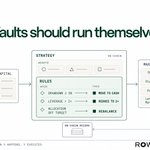
That is the problem we’re building @rowa_finance to solve. The curator writes the mandate once. The contract enforces it continuously. Breaching deposits revert, drift rebalances, breaching redemptions queue. No one has to be awake.
Risk limits shouldn’t have office hours.
If a position becomes too concentrated or borrowing gets too high at 3am, the response shouldn’t wait until morning.
With @rowa_finance you set the rules. The vault acts when they’re triggered.
The next generation of on-chain curators won't manage individual vaults.
They'll manage portfolios.
They'll express investment views across lending markets, tokenized credit, stablecoins, RWAs, and other yield opportunities.
They'll define allocation logic, risk constraints, rebalancing rules, and execution conditions and let infrastructure handle the rest.
That is what @rowa_finance unlocks.
A curator can turn investment expertise into programmable strategies and manage them at scale from one command center.
Less infrastructure.
More strategy.
More capital.
Really excited to partner up with @Dialectic_Group to bring state of art on-chain strategies to institutions. Access is limited right now. Let me know if you'd like to learn more!

ROWA is partnering with @Dialectic_Group.
Dialectic combines machine intelligence with crypto-native primitives to build superior financial compounding machines and have run active onchain strategies since 2020, across USD, ETH and BTC.
Strategies of that complexity are where enforcement matters most.
On ROWA, Dialectic's strategies deploy as governed vaults. The mandate is bound to the portfolio at deployment. Concentration, liquidity and drawdown limits are enforced at the contract level, continuously, rather than reported after the fact.
Institutional allocators get access to sophisticated strategy without giving up verifiability.

5
56
The next great fund manager might be in your group chat right now.
They know one market better than anyone. They have a strategy and they take risk seriously. What they don't have is a back office.
Because running a strategy is mostly operations. Moving capital, checking positions, rebalancing, keeping records. That overhead is a big reason managing money has stayed a big-firm game.
A lot of it can now live in the vault. The manager sets direction and limits, the vault executes the rules, and investors can check what happened on-chain without asking.
Cheaper to run means smaller teams get a real shot. That's the part I find most interesting, and it's a big reason we're building @rowa_finance.
Most people don't know this, but on-chain vaults are still being operated by hand!
Vaults are a great primitive. But in most of them, deposits are deployed manually. A person moves funds from the vault to an MPC wallet, then into a market. Rebalancing follows the same path. It runs on the curator's business hours, their judgment, and when they get around to signing the transaction.
That creates three problems.
More risk. Manual processes mean curators cannot react instantly to market events. By the time a transaction is signed, the moment has often passed.
Human dependency. Every allocation, rebalance and de-risking decision relies on individuals acting correctly and on time. Good operators still sleep, travel and make judgment calls under pressure. Every manual step is also another point where keys and processes can be compromised.
No transparency. Depositors cannot see how decisions are made or what triggers a rebalance. It all happens off-chain. What prices were used? What fees were taken? How much slippage was incurred?
That runs against everything on-chain finance is supposed to stand for: efficiency, transparency and decentralization.
So we built @rowa_finance to change it.
On ROWA, the logic governing a vault lives alongside the vault's smart contract. It works as a rule-based system: when X happens, Y executes.
That covers simple actions, like routing a deposit to its configured markets the moment it arrives. More complex ones, like adjusting leverage to bring a position's health factor back to 2.0 when it drops to 1.2. And emergency rules, like converting an asset to cash if it falls 5%.
The result:
Automation. Strategies execute without manual steps, reducing human error and reacting to events the second they happen.
Transparency. Everything lives on-chain. You can verify every position, every mandate rule, and when and why each one was triggered.
Trustless infrastructure. Assets can only move within the mandate the vault was deployed with. Not because an operator promises to follow the rules, but because the contract will not allow anything else.
Our smart contracts have been audited by @hexens , and is fully integrated with @Morpho @aave @Uniswap @CurveFinance @tori_finance @Dialectic_Group and many other DEXs, Pools, lending markets, and staking partners
ROWA is live. Access is limited. DM me to discuss

Institutions + retail on one ledger. APS ($13 B AUM) just bought $3.4 M of Rome real-estate bonds on @MetaWealth in minutes on @solana. Tokenization is quietly becoming mainstream finance.


With $50M in assets under management and 164 properties funded by our community, @MetaWealth is building a future of reliable passive income—one asset at a time. We’ve just launched our 11th asset package, and we're just beginning!!!

Keen to help Kamal with his development and help him ship more on @solana @arthurisfrench let's get him his new laptop and an chat about an internship @MetaWealth
Past few years many crypto founders moved away from the stats to build their startups due to regulations! USA is by far the most open to new tech adoption! Trump’s new policies is going to be key to bringing back crypto startups to the USA.

1
73
We have launched a new @telegram app yesterday! Great real estate token rewards await those that use the @solana blockchain
The New & Improved Metawealth Mini App is LIVE!
Stop wasting time on apps that give nothing in return!
✅ Teach real finance & real estate skills
✅ Reward you with up to $300 in fractional real estate
✅ Help you build wealth
Start now 👉 T.me/metawealthbot

This is how you fuck your interview with @MetaWealth! We're looking to change the future! We're looking for passionate people! We have a high bar of excellence! Everyone we hire needs to be on our level or better!

2
6
312
