

Economics Researcher at @avalanchefdn | Ph.D. | Talks about Web3, Econ, and AI | No financial advice | Views are my own
Sea of tranquility
Joined January 2023
- Tweets73
- Following137
- Followers192
- Likes81


Juan 🔺 retweeted

Given all the recent system outages and hacks, it's high time for the President to announce a Cybersecurity Initiative to harden our digital infrastructure.
Using formal verification, safe languages, and better runtimes, we can build secure systems. We have the technology.
Imagine a new Manhattan Project that will ensure that our data stays private, our systems just work, and we need pay no ransom (of any kind, financial or political) to any threat actor. It'll be well worth the spend.
Juan 🔺 retweeted

Welcome to the team, Juan!
The questions we’re working on, from how value is measured across Avalanche to how fees and staking fund network security, need careful, evidence-based answers. That’s exactly the rigour Juan brings.
Looking forward to building out our economic research agenda together 🔺

The Avalanche Foundation is pleased to welcome @_DoctorC_ as Senior Economics Researcher.
Juan holds a PhD in Applied Mathematics and several Master’s degrees, and has conducted crypto research since 2021, with published work spanning staking, pricing, mechanism design for L1 networks, agent-based modeling and verifiable computation.
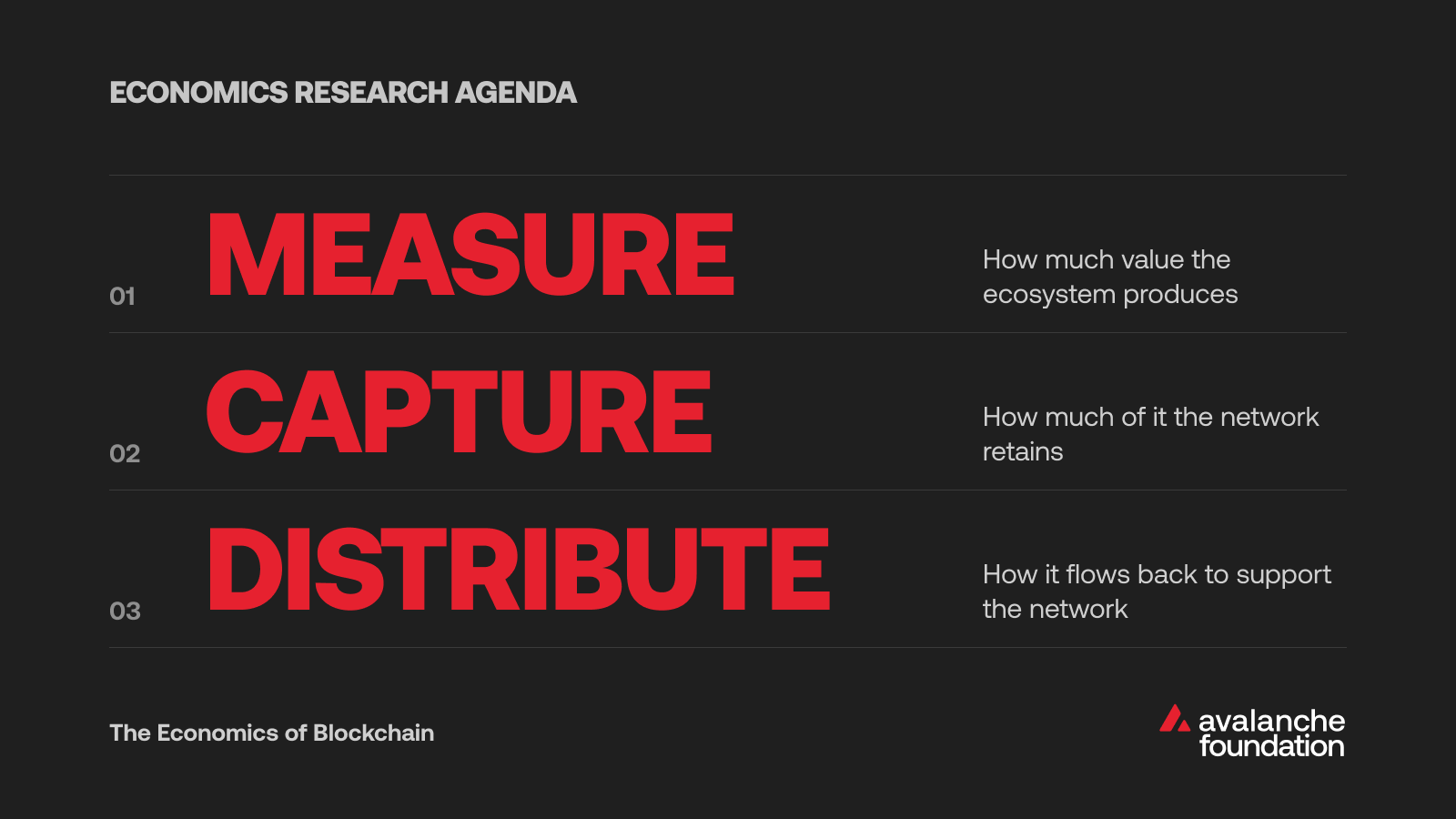
Working alongside @eric_lu_sc and the research team, he will advance the Foundation’s economic research agenda: how value created across Avalanche is measured, captured and distributed. His work is already underway, beginning with an analysis of the economic effects of the Helicon network upgrade.
We look forward to the rigor and expertise he brings to the Foundation’s research 🔺

Excited to share that I’ve joined @AvalancheFDN as an Senior Economics Researcher, working alongside @eric_lu_sc on the Foundation’s economic research agenda.
I’ve researched crypto since 2021, across staking, pricing, mechanism design for L1 networks, and agent-based modeling.
Avalanche is one of the most interesting environments in crypto to study, from the C-Chain to its growing network of L1s, each operating as its own economy with its own fee, staking, and validator dynamics. These questions deserve rigorous, evidence-based answers.
My focus is accelerating the research agenda: measuring the value created across Avalanche, designing ways to capture it sustainably, and understanding how it flows back to validators, the protocol, and the wider ecosystem.
The goal is research that informs real network design, with peer-reviewed work that helps put Avalanche at the forefront of cryptoeconomics.
The work is already underway. More to share soon 🔺

Juan 🔺 retweeted

The new home of our Economics Research Agenda.
As the work develops, it will be shared here 🔺
The Avalanche Foundation’s Economics Research Agenda is now available in one place 🔺
The agenda looks at how value is measured, captured and distributed across the Avalanche network. It covers tokenomics, validator economics, network security and protocol design.
Six independent research teams, selected through the Foundation’s first Call for Research Proposals, are now supporting the development of this work.
The Foundation publishes its findings openly through the Economics of Blockchain series, with ongoing commentary from its research team as the work progresses.
Explore here: avalanche.com/about/economic…

Juan 🔺 retweeted

The Avalanche Foundation’s Economics Research Agenda is now available in one place 🔺
The agenda looks at how value is measured, captured and distributed across the Avalanche network. It covers tokenomics, validator economics, network security and protocol design.
Six independent research teams, selected through the Foundation’s first Call for Research Proposals, are now supporting the development of this work.
The Foundation publishes its findings openly through the Economics of Blockchain series, with ongoing commentary from its research team as the work progresses.
Explore here: avalanche.com/about/economic…
Juan 🔺 retweeted
Today we announced the six research teams selected through our first Call for Research Proposals.
For some time now, we’ve been working through some of the central questions in blockchain economics: How much value does an ecosystem create? How much of it does the network capture, and what’s the right price for blockspace? And as networks mature, how should they pay for their security over the long term?
We’ve been exploring these questions in public through our economic research agenda. Now this program brings in independent researchers, affiliated with Stanford, Oxford, Imperial College London and others, to help accelerate that work and add independent scrutiny.
Getting these answers right matters.
They shape how a network sustains itself, how it rewards those who secure it, and whether the value it creates supports its long-term health. They’re questions many proof-of-stake networks face, which is why we intend to share what we learn openly.
As this industry takes on more responsibility, rigorous and independent research like this will only become more important.
Excited to work with these talented teams, and see what they find.
Vamos! 🔺
Juan 🔺 retweeted
Introducing the six research teams selected through our first Call for Research Proposals 🔺
The teams will take on some of the most important open questions in blockchain economics.
Accelerating research already underway through our economic research agenda.
Juan 🔺 retweeted
John captures why Avalanche's architecture matters: institutions need networks they can run on their own terms.
The economic side is the next layer of work.
As independent L1s with their own validators and markets grow on Avalanche, how does that activity contribute to the economics of the wider network?
That’s what our economics research agenda is working through 🔺

Why Avalanche for NYSE?
It’s important to note that this was not a quick, monetarily-driven decision made without due diligence, as I’ve seen a few posts speculating that. After more than a year of evaluating and testing multiple blockchain networks, NYSE arrived at Avalanche for a multitude of reasons.
For those who have followed Avalanche closely, this shouldn’t come as much of a surprise. For everyone else, it’s worth understanding the fundamental difference between building for speculative crypto markets and building the infrastructure that underpins global capital markets.
For regulated financial institutions, high TPS and low transaction fees are the baseline. Most modern blockchains can offer some version of both, with the much harder problem being architectural.
Monolithic chains share consensus, execution, and blockspace. Conventional EVM L2s introduce dependencies on external settlement layers, sequencing, and data availability. Both models come with constraints that become particularly consequential when institutions need direct control over their infrastructure, especially when it comes to regulatory compliance.
Avalanche was designed around a different premise.
Avalanche L1s operate with independent consensus, dedicated validator sets, customizable virtual machines, configurable fee markets, and protocol-level permissioning. Institutions can define who validates, who participates, how transactions are processed, and how their networks are governed, with the flexibility to implement regulatory requirements directly into the infrastructure.
They can do so without inheriting the congestion or settlement dependencies of another chain, while retaining the ability to interoperate with other networks and access the broader Avalanche ecosystem’s assets and liquidity.
This combination of sovereignty, customization, performance, and interoperability is what makes Avalanche uniquely suited for true capital markets. It’s one thing to offer institutions a place to deploy applications, anyone can do that. It’s another thing to give them the ability to operate the underlying infrastructure on their own terms.
We’ve spent years building around the conviction that the world’s largest financial institutions would eventually need purpose-built blockchains of their own, rather than forcing entirely different businesses and regulatory environments onto a single shared network.
NYSE’s decision is a powerful validation of that thesis.
And I believe we’re only beginning to appreciate just how important these architectural decisions will be as global financial markets continue to move onchain.
Juan 🔺 retweeted
A big day for Avalanche, and an important step for traditional finance.
The upcoming NYSE-affiliated tokenized securities platform shows what Avalanche technology makes possible: dedicated capacity, predictable economics and operational control, without a regulated market operator having to build its own blockchain from scratch.
New activity creates value across the ecosystem. Capturing that value sustainably is one of the key questions in our economic research agenda 🔺

BREAKING: Upcoming NYSE-affiliated tokenized securities platform’s core clearing and settlement layer will be built on top of Avalanche technology.
Avalanche will support the platform’s clearing firm, supporting the development of infrastructure for 24/7 trading, clearing, and settlement.
A landmark step toward the next generation of global financial markets.

Juan 🔺 retweeted
Markets only work as well as the infrastructure underneath them. How trades settle, how quickly capital moves and who can participate all shape economic outcomes.
That’s why the upcoming NYSE-affiliated tokenized securities platform, built using Avalanche technology, matters. This is core market infrastructure being rebuilt onchain.
It’s a strong validation of the model behind Avalanche: institutions running dedicated networks tailored to their own markets, while strengthening a shared ecosystem.
This is what the next generation of market infrastructure looks like.
NYSE, welcome to the Avalanche ecosystem 🔺
BREAKING: Upcoming NYSE-affiliated tokenized securities platform’s core clearing and settlement layer will be built on top of Avalanche technology.
Avalanche will support the platform’s clearing firm, supporting the development of infrastructure for 24/7 trading, clearing, and settlement.
A landmark step toward the next generation of global financial markets.
Juan 🔺 retweeted
An important milestone in bringing global financial markets onchain.
Avalanche technology will provide support for clearing infrastructure for the upcoming NYSE-affiliated tokenized securities platform.
The Avalanche Foundation looks forward to following the platform’s activity and its role in the wider Avalanche economy through its economic research agenda 🔺
BREAKING: Upcoming NYSE-affiliated tokenized securities platform’s core clearing and settlement layer will be built on top of Avalanche technology.
Avalanche will support the platform’s clearing firm, supporting the development of infrastructure for 24/7 trading, clearing, and settlement.
A landmark step toward the next generation of global financial markets.

Juan 🔺 retweeted

BREAKING: Upcoming NYSE-affiliated tokenized securities platform’s core clearing and settlement layer will be built on top of Avalanche technology.
Avalanche will support the platform’s clearing firm, supporting the development of infrastructure for 24/7 trading, clearing, and settlement.
A landmark step toward the next generation of global financial markets.
Juan 🔺 retweeted
Capture is the second stage of our research framework: how much of the value created on a network does the network retain?
Eric’s new piece benchmarks nine chains. Cheaper computation tends to mean lower capture, and on Avalanche, growing the value apps create matters as much as the share the network collects.
With ACP-283, the fee floor is now a lever we can study directly. Worth a read 🔺


Juan 🔺 retweeted
The latest piece in the Economics of Blockchain series is out 🔺
@eric_lu_sc, Lead Economist at the Avalanche Foundation, benchmarks the Avalanche C-Chain against eight other chains on cost and capture. The analysis focuses on the fee floor, a capture mechanism within our economic research agenda.
These findings predate the Helicon upgrade and set the baseline for understanding the impact of ACP-283, which now lets validators vote on the fee floor. Post-Helicon analysis to follow in due course.
Read the full analysis ⤵️
Juan 🔺 retweeted
Measuring capital markets onchain 🔺
Tokenized equities bring economic activity onchain that originates in traditional capital markets.
For our research, the question is how that activity shows up in Avalanche’s Gross Chain Product, and how much of the value it creates stays within the network.
Juan 🔺 retweeted
Speaking on the Avalanche Q3 Ecosystem Call, Matias A., Chief Investment Officer of the Avalanche Foundation (@frostLedger), shared an update on the Foundation’s economic research agenda.
The measurement framework is now established, work on value capture is underway, and research is now focused on how value is distributed through the ecosystem 🔺
Juan 🔺 retweeted
Avalanche continues to take meaningful steps toward onboarding institutional finance, with the introduction of tokenized real-world assets as live collateral.
Income that originates in traditional markets and flows to assets held on Avalanche is part of what our Gross Chain Income (GCI) framework sets out to measure 🔺
BREAKING: On Avalanche, Tokenized U.S. Treasuries can now back institutional loans and trading positions while continuing to earn interest
Through @Lynq_Network’s integration with ZeroBeta, institutions can manage collateral and settle transactions directly on Lynq’s Avalanche L1, without moving assets off the network.
More capital efficiency for institutional finance, powered by Avalanche.
