

Founder, CEO of Orbirtal Risk Intelligence Middle East / Global Maritime.
Joined November 2021
- Tweets2.4K
- Following1.4K
- Followers8.3K
- Likes749




ran, 10 attacks in 72hrs, >20 in October (15 days). 2 ships sunk.
Iranian bases, EMS, cyber command etc on high alert.
Hezbollah piping up and warnings from Israel.
Houthis since 13 July: 12 attacks on airports, 10 attacks on civilian objects, 9 attacks on energy infrastructure.
US re-deploying AAR to Europe, and C-17 traffic into MEG has picked up.
Déjà vu 20 Feb....
Right now we have explosions in the Strait of Hormuz and the RSAF striking Sana'a.
Likely means that ships have just been struck in SoH and the Houthis will respond by striking Aramco.
Let's tidy this up. Latest Iranian attacks:
3x container ships: Al Saadiyat, GFS Giselle, GFS Pride and tanker Alfonso were struck over the past 24hrs.
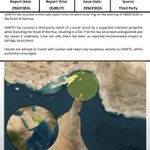
Yesterday, GFS PRIDE (9349045) and ALFONSO (9256298) were successfully targeted by Iran in the Strait of Hormuz.
GFS PRIDE was evacuated and the vessel sank in Omani waters, making this the second vessel to have sank following an Iranian attack in recent weeks after CAPE DAO.
It's only a matter of time before the US steps in to support KSA.
Saudi Arabia has stopped issuing alerts to its citizens, so the magnitude of what is going on isn't as 'out there' as other conflicts.
Since the latest round of hostilities began, the Houthis have struck Oil infrastructure at Jazan, Yanbu, Abqaiq & Damman.
Airports at Abha, Jazan and Najran have sustained direct impacts, while military installations around Khamis Mushait have faced repeated attacks.
In Riyadh, King Khalid International Airport has been struck on at least 4 occasions in October alone, with the attacks resulting in at least 16 fatalities and hundreds of injuries. The 10 October attack alone reportedly killed 12 people and injured 309.
These are not isolated attacks against remote border installations. We are talking about international airports, strategic energy infrastructure and critical national assets.
I think it's more a question of when, not if, the US will become involved. Then, we must consider the consequences on Red Sea shipping.
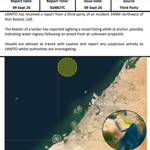
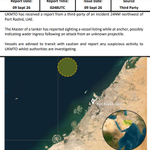
The IRGC issued a warning over VHF Channel 16 to several vessels anchored offshore Ras al Khaimah, UAE; advising vessels weigh anchor and relocate to Dubai anchorage immeditely.
This comes after the IRGC struck Gem No.2 on 10 October in a similar location and after Iran has resume attacks against vessels that are not transiting the SoH including ACERS north of Qatar on 7 Oct and SINGAPORE ENERGY on 5 Oct.
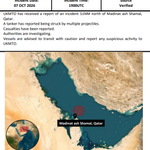
On 7 October, the Antigua and Barbuda-flagged tanker ACERS (IMO 9301902) was struck by three one-way attack drones north of Qatar.
The strikes caused damage to the vessel’s funnel and upper deck, with a fire breaking out in the engine room. The fire has since been extinguished.
A second vessel was struck in the Gulf of Oman, east of Fujairah according to Iran. FIRMS anomalies supports Iran's claims. If confirmed, would indicate Iran is targeting feeders and shuttle runners outside of SoH.
In KSA, on 7 Oct, Houthi attacks against Abha and Riyadh airports killed 36 people and injured a further 36.
The attacks followed coalition strikes against Sanaa on 6 October. Control of Dhubab and positions along the Bab al-Mandab remains contested.
Today, the Houthis renewed threats to target Saudi oil and gas, airports and sea ports:
The armed forces warn all employees, experts, engineers, and workers in all Saudi oil facilities against being present in locations that represent targets for our forces, so as not to endanger their lives—whether those that have been targeted previously or others. It also renews its warning to aviation companies in the airspace and airports, as well as travelers and workers therein, that were previously announced.
In the Black Sea, 12 Syrian crew members from ALFA WATAN (IMO 7510884) remain missing, with search operations suspended.
Ukraine’s Defence Ministry has also claimed a strike against a vessel carrying military cargo to Odesa.
On 7 October, the Antigua and Barbuda-flagged tanker ACERS (IMO 9301902) was struck by three one-way attack drones north of Qatar.
The strikes caused damage to the vessel’s funnel and upper deck, with a fire breaking out in the engine room. The fire has since been extinguished.
A second vessel was struck in the Gulf of Oman, east of Fujairah according to Iran. FIRMS anomalies supports Iran's claims. If confirmed, would indicate Iran is targeting feeders and shuttle runners outside of SoH.
In KSA, on 7 Oct, Houthi attacks against Abha and Riyadh airports killed 36 people and injured a further 36.
The attacks followed coalition strikes against Sanaa on 6 October. Control of Dhubab and positions along the Bab al-Mandab remains contested.
In the Black Sea, 12 Syrian crew members from ALFA WATAN (IMO 7510884) remain missing, with search operations suspended.
Ukraine’s Defence Ministry has also claimed a strike against a vessel carrying military cargo to Odesa.
For the first time since 9 September, Iran has struck a ship in the Gulf, away from the Strait of Hormuz.
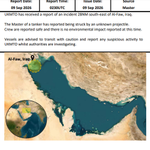
On 9 September, HERCULES STAR (IMO 9916135) was struck 24 nm north-west of Port Rashid, UAE, with two seafarers killed, and NEW ANDROS (IMO 9294252) was struck 28 nm south-east of Al-Faw, Iraq.
Tonight's attack comes as Iran has increased the tempo of attacks against shipping since the end of September.

BLACK SEA | AFRAMAX RIO ON FIRE OFF SOCHI
Crude oil tanker AFRAMAX RIO (IMO 9273844) is on fire close to the Russian port of Sochi following an apparent strike. A large fire and column of black smoke are visible from the vessel, although the exact cause has not yet been confirmed.
The incident follows attacks against commercial shipping in the western Black Sea earlier this week.
Turkish-owned grain carrier ROYAD MAMMADOV reportedly sank off Romania following a drone strike, killing two crew members.
ALFA WATAN and ABLE were subsequently reportedly struck by drones approximately 70 nautical miles off Bulgaria. ALFA WATAN sank, while a fire broke out onboard ABLE and its 18 crew members were evacuated.
This was always on the cards. The KSA-Houthi conflict has reignited and has escalated to consecutive strikes against Sana'a and Riyadh; the hearts of either side.
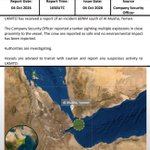
There Houthi target profile relating to this conflict is current those ships that have called at KSA, or owned by a KSA entity.
The Houthis historically have expanded the target profile in response to conflict developments and may very well do so again in the near future.

Increasing the risk is an admission that Iran is having increasing success and the optics of a threat increase wouldn't support the narrative.


The Houthis have had more success striking Saudi oil infrastructure in the past month than Iran has since Feb.
Iran hasn't been trying since Feb, however, Saudi is intercepting less than it did when Iran was trying.
This week alone, the Houthis have struck pumping stations along the E>W pipeline, Aramco in Riyadh & Yanbu.
How long until the UK/US take a supporting role beyond the current AAR support?
Houthis threatened the following amidst ongoing escalation:
1.King Khalid Airport in Riyadh
2.King Abdulaziz Airport and Port in Dammam
3.Jeddah Airport and Port
4.Aramco Oil Company and Refineries
The Houthis struck Aramco in Riyadh this morning after the RSAF targeted a meeting of Houthi leaders in Sana'a.
The RSAF has just conducted another round of strikes against Sana'a.
This is how escalation happens.
However, the Houthis are likely to escalate beyond tit-for-tat and we could soon see a new target profile in the Red Sea.
Strait of Hormuz: five tankers struck in four days
Iranian forces struck the Kuwaiti VLCC KAZIMAH III in the Strait of Hormuz on 1 October. It is the fifth tanker hit since 28 September and the second Kuwaiti state VLCC in four days.
Neither Kuwaiti tanker was on the PGSA NCV list.
Most of the recent victims were transiting AIS-dark.
Gulf crude flows are holding up through a dark tanker shuttle and ship-to-ship transfers.
In the Black Sea, a Turkish-operated bulk carrier was disabled near Novorossiysk with one crew member missing.
Off Somalia, Puntland has recovered two hijacked tankers, but the pirate networks remain intact as the monsoon ends.