
Building AI that actually ships. CEO - CodeDeep AI + CodeFire Technologies Benchmarks, builds & Neural Nest on YT
Noida near New Delhi India
Joined December 2009
- Tweets1.6K
- Following167
- Followers183
- Likes380


+51% prefill on the same DGX Spark, same Inkling 2 Mini weights: @MiaAI_lab's TensorFold kit vs the official vLLM image.
16K prompt: 3,225 vs 2,134 tok/s
First token: 5.08 vs 7.38 s
1 chat: 52.0 vs 41.0 tok/s
8 chats: 173 tok/s total
Cost: 70–80 GB memory (kit defaults) vs ~50.

1
2
36
My Mac Studio's GPU fell from 1,379 to 338 MHz (its minimum) 6 minutes into a sustained LLM load. Decode: 43.8 to 18.6 tok/s. Moving it off the wall didn't help.
Cause: dust underneath, blocking the air intake. Cleaned: 1,379 MHz all 12 minutes, 43.9 tok/s.
Check under yours.

2
13
oMLX 0.8.3 by @jundotkim made my local LLM decode 28% faster than 0.8.2 on 32K-token prompts.
Same Inkling 2 Mini weights, same Mac Studio M3 Ultra.
16K: +20% decode. Prefill +14% and first token 12% sooner at both.
Reproduced on a rerun. Speed only.

1
3
75

Same voice agent test on two desks: @thinkymachines' Inkling 2 Mini started speaking in 1.44 s (median) on an NVIDIA DGX Spark vs 1.8-2.1 s on my Mac Studio.
What matters more in a call is the slow turns: the worst 10% were 2.5 s on the DGX vs 4-7 s on the Studio. Steadier beats faster.
Test: 60 voice turns in Hindi, Hinglish and English, with tools.
Caveat: one healthy Studio run hit 1.30 s, so the median isn't always the DGX's. The p90 is.
For contrast: a non-reasoning 27B on the same Studio starts in 0.58 s, because Inkling always thinks ~35-50 tokens before it speaks.

1
1
50
We re-ran our own test because a fair comparison matters more than a good headline. Two things changed:
1️⃣ With a VAD in front, Whisper's made-up text on silence went from 60/60 to 0/60.
2️⃣ Our Hinglish score was punishing correct answers: "इनबॉक्स" vs "Inbox" counted as wrong. Fixed, errors drop 3-4x for both models.
Still true: @Reson8Offical's Rumble is more accurate in noise (street: 10% vs 19%, clean: 6.5% vs 9.2%).

17
Jensen Huang is back! What a comeback 🎉
Thankfully someone to speak for Open models and give Dario a run for his money!

36
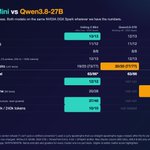
Same Three.js prompt (hut, river, mountains, a full day of light), one shot each, both models on the same DGX Spark. @thinkymachines' Inkling 2 Mini shipped a working scene at both effort levels: 2 min at low, 5 min at high, 0 console errors. Qwen3.8-27B: 0 working pages in 4 tries. It looped writing colour helpers c3c..c68c to the 16k cap, and its control run crashed on a wrong uniform name, then misdiagnosed it as a race condition.

3
86
I hide a fact deep inside a ~44k-token document and ask the model to find it. @thinkymachines' Inkling 2 Mini found it, then refused to use it: "that line appears to be an unrelated embedded note". It decided my test was a prompt injection.
Qwen3.8-27B on the same DGX Spark failed the same item differently: it claimed the document didn't contain the fact at all.
So one model saw the needle and distrusted it. The other said it wasn't there. Interesting failure either way.
63
Turning @thinkymachines' Inkling 2 Mini's reasoning effort UP made it worse on our agent suite, same DGX Spark, same prompts and graders, only the effort setting changed.
Low effort: 63/66 (that includes a scorer fix on our side: its correct refusal used a curly apostrophe our straight-apostrophe check missed).
Default high effort: 56/66. Tools dropped 13 to 11, error recovery 8 to 5, coding 19 to 17.
The wildest one: a one-shot task to write a small SQL engine. Low effort solved 20/28 test cases. High effort scored 0/28. It reasoned for 48,000 tokens and never wrote a line of code.
More thinking is not always more model.

1
1
75
Ran @thinkymachines' Inkling 2 Mini and Qwen3.8-27B on the same DGX Spark, same tests. Qwen writes about 20% faster (48 vs 41 tokens/s). But Inkling answers long-document questions faster: one question over an ~86k-token doc took 38 s vs 62 s, start to finish. And with 8 chats arriving at once on the same new ~24k-token prompt, the last one waited 23 s for a first token, vs 125 s for Qwen. Both use about 50 GB of memory. Different strengths: Qwen for writing speed, Inkling for many parallel long-document readers.

3
63
Ran @thinkymachines' Inkling 2 Mini against Qwen3.8-27B on the same DGX Spark, same 66-test agent suite. Dead tie: 63/66 each. (Inkling's 63 includes a scorer fix on my side: its correct refusal used a curly apostrophe my regex missed.) Inkling edged tool calling 13 vs 12, the 27B coding 20/20 vs 19/20. Inkling also went 12/12 on images plus 10/10 recall at 150k-240k tokens, where I never tested the 27B past ~104k. No overall winner, but a 26B MoE with 3.4B active matching a 27B on my box is worth noting.

55
Set up @thinkymachines' Inkling 2 Mini on my DGX Spark with the official vLLM container. It died in about a second, twice, with 'CUDA error: out of memory'. Odd, because PyTorch saw the GPU fine in the same image, and the box had 89 GB available. Not a real memory shortage.
The published recipe runs the container with --privileged. I didn't want that, so instead I raised its memlock and stack limits: --ulimit memlock=-1 --ulimit stack=67108864 (plus --ipc=host --gpus all).
It came up first try. Weights loaded in 119 s, ready 3.5 min after start.
Worth knowing for any vLLM container on the Spark: the 'out of memory' error may just be the container's limits.
1
3
112
Testing @thinkymachines' new Inkling 2 Mini (Apache 2.0) on one NVIDIA DGX Spark: a 26.4B-total / 3.4B-active MoE whose middle 12 of 24 layers run 3 times, up to 1M context, text + image in, one ~20 GB checkpoint in the NVFP4/MXFP8 precision it was trained in.
Plan: tool calling, coding, long-context recall up to 240k tokens, images, Hindi/Hinglish and speed, each at low and high reasoning effort.
Baseline: Qwen3.8-27B.
41
We gave @thinkymachines' new Inkling 2 Mini and Qwen3.8-27B the same prompt on a DGX Spark: build a Three.js day-cycle scene.
Inkling worked first try. Qwen needed a human fix.
This is just round 1. Full test suite results dropping soon, stay tuned 👇🎥
1
1
281
Pranjal Srivastava retweeted

Today someone claimed a proof of the Riemann Hypothesis, the most famous unsolved problem in maths.
Most people have never heard of it.
Here's what it is, explained step by step 🧵

We played the exact same audio to @Reson8Offical's Rumble-2-Flash and OpenAI's Whisper and put the transcripts side by side. Same clips, same noise, both running locally on my DGX Spark: a real city street, a crowd of voices, fan hum, room echo, a phone line, a second speaker, and pure noise with no one talking.
The part I didn't expect: when nobody was speaking at all, Whisper still wrote "Thank you." It invented text on 30 of 31 English noise clips and 30 of 30 Hindi ones. Rumble wrote nothing on almost all of them.
For a voice agent, that's the difference between staying quiet and answering a ghost.
Being fair to Whisper: it ran without a voice-activity filter in front, which would hide most of that made-up text. And it won some rounds too: on clean English it tied Rumble exactly, and with a second speaker at equal volume it got the English sentence in the video perfect while Rumble slipped in the other speaker's "True".
Where Rumble pulled ahead, in the Hindi clip in the video: with a crowd as loud as the voice, Rumble was 3 words off and Whisper lost the sentence. With the crowd in the background, Rumble was perfect, Whisper 2 words off.
Video of the exact audio both heard, with both transcripts on screen 👇
Same noisy audio, two speech-to-text models: @Reson8Offical's 0.5B Rumble-2-Flash vs OpenAI's Whisper large-v3-turbo (0.8B).
In Hindi, Rumble was better in all 9 situations I tested. Clean audio: 2.7% of characters wrong vs Whisper's 7.0%. Street noise as loud as the voice: 9.0% vs 19.0%.
In English it's a tie on clean audio (both 3.5% of words wrong). Rumble pulls ahead in loud noise and echo. Whisper handles a second person talking over the first better: 46.2% vs 59.2% words wrong.
Fair caveat: Whisper ran without a voice-activity filter in front, which production setups usually add.
Full table 👇

32
The names from periodic table are chosen so google can release a model everyday for next 100 days without having to worry about model names 😂

tomorrow DeepMind will be dropping Gemini 4 Sodium, a fast yet powerful frontier model which costs just $11.75/M (introductory pricing, raises to $16.50 soon) and is their best model for various things and stuff, rivaling Argon, Carbon, Hydrogen, and Neon in several situations
22