
Advisor, Investor, builder @ Helix. @buildoniris
New York, NY
Joined September 2015
- Tweets3.8K
- Following5.5K
- Followers7.5K
- Likes20.6K




Scott Friedman 🎗️ retweeted

Innovation. Tokenization. 24/7 trading.
In this episode of Material Matters, @SECPaulSAtkins and Director Jamie Selway discuss the evolving landscape of U.S. capital markets and SEC efforts to modernize market infrastructure.
🔗 below - listen wherever you get your podcasts!
Scott Friedman 🎗️ retweeted

With Anthropic’s IPO, earnings and disclosures will put public-company numbers on compute and inference markets for the first time.
What we’ll finally see:
• How tightly Anthropic’s cluster commitments track the earnings of the largest neoclouds and hyperscalers, i.e., how much of the GPU rental market is effectively just Anthropic
• To what extent biggest labs are shifting from renting capacity to owning
• The margins on the crack spread between raw compute cost and inference revenue, and how those compare to the same spreads for open-weight models
• The sensitivity of lab revenue to macro and commodity correlates, such as electricity, memory, and metals prices
• The trend of training time and cost for each successive frontier model pre-training
Congratulations to Anthropic on a historic market event for super intelligence.


Scott Friedman 🎗️ retweeted

Cryptocurrency is gaining a broader role in many Americans’ investment journey, according to Charles Schwab’s 2026 Modern Wealth Survey.
Click here to learn more key findings about digital assets: spr.ly/6011By8ZX7


Scott Friedman 🎗️ retweeted

wow big update in agentic commerce
@OpenAI just rolled out @ChatGPT Wallet, which lets your dot buy things for you inside ChatGPT
how it works:
> add a card once, then review + approve each purchase w/ Face ID or a fingerprint
> card network issues a token (card #, CVV, exp), so neither the agent nor the merchant sees your real card
> works w/ merchants’ existing checkouts (+ merchants keep the customer relationship, pricing, returns + support)
> card rewards + dispute protections carry over
built w/ @Visa, @Mastercard + @AmericanExpress + also working w/ Forter, Riskified, Sardine + Signifyd on fraud, plus Adyen, Checkout.com + Stripe, so legit agent purchases don’t get declined
sounds like fully delegated buying w/ spending limits + category rules comes later
OpenAI isn’t taking a cut of txns (for now)
starting w/ US Pro users
wsj.com/tech/ai/chatgpt-laun…


Scott Friedman 🎗️ retweeted

North Korea was committing to our GitHub under my name for months without us noticing.
Embarrassing to say, but it's worth a PSA for anyone building with AI right now.
One of my engineers was moving fast on a build. His AI agent found a project on the internet that helped with the task.
It either picked it on its own or recommended it, and nobody really cared. We just went with it. He built it on his Mac.
That one build tampered with his GitHub Desktop app and stole the token that lets anyone act on our behalf.
(GitHub is the Google Drive for developers. It's where almost every piece of software you use lives.)
From there they re-created our real commits. Same names, same dates, one thing added: a line of malware at the end of a file nobody ever looks in, hidden behind a trail of blank space.
You could open the file, look right at it, and see nothing.
We cleaned it up in September. It came back in October. Then November 2. Then November 6: 153 force-pushes in 23 minutes.
We'd swap our tokens and it still came back. We scanned the Mac and it said clean. It wasn't. The scanner tripped on one small detail: the space in GitHub Desktop app filename. Once we found it, we were good. It wasn't easy at all.
Luckily our systems held. The biggest wave never reached production. Not a client's app, not ours. Main branches block force-pushes, production only ships from them, every push gets scanned, real secrets only live in production. We built that for a day like this.
But it was a close one. It's my fault. I didn't put enough safeguards around my engineers and what their agents were allowed to do. Moving fast vs moving properly. It's the risk you take. You need good systems underneath it.
This matches public reporting on PolinRider, which researchers tie to North Korea. Hundreds of repos hit. We're just embarrassed enough to write it up.
Vibe coding or letting agents run things you don't fully understand? Run routine checks. Talk to someone who builds systems that hold up, because attackers are using the same tools we are.
Know what you're running. Especially when you didn't pick it.
The full timeline, a 30 second check, and a prompt you can paste into your AI to audit yourself: github.com/anurieli/polinrid…
PS. Yes, I just warned you about random repos and sent you to a random repo. Read it before you run it. That's the whole point.



Scott Friedman 🎗️ retweeted

Thrive’s proposed acquisition of ADT feels like 4D chess with clear downside protection, levers to increase EBITDA and many upside cases.
Here’s how I imagine @JoshuaKushner could be thinking about it.
1. Buy millions of sticky customer relationships.
ADT ended 2025 with approximately 6.1 million monitoring subscribers. As of June 2026, it generated $360M in recurring monthly revenue, equivalent to a $4.32B annual run rate, with annual gross revenue attrition of 13.1%.
Equipment is installed in the home. Customers pay every month. Families depend on the service. There are real reasons to stay.
2. Acquire a household brand people already trust.
ADT has spent more than 150 years building its name in security. Something that Warren Buffett has commonly looked for in his investments.
That could be incredibly valuable as AI moves into our homes. A startup asking for access to your cameras, front door, or family’s daily routines has to earn that trust from scratch.
3. Use AI to materially lower the cost to serve.
ADT reported $433M in customer-service expenses in 2025. Billing, scheduling, account changes, and routine troubleshooting create a substantial opportunity for automation.
A hypothetical 50% net reduction would save approximately $216M annually. At 80%, that becomes $346M.
Against the announced $15.3B enterprise value and $2.68B of 2025 adjusted EBITDA, those scenarios take the effective purchase multiple from approximately 5.7x to 5.3x or 5.1x.
4. Make customer acquisition more efficient.
ADT reported approximately $98M in advertising expenses in 2025. Google’s case studies are finding large branding lowering cost per acquisition by 22%+ using AI Max.
ADT already uses AI in marketing. Better targeting, creative testing, and lead conversion could help it acquire more customers with the same budget.
5. Own distribution for the next generation of AI hardware.
ADT already has approximately 3,100 installation and service technicians and 130 sales and service offices.
Building great hardware is hard. Getting someone to buy it, install it, connect it, and support it is another entire business.
ADT has infrastructure for all of that.
6. Expand what each household can spend with you.
The upside could extend well beyond selling another camera.
Drone security for larger properties. Intelligent perimeter systems. Eldercare monitoring. Home robots with recurring service plans.
These could carry substantial upfront order values and generate years of subscription, maintenance, and upgrade revenue.
Further out, a household agent could coordinate repairs, book service providers, and purchase supplies with the owner’s approval. That potentially adds transaction revenue to the relationship.
The bet: AI can increase lifetime gross profit per household while reducing the cost to serve it.
7. Have a potential macro tailwind.
If civil unrest or heightened concern about personal safety increases demand for protection, it could accelerate the pull for more capable security systems.
I wouldn’t say you need that scenario for the thesis to work. But it could increase the urgency to buy and willingness to pay.
8. Give it time to compound.
Thrive’s permanent capital structure supports a long ownership horizon.
Lower service costs can fund better products. Better products can increase household spending and strengthen retention. The permanent capital structure enables them to reinvest more in growth going into a macro cycle where security might be more top of might for people as well...and the existing business provides a foundation while the other new categories develop.
In the meantime Josh is buying a trusted route into millions of homes just as the range of valuable things you can sell into those homes is about to expand dramatically.
Scott Friedman 🎗️ retweeted

Excited to work with Payward to forge a path for onchain derivatives built on Hyperliquid's infrastructure. Kraken is one of the most trusted and respected exchanges in crypto. They are also true believers in the technology and crypto ethos. We're honored that they are building on Hyperliquid to bring the next evolution of perpetual markets to the United States.

Payward, the parent company of Kraken, announced its intention to be the first CFTC-regulated deployer on HIP-3* markets. Payward will use Hyperliquid as the infrastructure layer to deploy perpetual futures markets for US clients. Subject to regulatory approval, Bitnomial, Payward’s CFTC-regulated DCM and DCO, would act as the HIP-3* deployer: creating, owning, and administering the markets and clearing and settling the contracts. If approved, NinjaTrader Clearing, Payward’s CFTC-registered FCM, would carry client accounts.
HIP-3 will support optional deployer configuration for permissioned markets in a future network upgrade. This set of additional deployer functionality is collectively called HIP-3*. At its core, HIP-3* activation involves an onchain allowlist managed by the deployer or its sub-deployers. The functionality is strictly additive to HIP-3; its use is optional and up to the deployer. Existing markets remain unchanged. The initial release is available on testnet, where specifications are preliminary and subject to change based on feedback.
Hyperliquid is a neutral infrastructure layer with the goal of supporting large parts of the financial system. HIP-3* gives deployers additional functionality to operate deployments consistent with the requirements applicable to them. As with HIP-3, HIP-3* deployers are independent operators who use Hyperliquid as the onchain infrastructure layer for their own markets, while retaining control and responsibility over their deployment.
Scott Friedman 🎗️ retweeted

88% of VC-backed founders who exited their companies got $0. Eduardo Azevedo and Kent Smetters analysed 157,669 startups and 248,454 founders from 1987 to 2025.
Let that sink in...
Scott Friedman 🎗️ retweeted
Dramatic week for biz banking 🤣
@tryramp takes a shot at @mercury for paying 0% on checking
@mercury fires back at @tryramp for paying <1% cashback
@airwallex enters the chat + calls out @tryramp’s advertised yield as misleading
@slashapp fires one off at @rhobusiness


Scott Friedman 🎗️ retweeted

From concept to reality.
@SpaceX has successfully deployed Starlink V3 satellites into Earth’s orbit and made contact with them for the first time.
At scale, one Starship carries 60 V3 satellites, the same network capacity as about 20 Falcon 9 launches.
Scott Friedman 🎗️ retweeted

I don't see how this could possibly be seen as a net negative.
Banks were fucking their customers. Agents now realize that. Agents then route customers to better products.
This is... bad? That people get a better deal? That they earn interest on their own money?

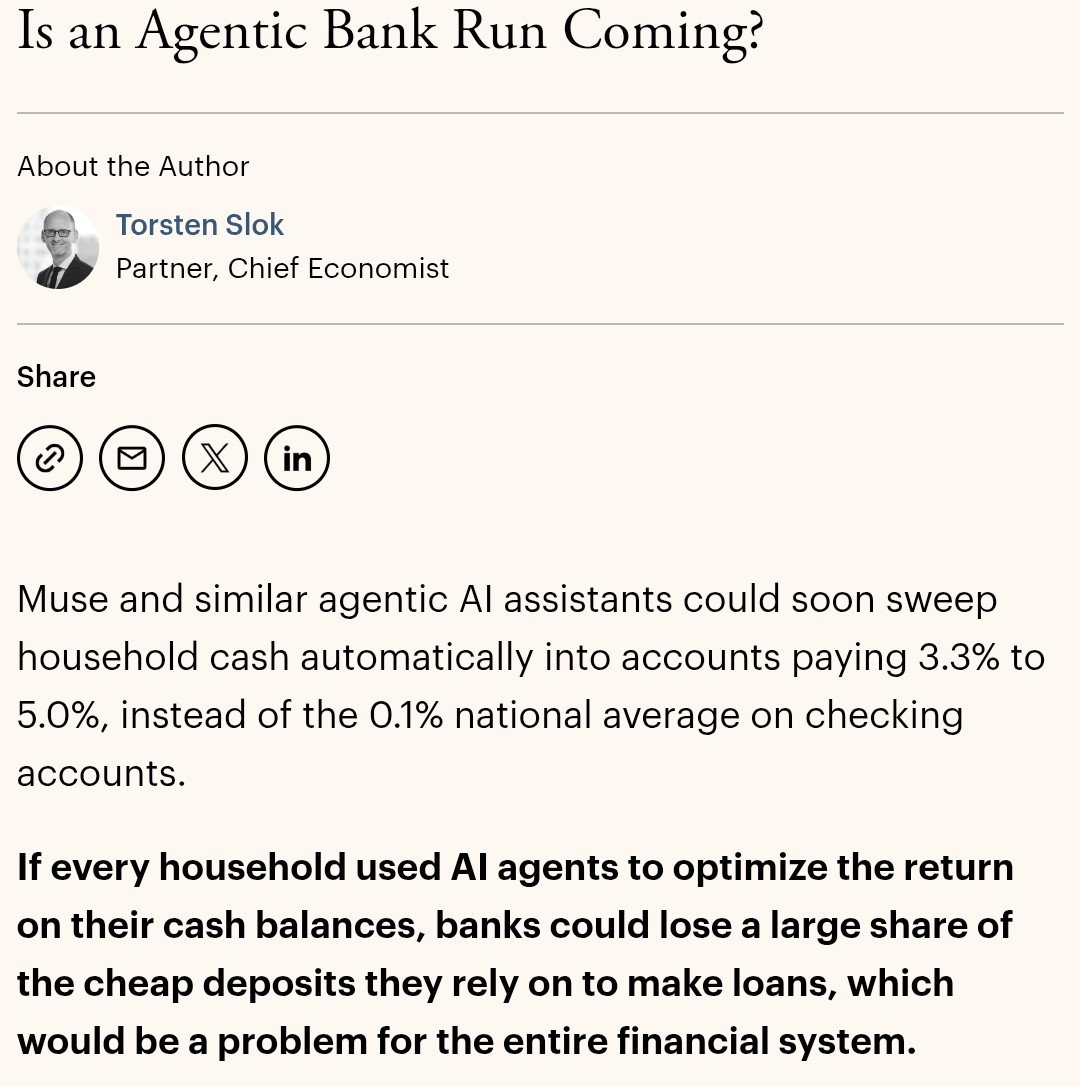
The chief economist at Apollo is warning that mass adoption of AI agents could trigger a bank run as they optimize user investments. Gary Gensler spent his last few years as SEC chair warning that the exact same problem will hit the markets: the pursuit of algorithmic perfection at scale destroys system stability. Personal-finance agents making simultaneous optimal decisions could potentially cause a massive flash crash.
Agent acausal coordination, with no messages passed between them, will show up in a lot of places. Markets will get the big headlines, but huge numbers of clever advisors making very similar choices will impact all of human society. Capability gains make this worse, not better. The smarter the agents, the narrower the optimal path; and knowing that other agents see that exact same path lets them move together without talking to each other. Agents do not need to collude to act in unison. Thus, they break no human laws by doing so. Human laws were not written for this. They were not written for a lot of what is coming, and it is about to start happening very fast.
Scott Friedman 🎗️ retweeted

Because this “Meta uses OpenClaw” story is going around. They built their own agent, being inspired. Nat and his team did a great job. Kudos!

we built muse from scratch, but it is definitely heavily inspired as a product by openclaw. After I used openclaw in january I bought hundreds of mac minis for the MSL team and lots of us fell in love with using openclaw (and other personal agents). @steipete is a genius and his harness was pioneering from the jump. I think a lot of people were inspired by it. our goal with muse was to build something like openclaw that we could make safe and secure and easy to use and scale to billions of people.
Scott Friedman 🎗️ retweeted

we built muse from scratch, but it is definitely heavily inspired as a product by openclaw. After I used openclaw in january I bought hundreds of mac minis for the MSL team and lots of us fell in love with using openclaw (and other personal agents). @steipete is a genius and his harness was pioneering from the jump. I think a lot of people were inspired by it. our goal with muse was to build something like openclaw that we could make safe and secure and easy to use and scale to billions of people.