





Pinned Tweet
How’d I do?
What a cool experience!
Just the start for us here at @AvoryCo
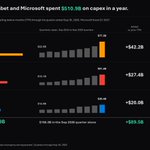
Amazon largest dollar spend on CAPEX, slowest Y/Y rate.
BUT $42B incremental.
$AMZN

If you want to see what happens in the chip business when revenue plateaus or declines slightly, look at Intel’s Q4 guide.
Q3 revenue: $16.5B
Q4 revenue guide midpoint: $15.5B
That’s about a 6% sequential revenue decline
Gross margin?
Expected to fall from 44.1% to 38.0%
So a 6% decline in revenue translates into roughly a 19% decline in gross profit dollars.
Growth will come back, but something to chew on.
$INTL $NVDA
Some impressive results from Rivian here as R2 becomes a real business, but...
Rivian consolidated = gross-profit positive.
Rivian automobiles = still gross-profit negative.
Still work to do, scale to drive up economics.
$RIVN
Very simple take for Amazon: $AMZN
AWS is accelerating at an enormous scale, while the rest of Amazon continues becoming structurally more profitable.
AWS grew 39.3%, fastest growth rate in nearly 5 years. That puts AWS at roughly a $184 billion annualized revenue run rate.
Amazon is adding something on the order of +$50B of incremental annualized rev in a relatively short period.
then you have
Amazon generated $28.1B of operating income at a 13.9% margin... UH the highest operating margin in company history.
I keep getting texts asking what I think about DoorDash / Instacart deal, so here’s my take.
At a high level, I think one of the most important things AI is doing is removing discovery layers where the discovery itself never created much value.
Search is the obvious example.
For yrs, we opened Google, typed something in, clicked through bunch of links, compared results, and eventually arrived at an answer.
ChatGPT changed that interface completely. You increasingly just ask for the outcome you want.
and the LLM handles a large portion of the discovery process underneath it.
I think AI agents do the same thing to commerce.
Instead of: Open an app, then search + scroll + compare + select, then checkout. All of that was friction. Now you get:
“I need groceries for tacos tonight for six people.”
Or:
“Order me dinner from somewhere healthy that can get here within 30 minutes.”
The agent can increasingly handle everything in between. and yes it was come back w/ 3-4 options, but still cuts down friction.
So that creates a pretty important strategic question for companies whose businesses historically sat inside that discovery layer.
I think this is where the DoorDash / Instacart combination came about.
DoorDash is effectively expanding the surface area of commerce it can touch. Restaurants. Groceries. Convenience. And some Retail.
Now there are two ways I think about this.
First, there is still plenty of commerce where discovery actually has value.
People want to browse restaurants. I DO
They want to see what looks good. I DO
They want to compare grocery items. SOMETIMES
They want to explore stores, products and options.
In that world, building one destination where a consumer can open a single app and access a huge percentage of their local commerce becomes more valuable.
You are essentially trying to create the operating system for local delivery. That’s one type of user they would serve.
But the 2nd piece may be even more important.
It’s defensive.
If AI agents increasingly abstract away the consumer-facing discovery layer, you want to own as much of the infrastructure, merchant connectivity, inventory, logistics and transaction layer underneath that agent as possible.
The consumer may eventually care less about which app they opened. The AI might make that decision for them.is it 50-50, 80-20, 20-80?
But somebody still has to know what is available Where is it? What does it $? How quickly can it arrive? Who can fulfill it? How does the transaction actually happen? Also when there’s an issue who resolves it.
That underlying network will become more important as the interface gets abstracted away.
So I look at the deal as both offensive and defensive.
Offensively, $DASH can become a much broader consumer commerce platform. Defensively, it gives them more scale and more verticals underneath the emerging AI-agent layer before agents potentially start sitting between the customer and the apps.
$CART $UBER
If Google Search is eroding, guess who wins?
It’s not that complicated.
Instagram and Facebook.
We’re already starting to see it.
Advertising dollars have to follow eyeballs, and there are only going to be a handful of platforms with true, authentic reach at scale.
Increasingly, those will be quasi-entertainment platforms where people spend a significant amount of their time.
I actually think the platforms that own attention could see both sides of the flywheel accelerate: more users spending more time on the platform, followed by more advertiser demand chasing that attention.
Look at the numbers for Google Search vs Metas.
Night and day.
This will continue.
Meta is also going after the search aspect. Meta Muse isn’t search as we know it, but it is an extension of all the insights and personalized info the platform has to then drive personalized results. Can be tasks, queries, transactions.
That’s the power. If you don’t see that as mega opportunity on both front, you blind.
$META
Nobody probably listens to Omnicell earnings lol. But lots of juicy nuggets.
1. The $2.5B opportunity for their new Omnicell XT Titan system did NOT include Omnisphere Cloud and Software attached revenue. That’s incremental positive to come in future years. Kind of a big deal!
2. They ship their FIRST XT Titan next week. So cycle begins here. Systems will be out in the wild. Finally. And ramp in the replacement cycle happens next year and beyond.
While this quarter and next are somewhat less meaningful as we wait for the next cycle to begin, the results were still encouraging. Earnings and margins were strong even this late in the prior cycle, which suggests full-cycle margins in the upcoming cycle could ultimately be higher than previously anticipated… particularly if the next cycle comes with the larger revenue opportunity we expect (hardware + cloud software which was not included in their previously stated $2.5B)
We are moving UP our revenue and margins opportunity for the next cycle due to this info.
$OMCL


Block tops the list for credit rating upgrades.
While we keep hearing about the cost of Capital going up for certain players and industries, this would be the opposite for Block.
$XYZ

Pretty impressive.
ServiceNow had 19 deals above $5M of net-new ACV, up more than 135% YoY.
It now has 680 customers spending more than $5M annually, up about 23% YoY, versus 658 last q.
Looking like.
IT + security + CRM + employee workflows + AI agents + AI governance = ServiceNow.
Also on AI
At the beginning of 2026, ServiceNow was thinking about roughly $1B of AI ACV.
At Analyst Day they raised the FY26 goal to $1.5B.
Now they’re raising it again to $1.7B
$NOW
Cheesecake Factory printed comps +15.2%
Must be back consumer.
Is that the bottom of the K or middle or upper. The negative thesis is breaking on consumer.
Sean D. Emory retweeted

"Credit and Insurance has officially overtaken Private Equity and Real Estate as Blackstone’s largest business"
@_SeanDavid

Nice report from $LH LabCorp
Diagnostics organic revenue:
Q1: +2.9%
Q2: +3.6%
Q3: +4.4%
And organic requisition volume has gone:
Q1: +1.1%
Q2: +1.8%
Q3: +3.1%
That’s a meaningful utilization acceleration.
Also Biopharma Laboratory Services looked good, really healthy.
Revenue: +8.5%
Organic revenue: +9.6%
Central Labs: +11.5%
Early Development: +0.4%
Margin: 18.3%, +180 bps Y/Y
Also closed/announced four transactions around the quarter: MLM Medical Labs, BioReference assets, Myriad’s prenatal testing business and Millennium Health.
So I’m increasingly convinced that the most important AI metric is going to become:
How much useful work can I get done per dollar?
Not model size.
Not parameter count.
Useful work.
Important info here.
Nice complement to my post yesterday on the $16-19B infra spend in 2026.

Circular financing on steroids here
Amazon gave Anthropic 75% discount on compute vs Anthropic shares via convertibles on which AMZN can make ~30x gain if Anthropic goes IPO at 2 Trillion valuation
All together $AMZN is “losing” ~20bn$ revenues to make 200bn$ of capital gain
Solid Robinhood results, the knock could be the deposit decel from 28% annualized to a multi-year low of 17% annualized…
Last year we saw a step up from from Q2-Q3…
2026 a 11% step down.
$HOOD

Visa, strongest growth in 15 years.
Yet I keep hearing consumer must be in bad shape, or AI is only thing driving economy.

Snowflake and Anthropic models are not to different.
From lens that these are consumption based.
They have to earn multi year credit consumption purchases.
Point is you can go from little to no visibility in +1 out year revenue, which is where Anthropic sits today, to multi year commits.
What’s the product for Anthropic tho???
$SNOW $ANT
Bloomberg now pointing to what we expressed here recently.
Expecting serious software M&A.
$IGV
