

In pursuit of FREEDOM 🔗 onchain unchained.
Decentralized
Joined January 2022
- Tweets21.2K
- Following567
- Followers584
- Likes23.3K




Solo ☀️ retweeted
Loopscale has confirmed all issues have been resolved and all USD.infra Vault functions are operational.
The Vault has resumed staking sUSD.infra and loan activity.

Loopscale paused its protocol after an escalating attack campaign targeted its SOL and USDC Genesis Vaults, and reports that affected vaults have been made whole with no loss to user deposits.
Loopscale is our Vault infrastructure partner, but Tokenization Infrastructure Vaults were not impacted. We have paused staking sUSD.infra and loans until an all clear has been issued out of extra precaution.
No funds are at risk and no action is required. USD.infra deposits are available as usual.
We will notify you as soon as this is resolved.
teapawt.org/Loopscale/status/21182…
Solo ☀️ retweeted
Loopscale paused its protocol after an escalating attack campaign targeted its SOL and USDC Genesis Vaults, and reports that affected vaults have been made whole with no loss to user deposits.
Loopscale is our Vault infrastructure partner, but Tokenization Infrastructure Vaults were not impacted. We have paused staking sUSD.infra and loans until an all clear has been issued out of extra precaution.
No funds are at risk and no action is required. USD.infra deposits are available as usual.
We will notify you as soon as this is resolved.
teapawt.org/Loopscale/status/21182…

Over the past week, Loopscale has been targeted in a sustained campaign by a sophisticated actor, with the protocol APIs receiving more than 30,000 malicious requests per day. All deposited user funds are secured.
Earlier, our security systems detected a significant escalation in the campaign, and we promptly acted to pause protocol activity to mitigate impact. The attack attempts targeted the SOL and USDC Genesis Vaults. Affected vaults have been made whole and no user deposits have incurred a loss.
The protocol will not resume normal operations until we have established the complete scope of the campaign and implemented further security hardening. We will be re-enabling the protocol interface shortly and are working to resume repayment functionality as soon as possible to mitigate unforeseen liquidations.
The following addresses have been identified in connection with this activity:
247Lk5YNH9URfBBvxVUtDruz8GvGX8gKGuYHVCZThpiR
AzPh2dUV3duK9n8PWV6CxKMwWr9Rk7fxPNBZuv1CiwMr
0xb8959Aca4e4C796A3BaDA66833eAe60b1BC0bfb2
0xB7Ec7eF24FD73f3000C651CA9D0Fa45b61DcF854
We are actively engaged with federal law enforcement and security professionals. Protecting user funds remains our highest priority, and we will continue to share relevant information and material updates as they become available.


Solo ☀️ retweeted

gDAWN CT 👋
today we see who builds what, inside the Vault 👇
@dawninternet's USD.infra Vault runs on Solana, and every part of it has its own partner.
M0 handles the stablecoin side, so USD.infra can be issued and redeemed. Loopscale provides the vault infrastructure. Chainlink brings in verified outside data. Orca gives it swaps, Kamino and Allez Labs bring sUSD.infra to a lending market, and Exponent lets eligible users split principal from variable payments.
Titan covers the infrastructure side, with AI compute and data delivery.
see u on the next👋
Solo ☀️ retweeted

GM CT
gDawn to you Internet Adopters🙌
CT it's time to pay attention on what @Dawninternet is building
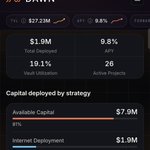
33 days and dawn is continue to scale and getting more adoptions now is hitting ATH across the board
TVL: $17M → $18.11M
This's Onchain capital backing real infrastructure, with vault contributors eligible for yield tied to infrastructure revenue and Bytes participation rewards
The narrative is becoming infrastructure powering tomorrow internet and AI economy
Explore more here
powering tomorrow’s internet and AI economy
Explore more here
app.infrastructure.finance

Solo ☀️ retweeted

Grateful doesn't even cover it
Just earned Stabimemer on @StabilizerFi, and I want to say thank you to the team for actually seeing the effort and loving the memes. It means something when consistency gets noticed.
Building with Stabilizer, one swap (and one meme) at a time!


Solo ☀️ retweeted
BUILDING WITH STABILIZER FINANCE
So last week Saturday, I joined spaces for the first time grinding Web3 🙈. It was on @StabilizerFi hosted by my grand daughter @_rumaisah and her siblings @whykay___ , @tunde_ayanlade.
Things I heard or learnt
1. They kept saying let's bring somebody "UP". How? Up how? What does it mean to bring somebody up on spaces biko nu?
2. @_rumaisah kept saying "he is rugging" when probably there's a network glitch. Abi dem dey rug spaces too? I thought it's only memes that people rug🤦. Because @tunde_ayanlade was always rugging 😂😂😂😂.
Ignorance is bliss until it's not. You guys should explain these things to me before I go and disgrace myself outside.
Thank you @StabilizerFi for teaching me new things.

Solo ☀️ retweeted
Great people. Great conversations. 🤝
It was a pleasure to co-host Proof of Liquidity at @token2049 in Singapore.
teapawt.org/ProofOfLiq/status/2110…

And that’s a wrap for our Singapore Edition!
Thank you to everyone who joined us, here’s a look back at the event.
Shoutout to our co-hosts @inkonchain, @NexusMutual, @RockawayX, @dawninternet and event partners @Figure, @EmberProtocol, @bitmakerfi, @Arch_Prime for making this edition possible.
Solo ☀️ retweeted
BUILDING WITH STABILIZER FINANCE
Phase 2, Epoch 2: What Do the Numbers Tell Us?
Today, let's look beyond the leaderboard and examine what is happening in the @StabilizerFi ecosystem.
📊 Here are the stats from my Proof of Swap card:
🔹 Weekly Trading Volume: $1.5401 billion
🔹 My Rank: #15
🔹 Total Trades: 3,994
🔹 Reported Slippage: 0% on every swap
But what do these numbers actually mean? Let's break them down. 👇
1️⃣ $1.54 billion in weekly volume
This represents the trading volume displayed on my card for the period.
Volume helps us understand how much trading activity is being recorded. However, volume alone doesn't tell us how many unique users participated or how much revenue the protocol generated.
2️⃣ 3,994 trades
This is the number of trades recorded on the card.
Every trade represents an interaction with the swap system. But remember, the number of trades is not necessarily the number of individual users. One person can make multiple swaps.
3️⃣ Rank #15
This is my position on the leaderboard at the time shown.
Rankings give participants a way to track their standing within the community. They can change as activity and leaderboard calculations change.
4️⃣ 0% slippage on every swap
This is the feature that makes @StabilizerFi particularly interesting to study.
Slippage is the difference between the expected execution price and the actual execution price.
Stabilizer is designed to provide zero-slippage stablecoin swaps under its protocol conditions. The 0% figure displayed on my card reflects the app's reported result.
The bigger question is how this design works and what it means for traders and liquidity providers.
That's why we need to understand the mechanism, not just repeat the claim.
💡 MY TAKEAWAY
Numbers tell us that activity is happening, but understanding the mechanism tells us why the activity matters.
Trading volume, trade count, leaderboard position and slippage each tell a different part of the story.
As we continue testing @StabilizerFi , the goal is not just to participate. It's to understand what we're using, ask better questions and share what we learn.
We're not just watching DeFi develop. We're learning by building with it.
@StabilizerFi


Solo ☀️ retweeted
Building with Stabilizer - Day 15
My Phase 2 Epoch #1 stats for @StabilizerFi are out.
And honestly, seeing the numbers made me pause.
6,113 trades.
$2.6386B weekly volume.
Rank #8.
0% slippage on every swap.
But beyond the numbers, I started thinking:
What does this actually tell me about building in DeFi?
6,113 trades isn't just a number.
It's thousands of interactions with the product.
Every swap is an opportunity to notice something:
What feels intuitive?
Where could the experience be smoother?
What happens when users make mistakes?
Where does liquidity matter?
What would happen if this activity scaled?
That's the part of testing I enjoy.
I'm not just clicking buttons to complete transactions.
I'm trying to understand what the product feels like from the user's side, and what it could become.
And that #8?
I'll celebrate it. 😂
But I'm even more interested in what Epoch #2 will teach me.
Because Building with Stabilizer isn't about getting to the end.
It's about getting better with every interaction.

Solo ☀️ retweeted
Building with Stabilizer - Day 14
“I have the same stablecoin. So why should I care which chain it’s on?”
Imagine I have $1,000 USDC.
You have $1,000 USDC too.
Same asset. Same value.
But mine is sitting on Ethereum, while yours is on Arbitrum.
Now I want to use a DeFi application that's operating on Arbitrum.
Suddenly, having USDC isn't the whole story.
I have to think about:
Which chain?
Where is the liquidity?
Do I need to bridge?
How much will the transaction cost?
How easy is it to move?
And this is something I understood better while testing @StabilizerFi
Moving from Ethereum Sepolia to Arbitrum Sepolia wasn't just changing a network in my wallet.
It made me think about something bigger:
Assets don't exist in isolation. They exist within ecosystems.
The chain determines where I can use them, what liquidity I can access, and how easily I can move them around.
That's why cross-chain connectivity matters.
Because ultimately, as users, we don't want to think:
“Which chain is my stablecoin on?”
We just want to think:
“I have my stablecoin. Let me use it.”
And I think that's one of the bigger questions worth exploring as Stabilizer grows:
How do we make stablecoin liquidity feel less fragmented across chains?
That's the kind of thing I'm thinking about while Building with @StabilizerFi

Solo ☀️ retweeted
Building with Stabilizer - Day 12 🎤
I get a last-minute call:
“Ngozi, we need you on stage. You're speaking about @StabilizerFi.”
No preparation.
No PowerPoint.
Just me, a microphone and a room full of DeFi enthusiasts. 😅
I walk onto the stage and look around.
Builders.
Traders.
Liquidity providers.
Researchers.
People who probably know way more about DeFi than I do. 😂
So I don't start with fancy terminology.
I start with a simple question:
“How many of you have ever swapped one stablecoin for another and wondered where some of your money went?”
Now I have their attention.
I explain the problem.
Then I tell them:
This is what @StabilizerFi is trying to change.
Zero-slippage stablecoin swaps.
MEV protection.
Liquidity pools.
Cross-chain stablecoin infrastructure.
I explain everything in lay-man's terms so they actually understand what I'm saying.
And then I say:
“But don't take my word for it. Let me show you what I've been testing.”
I open the app.
Connect wallet.
Swap.
Provide liquidity.
Remove liquidity.
Claim fees.
Ask Stabi.
Suddenly, I'm not giving them a pitch.
I'm showing them the journey.
And that's how I introduce @StabilizerFi to a room full of DeFi builders:
Don't just tell people what you're building.
Let them experience why it matters.
I thanked them for listening to my TED talk and I was proud of myself 😊.

