

A settlement-grade oracle in which the absence of trade is evidence of correctness.
Joined August 2025
- Tweets37
- Following33
- Followers119
- Likes105


If we want DeFi to scale to civilizational size, the price oracle it uses should be too expensive to manipulate by construction.


trust
minimized
lending
no paternalistic risk managers. no admin keys. no emergency pauses. no pool contagion.
control your own destiny



Hello Vitalik,
In your fireside chat with @vnovakovski and the Lighter team last week, you suggested using something like an AMM TWAP as a price oracle when the relevant assets are already onchain.
You also noted the question of how to sample spot prices in a way that is not easily manipulable. More detail on how you are thinking about that would be very helpful, especially in a world with adversarial block production and ePBS.
From our perspective, the sampling question is the core oracle problem for trade-based aggregation mechanisms like AMM-derived price oracles. If a protocol relies on sampling onchain market state, the relevant security question is: what does it cost to control, distort, or censor the sampled state during the oracle window, and how does that cost compare to the value extractable from the external notional settled by that price?
Do you have a concrete model or proposal for doing this without making the oracle window so long that price latency becomes a major cost? Longer observation windows may improve manipulation resistance, but for exchanges or lending systems using leverage, stale prices can be uncompetitive and economically expensive.
It is good to hear you express concern about oracles as skeletons in the closet. If we want to be as rigorous about oracles as we are about proof systems, then the sampling problem needs a concrete adversarial model rather than being treated as an implementation detail.
One possibility is that importing prices into adversarial financial mechanisms should itself be a paid, adversarial process, rather than assuming robust prices can be sampled for free. That is the direction we are exploring.

The new openSwap is powered by openOracle v2, an optimized version of our core oracle contract.
The v2 oracle features native ETH support, game state stored in a single hash, internal balances, and more.
Read about it here:
docs.openoracle.org/openorac…

1
2
242
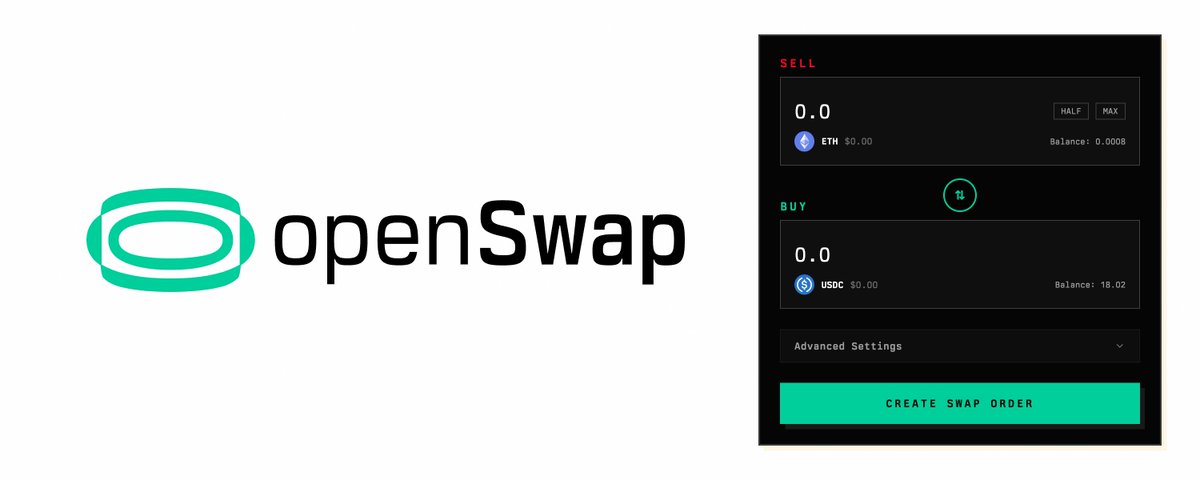
openSwap v2 is live on @base:
+ 60% cheaper gas
+ Atomic match and oracle report
+ permit2 approvals for USDC
+ Automatic cancels by MEV bots if unfilled
Enjoy some of the cheapest swaps onchain.
The generalized oracle problem is a monster.
What if the most robust way to solve it is by building something even worse?
medium.com/@openOracleProjec…

Even if much of the industry is punting on the hard problems, we aren't.
Nothing we build has admin keys, upgradeability, governance, or privileged access. Our price oracle is an onchain, permissionless escalation game.
It's hard to build this way. But we think this is the only way to scale securely.
This quoted post is unavailable.
How should we think about solving some of crypto's hardest problems? The right framing may improve our chances.
medium.com/@openOracleProjec…

openSwap is live
= P2P liquidity
= MEV-as-a-feature
= Engineered to undercut AMM fees
On-chain RFQ flow:
swap intent → match →
oracle settlement → execution
swap.openoracle.org