






Pinned Tweet
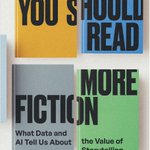
Today is launch day! My new book, *Why You Should Read More Fiction*, synthesizes over ten years of research to provide a science-based approach explaining why fiction is so important for our brains, especially right now. I hope you will pick up a copy and spread the word.

No offence to Ruskin but all books are books of the hour. Take that hour or even half hour and read everyday. Fiction especially. It's the hour not the greatness that matters for your mind.

How Ruskin divided the books that matter from those that do not:
“All books are divisible into two classes, the books of the hour, and the books of all time. … The good book of the hour, then,—I do not speak of the bad ones,—is simply the useful or pleasant talk of some person whom you cannot otherwise converse with, printed for you. Very useful often, telling you what you need to know; very pleasant often, as a sensible friend’s present talk would be. These bright accounts of travels; good-humoured and witty discussions of question; lively or pathetic story-telling in the form of novel; firm fact-telling, by the real agents concerned in the events of passing history;—all these books of the hour, multiplying among us as education becomes more general, are a peculiar characteristic and possession of the present age: we ought to be entirely thankful for them, and entirely ashamed of ourselves if we make no good use of them. But we make the worst possible use if we allow them to usurp the place of true books: for, strictly speaking, they are not books at all, but merely letters or newspapers in good print. Our friend’s letter may be delightful, or necessary, to-day: whether worth keeping or not, is to be considered. The newspaper may be entirely proper at breakfast time, but assuredly it is not reading for all day. So, though bound up in a volume, the long letter which gives you so pleasant an account of the inns, and roads, and weather last year at such a place, or which tells you that amusing story, or gives you the real circumstances of such and such events, however valuable for occasional reference, may not be, in the real sense of the word, a ‘book’ at all, nor in the real sense, to be ‘read.’ A book is essentially not a talked thing, but a written thing; and written, not with the view of mere communication, but of permanence.”
— John Ruskin, Sesame and Lilies
If you enjoy our posts, consider becoming a paid subscriber. You'll get:
- Live book club discussions (biweekly)
- Access to our incredible community chat
- Essays to guide you through the Great Books
- All past recordings, essays, and podcasts
- The ability to vote on what we read next
Join here: athenaeumbooks.com/subscribe

Andrew Piper retweeted

“I began seeing my memories with the wisdom of adult hindsight and thinking, Goodness, this could be rather interesting to write about in a completely different way.” —Penelope Lively buff.ly/8hg6qeB

Not just books. Fiction! Imaginative worlds! It's the best thing you can do for your brain. And fiction is low cost and abundant. Like a renewable energy source.


Andrew Piper retweeted

The most revealing part of this conversation between Jon Stewart and Jacob Coxon wasn't Coxon's warning about A.I. doom, but his description of A.I. utopia, and Stewart's incredulous response. I wrote about it — and Francis Fukuyama's "Last Man," and A.I. easily solving the problems that bedeviled my father's field of mathematics for decades — here: nytimes.com/2026/10/18/opini…


Former Anthropic researcher Jacob Coxon (@hilbertspaess) and Jon Stewart discuss AI, jobs disappearing, universal income, and whether tech CEOs are creating a dystopian future

Andrew Piper retweeted

🚩 When Polymarket or Kalshi says there's a 70% chance something will happen, should we believe it?
Excited to share our new paper, just published in PNAS, in which we examined more than ONE MILLION forecasts from Polymarket, Kalshi, Manifold, and Metaculus, spanning 12 domains and forecasting horizons ranging from hours to years.
The main finding is striking: Prediction markets and collective forecasting platforms are remarkably well calibrated. When they assign events a 70% probability, those events really do happen about 70% of the time. And this pattern holds surprisingly well across different platforms, domains, and forecasting horizons.
But there's an important twist. When we looked more closely, we discovered systematic biases in some of the domains where forecasting matters most (wars, elections).
For decades, psychologists have documented how poorly humans often reason about probability and uncertainty. Our findings offer an encouraging counterpoint: When judgments and information are aggregated, we can achieve a surprisingly accurate understanding of an uncertain future.
That doesn't mean we can predict what will happen next with certainty. But it does mean that we can be remarkably good at estimating how uncertain the future really is.
This work was a great collaboration. The data for this project was meticulously collected for years by Justin Dickerson, the project was led by Hilla Shinitzky and Maayan Peer, with @mattansb leading the analyses.
📄 Read the paper:
pnas.org/doi/10.1073/pnas.26…
#Forecasting #Polymarket #Kalshi #DecisionScience #PNAS


Andrew Piper retweeted

As LLMs evolved into agents, earlier best practices no longer serve us well. This new research field needs a field guide, so we wrote one. If you're new to agent evals, please take a look. Seasoned researchers and those interested in steering the community will also find many useful observations. sage.cs.princeton.edu/trends…


New paper: AI evaluation is a burgeoning field. How can researchers entering the field understand best practices and open problems?
In our paper, led by @flxcn, we develop a concrete list of open questions and best practices for agent evaluation. We also share recommendations for evaluators, AI companies, policymakers, and more.

ALT Figure 1 from the paper with the list of 33 emerging trends
The best antidote right now is fiction. It may sound niche. It's not. Fiction is an incredible tool for building attention and mental connection to your world.


"Right now, we’re in the midst of an attention crisis, individually and collectively snared in an infinite scroll of disruption and distraction. Berger saw this crisis coming and foresaw its consequences." A.O. Scott for @nytimes/@nytmag nytimes.com/2026/10/18/magaz…

Should engineers read novels? Michael Kuhn says yes.
1. Design work is work with fictions. Kuhn defines a fiction by three criteria: it uses representations that could describe the real world, they don’t describe anything real in this case, and that fact is clearly signalled. Without the signal you would have a lie, not a fiction. Engineering designs meet all three. The flow charts, CAD models and simulations for a new plant could describe one that already exists, but they describe one that hasn’t been built yet. Good documentation makes clear what is finished and what is still only planned.
2. Fictions also always have gaps. A flow chart doesn’t show the real piping layout. A CAD model says nothing about flow and reactions inside the pipes. Even a detailed simulation usually leaves out noise, seal wear, or the unexpected ways people will use the system. Engineers try to shrink these gaps but can never close them. Novels train the same skills: imagining things that don’t exist yet, keeping several people’s mental pictures aligned, knowing what a text does and doesn’t tell you, and not confusing the model with reality.
3. Novels train ethical judgment. Kuhn defines acting morally as weighing an action from the point of view of anyone it affects, not just yourself. For engineers, this means a technology should be good for more than its users. It also has to be good for the workers who build it, the neighbours who live next to it, people in other parts of the world, and generations not yet born. Many of today’s big problems, like climate change, involve effects that are far away in space or time. That makes them easy to ignore.
4. Reading a novel means seeing the world through someone else’s eyes, which is the same move ethical reasoning requires. Novels also produce empathy, and that gives people a reason to act, not just an argument. Kuhn adds that empathy tends to favour those close to us, so it needs to be balanced with impartial judgment. He also makes a practical case: markets and regulators increasingly reward sustainability and fair working conditions. Companies that get ahead of these expectations are less likely to be caught off guard by new rules.

Andrew Piper retweeted

How are #AI and #LLMs changing the way
we study and learn #language? From developing models for low-resource languages to understanding how we interact with machines, a new collection from @CambUP_LangLing Cambridge's #linguistics journals brings together the latest research on AI and language from applied, sociolinguistic, computational, and psycholinguistic perspectives.
view.updates.cambridge.org/?…

Read the Nibelungenlied if you want to know how this cycle ends!

Two wrongs make a right when it comes to incivility
Retaliatory incivility (i.e., incivility in response to someone else's incivility) is seen as less morally condemnable than initial incivility.
This may create a vicious circle of conflict, as each side responds with greater incivility.
sciencedirect.com/science/ar…

Andrew Piper retweeted

UC Berkeley researchers are developing AI models that learn language by imitating speech, much like babies do. Their work could make AI more efficient while revealing new insights into how humans and other species communicate.
bit.ly/4BeESMn

Andrew Piper retweeted

My new book, Co-Existence, is out today. It is a guide to how to live & work in a world where AI is sometimes, but not always, better than you.
(And, for the release, I worked with Opus 5.5 to make a quite interesting experience for the book's website: co-existence.ai/)

I am very excited to be writing a fully AI-supported book. It's about the "lessons of stories" and will offer a global history of the values encoded in storytelling. I hope this can provide an example of how AI can assist the humanities. Here is what I've done so far:
1. Data Collection. One of the challenges of studying world literature is the unevenness of the data. It's a total mess out there. I have been using AI to help survey this massive landscape and build collections. First attempts are here: github.com/piperandrew/World…
2. Evaluating AI behavior. If AI is going to be used as a way of interpreting stories we need to robustly evaluate its interpretations. I've done a lot of work so far in evaluating how AI succeeds or fails to understand the values encoded in stories from different cultural positions. arxiv.org/abs/2604.08797 [incidentally nominated for best paper at EMNLP]
3. Helping design research questions. Understanding the unique ways stories narratively encode values and value choices has been a fascinating research process. AI has been helpful making sense not just of the literature but also how to think about narrative values more generally.
I'll be posting more about this experience as I go.

So important to have multiple perspectives of the meaning of AI around the world. We have a new paper out looking at the "many morals of AI" using narrative analysis of global news. arxiv.org/html/2610.18573v1

This is perhaps one of the great ironies of our time: China is increasingly shaping the future of AI, yet very few people in the West have the faintest idea how its key thinkers see it - its philosophers, sociologists or ethicists.
As is too often the case, we - much like the frog in the well - assume our own AI debate covers every possible view, when much of it springs from the same cultural soil, built on assumptions about what defines us that we don’t even know we’re making.
Take for instance the assumption that intelligence is a key part of what makes us human. It’s so intuitively obvious to us that we literally named our species after it - Homo sapiens (Latin for "wise man").
If you think about it, just this assumption explains a large share of the anxiety: if intelligence is what makes us human, then artificial intelligence - or super intelligence - threatens the very thing that makes us us: we’re about to compete with artificial or super “us”. No wonder this feels existential.
But China has a tradition of thought as old as ours, if not older, and every bit as rich and sophisticated, which never placed intelligence at the core of what makes us human, and so meets the thinking machine from a completely different starting point.
Have you, for instance, ever heard of Zhao Tingyang? Probably not, and yet he may be the most original thinker on AI you’ve never read. He’s one of China’s most prominent philosophers, at the Chinese Academy of Social Sciences. While Silicon Valley spends billions trying to make AI share our values, he for one argues that doing so “may very well be a suicidal mistake”.
Sounds pretty important to hear him out, don’t you think?
Or take Liu Yongmou, a philosopher of technology at Renmin University in Beijing. His thinking is almost the opposite of ours. Where we fear machines that become more and more like us, he says that “humanity’s biggest problem is the machinization of humans, not the humanization of machines.”
You could even go back to antiquity, when, in many ways, we started asking questions about AI.
Did you know, for instance, that Aristotle, in the Politics, imagined a world where “the shuttle would weave and the plectrum touch the lyre without a hand to guide them”, and wondered about the social order consequences of this (mostly whether slaves would still be needed)?
There are Chinese equivalents to this. For instance, in the Zhuangzi, a foundational Taoist classic, you’ll find a similar thought experiment, with a completely different worry attached. An old gardener is watering his vegetables by hand, hauling water out of a well jar by jar. A visitor shows him a labor-saving device, and the gardener turns it down for the reason that whoever uses machines ends up with 机心 (jīxīn), a “machine-heart” - a mind that schemes, calculates and loses its simplicity. “It is not that I do not know [the machine],” he says, “but I should be ashamed to use it.”
Two labor-saving machines, two very different questions: where Aristotle wondered what automation would do to the social order, the Zhuangzi wondered what it would do to us, on the inside. Which, you’ll notice, is exactly Liu Yongmou’s worry, more than two thousand years earlier.
In fact, as we’ll see, 心 (xīn), the heart, is a motif that runs deep through the Chinese AI debate. It appears both in the fear, from Zhuangzi to Liu Yongmou, that machines could give us a “machine-heart” and its mirror image: the ambition to give machines a heart of their own. Zhu Songchun, who heads the Beijing Institute for General Artificial Intelligence, wants “to set a heart for machines” (为机器立心, wèi jīqì lì xīn).
“Heart” in the Chinese sense, that is, which differs totally from the Valentine's Day fluff we’ve reduced it to. 心 (xīn) means heart and mind at once: it’s where we feel but also where we think, tell right from wrong and care for others.
And, crucially, it’s in the heart that the quality Confucianism sees as the very definition of a human being takes root: 仁 (rén). We need two words to translate it, “benevolence” and “humaneness”, but in Chinese they’re one and the same: to be benevolent is to be human. It’s not about intelligence.
This is the entire point of my new article: to step out of our well for a moment and peer over the edge of China's.
What you’ll find there will, I think, surprise you, with questions you’d never thought to ask: from Zhao Tingyang warning that AI’s bad consequences can at least be fought, but that “humanity may die of all the good things AI creates”, to whether the fear that AI will make us “useless” rests on the false premise that a person is worth what they’re useful for.
A premise that a 2,300-year-old Taoist tree, which survived precisely because it was useless, demolished long ago. Could our predicted uselessness turn out, much like that tree’s, to be our saving grace?
Chinese thinkers’ answers to these questions are, I think, among the most interesting anyone has given to the defining question of our time. Whether or not you agree with them, they’re the intellectual backdrop of a country shaping much of AI, and with it our future: you might as well know what they think.
Enjoy the read here: arnaudbertrand.substack.com/…

Andrew Piper retweeted

New paper: AI evaluation is a burgeoning field. How can researchers entering the field understand best practices and open problems?
In our paper, led by @flxcn, we develop a concrete list of open questions and best practices for agent evaluation. We also share recommendations for evaluators, AI companies, policymakers, and more.
ALT Figure 1 from the paper with the list of 33 emerging trends
Andrew Piper retweeted

Audio long read 🔊 How to stay smart in the age of AI — the science of critical thinking
go.nature.com/4Bg70i6
