

Web3
Chandigarh , India
Joined December 2023
- Tweets38
- Following25
- Followers7
- Likes372





covering essential Rust concepts : ✅ Memory safety & ownership ✅ Error handling & Option types ✅ Pattern matching with enums ✅ Generic programming ✅ Traits & polymorphism ✅ Collections (HashMap, Vector) ✅ String manipulation
15
Just Published a comprehensive repository on RUST
Repository link:
lnkd.in/gaMyVg-D
1
12
💡 Your Turn!
Try to combine iterator and consuming adapters in a single pipeline. Can you create a one-liner that filters out odd numbers, doubles the even numbers, and sums them up? 🤔
Solution :

24
🤔 When to Use What?
Use iterator adapters when you want to "build a pipeline" of transformations.
Use consuming adapters when you’re done with the iterator and need to get a result.
1
26
🔥 What are Consuming Adapters?
Consuming adapters consume the iterator, meaning they take ownership of it and do not create another iterator.
✍️ Common Consuming Adapters :
count() , sum() , product()
Example :

1
7

🚀 Mastering Rust's Consuming and Iterator Adapters!
1/n
🔥 What are Iterator Adapters?
Iterator adapters transform an iterator to create a new iterator. They do not consume the iterator instead they "adapt" it by applying some transformation.
1
30
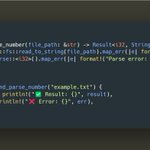
1. Using Result for File Handling with Errors Handle file reading and parsing with custom errors:
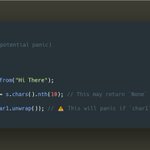
2. Using Option to Safely Return None or a Value Find the first uppercase letter in a string:


12
🚀 Rust's Result & Option: Powerful Error Handling & Null Safety 🦀
Rust's Result and Option enums are game-changers for writing safe, reliable code! No more null pointer exceptions or unexpected crashes. Here’s how I used them in real-world scenarios:
1
19
Why ✅ Safer Approach 2 Works :
If nth(10) returns None, unwrap_or(' ') will return a default character instead of panicking.
This is super useful if you just want to avoid the panic but still get a usable result.


13
Why ✅ Safer Approach 1 Works:
We explicitly handle both Some(c) and None, so there’s no chance of a panic.
Rust enforces exhaustive pattern matching, so you’ll never forget to handle the None case.
1
14
For --> Original Code (with potential panic)
If the index is out of bounds (like nth(10) in a 7-character string), unwrap() causes a runtime panic. 🚨
1
6
Here’s a simple code snippet I wrote to extract the character at a specific index of a string. Initially, I used unwrap(), but I realized it could lead to a runtime panic if the index is out of range. So, I explored safer ways to handle it.
1
4
🚀 Mastering Rust Option Handling:
Hey everyone! I've been working on Rust's Option<T> and how to safely access characters in a string without triggering runtime panics. Rust’s strict ownership and type system might seem tough at first, but trust me, it’s good for the safety
1
13
Here’s a sneak peek of my code, where I showcase:
🔹 Moving Ownership — How one variable transfers ownership to another.
🔹 Function Ownership — How Rust manages ownership when passing values to functions.
🔹 Ownership Return

14
Mastering Ownership in Rust — No More Dangling Pointers or Double-Free Errors! 💪🦀
Hey everyone! I've been exploring Rust's ownership system, and I wanted to share a simple yet powerful concept that demonstrates how Rust prevents common memory issue
1
17
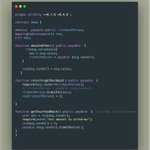
Contributions and token allocations are being tracked, but the tokens will not be transferred immediately to ensure the refund process works properly if needed.
23
🔑 Next Steps:
Refund & Claim Functionality : I will soon implement functions that will allow users to:
# Claim Tokens if the sale is successful.
# Claim Refunds if the sale does not reach the minimum cap.
1
29
Token Address : 0xfd06A122141D611504d34DF2cCA01acF285D9A65
Token Sale Address : 0xDf03C739e8A9B1400B3E12A38a605854A29ea324
Let me know what you think! Any feedback or suggestions are welcome. 🚀
#Blockchain #Ethereum #SmartContracts #Solidity #ERC20 #TokenSale #Testnet #MetaMask


1
61