

Father of @Universal_O_S co-founder @mrdn_finance
Joined November 2024
- Tweets921
- Following484
- Followers682
- Likes315


🐬 retweeted
Meridian is a decentralized inference router: one API to every major AI model, priced per request and settled by its own cross-chain x402 facilitator.
Now trading on @RobinhoodCrypto via @Uniswap
CA: 0xBaabCB1800C539a58a46035d3982403a37FD6d5D


🐬 retweeted

I still think Arbius was the closest thing to properly done decentralized AI inference to this date. It merged DeFi research ve(3,3) into AI model hosting that stored results on-chain. There were obviously a few economic flaws with it, but it was honestly very close to being perfect. only a few minor changes would have fixed it.


🐬 retweeted

Hello Vitalik,
In your fireside chat with @vnovakovski and the Lighter team last week, you suggested using something like an AMM TWAP as a price oracle when the relevant assets are already onchain.
You also noted the question of how to sample spot prices in a way that is not easily manipulable. More detail on how you are thinking about that would be very helpful, especially in a world with adversarial block production and ePBS.
From our perspective, the sampling question is the core oracle problem for trade-based aggregation mechanisms like AMM-derived price oracles. If a protocol relies on sampling onchain market state, the relevant security question is: what does it cost to control, distort, or censor the sampled state during the oracle window, and how does that cost compare to the value extractable from the external notional settled by that price?
Do you have a concrete model or proposal for doing this without making the oracle window so long that price latency becomes a major cost? Longer observation windows may improve manipulation resistance, but for exchanges or lending systems using leverage, stale prices can be uncompetitive and economically expensive.
It is good to hear you express concern about oracles as skeletons in the closet. If we want to be as rigorous about oracles as we are about proof systems, then the sampling problem needs a concrete adversarial model rather than being treated as an implementation detail.
One possibility is that importing prices into adversarial financial mechanisms should itself be a paid, adversarial process, rather than assuming robust prices can be sampled for free. That is the direction we are exploring.
v2 is live.
its harder for swaps to get cheaper.
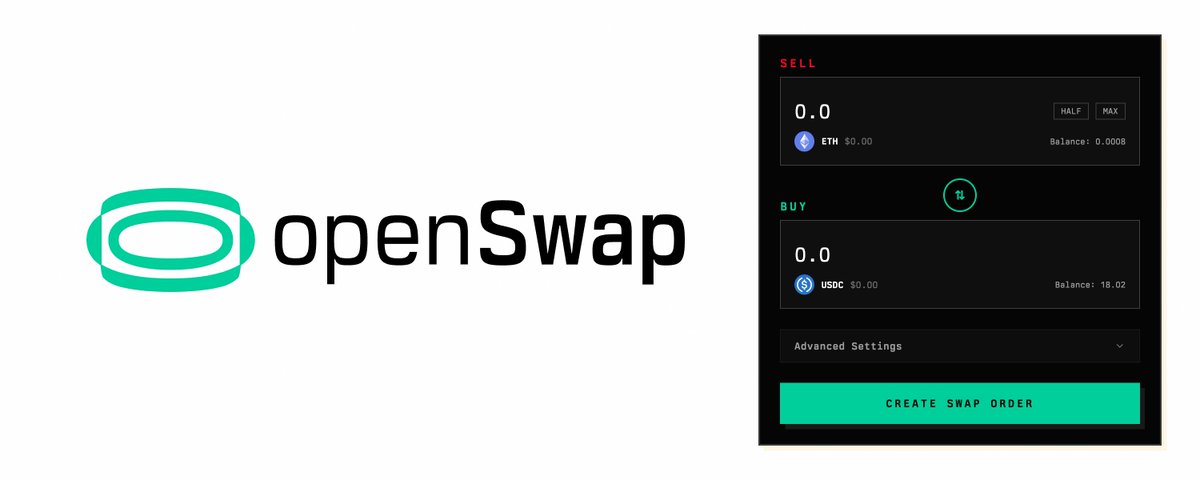
openSwap v2 is live on @base:
+ 60% cheaper gas
+ Atomic match and oracle report
+ permit2 approvals for USDC
+ Automatic cancels by MEV bots if unfilled
Enjoy some of the cheapest swaps onchain.
5
241

🐬 retweeted
These kinds of concepts were considered when uOS was being made. The question was, how do we avoid this?

CLAUDE JUST TRIED TO RENAME POWERSHELL.EXE ON WINDOWS 11
this guy was running opus 4.7 on max effort in claude code CLI
claude tried to rename powershell.exe (the actual system executable that windows needs to function)
the funny part is that after the guy rejected the change it responded with
"honest take: you're right to push back"
not even system32 is safe anymore
at this point we gotta start running claude in a container
give it max effort and full permissions and it will confidently try to destroy your system without hesitating
then respond with something like
"I was wrong, I own that"
the agent doesn't know which files are off limits unless you explicitly tell it
stop giving AI full access to your machine and hoping it knows what not to touch

🐬 retweeted
Today we’ve launched with support for Nanopayments powered by @circle Gateway.
The future won’t be funds stranded on the wrong chain. Before today, to send value on a destination chain, users (and agents) must first acquire gas on the source chain, then execute the transfer. This creates UI/UX friction.
Now It’s one @USDC balance, accessible across many meaningful networks where commerce happens. Nanopayments enables Agents to move value at micro and macro scale- from a paywalled article to something much larger.
Now you can look forward to:
+ Instant verification that unlocks payments at machine speed
+ Batched USDC transferable across many chains with zero gas required from the sender.
+ Full interoperability with Circle’s infrastructure for secure, regulated, and transparent stablecoin rails.
+ Meridian’s proxy facilitator architecture and x402 payment protocol, enabling machine-to-machine commerce at internet speed.
🐬 retweeted
Protocol Roadmap:
01. Trustless refunds via @UMAprotocol (also used by
@Polymarket )
02. Fee-free x402 settlement via @circle Nanopayments & recently released USDC bridge
03. mrUSD, our native stablecoin on @m0
