






Aleh Shydlouski retweeted

🚀 Today we're launching Agent Sandboxes in @pydantic Logfire: a profoundly different kind of sandbox.
"The world doesn't need another sandbox" they say. Maybe. Or maybe the world doesn't need another firecracker/gVisor/VM infra-fest.
Our Agent Sandboxes are different. They're just an isolated interpreter with cold start times measured in milliseconds, where the code can only call the tools you give it and use the directories you mount.
A massive bonus is you can snapshot and resume a REPL weeks later, with the snapshots costing virtually nothing.
Programmatic tool calling, solved.
Start free, $1000 of free credit to try it in the first month 👇
pydantic.io/launch-agent-san…
I see two possible scenarios, depending on the use case:
When it's important to guarantee very specific behaviour that matches the original. In this case, it's indeed make sense to publish a set of verification rules/tests that get checked on the user's side. Interestingly, this verification will most likely be written by Al too, so publishing how the Al generates it could be another option.
When some deviation is okay. In this case, before publishing, we check how well the generated spec replicates across different environments and models, comparing the replicas with the original implementation (e.g., with some fuzzing). It's like compiling software for different architectures.
Given how often agents one-shot a solution from a single prompt, this extra verification could be enough.
1
1
49
Friday hot take: After @dhh keynote, I was thinking about projects that contain only AGENTS md and SPEC md.
You built your little tool, tested, it works, then you ask an agent to describe it in .md files
Instead of publishing the whole project, you publish only these .md files.
As an outcome of this, we have two things:
- Anyone can replicate your tool however they like, in any language, style, or architecture.
- After a while, your project gets indexed by agents, and when agent solves a similar problem, it already has the spec of what worked before
This approach not for production, but rather for small local dev tools and its like encoding-decoding mechanism for universal libraries that fit any environment.
There is also a "Spec driven development". (see @dbreunig talk about No code libraries)
But SDD kind of expects evaluation/development of the project throught the spec+tests, whereas here we only looking for replication in other environments from somewhere already implemented and working version.
The .md files would be written targeting such replication (with examples and corner cases) from already working solution - "Spec driven replication" 👀
Would be Interesting to try how much better/worse it would be compared to rewriting code from one language to another 🤔
2
2
227
I'm inspecting Qwen reasoning trace and upgraded my previous research with Decision models, but latest Opus 5/5.5 no longer letting me inspect reasoning trace of another model. Seems related to anthropic.com/news/distillat… . Very poorly done safeguard, no problems like this on OpenAI


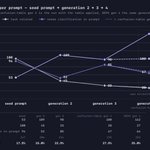
Lately I've been exploring reasoning traces from local models like Qwen3.8, and found they can expose the exact phrases in a prompt or skill that make the model argue with the prompt instead of solving the task.
I'm collecting such cases into a so-called "confusion-table", each case pinned to the phrase that caused it and explaining the mechanics of prompt/skill confusions.
With those phrases repaired, the model spends its reasoning on the task instead of the prompt — and follows the intent more reliably across runs.
Tested on two popular skills and inside GEPA. Thread:
olegivye.com/twitter/confusi…

1
210
Hey @poteto You can integrate to any harness/dev tool without plugins or extensions.
Skill can implement state machine to control Harnesses
For example you can run Skills as Jinja templates, spawning sub-agent, using Decision models, and use power of Jinja composition:
Working on a Skill that lets you run other Skills as Jinja templates. It works in any Harness/dev tool that supports Skill loading, with no extensions or plugins needed.
A few cool things you can do with it:

32
Hey @devagrawal09 you can make it a Skill with this
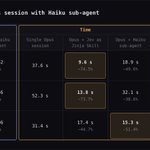
Jev + Jinja Skills turned out to be a great combination for tasks where you need simple, non-deterministic answers across many items.
You can run Jev in the middle of a Claude session and pass data without loading it into the context, saving tokens, time, and cost.
I ran some benchmarks with LLAJinja triggering Jev from Opus session 🧵:

1
57
@mitsuhiko Any future plans on MiniJinja for python? Its marked as experimental and it would be nice to apply it here from the sandbox perspective
1
93
More about Jinja Skills and LLAJijna:
teapawt.org/_electronick/status/21…
Working on a Skill that lets you run other Skills as Jinja templates. It works in any Harness/dev tool that supports Skill loading, with no extensions or plugins needed.
A few cool things you can do with it:
45
When Jev is defined in a Skill you can re-run something that worked before with a one-second response time.
It's a good use case when a non-deterministic task needs a lot of context and Opus can't handle it with a Python script.
Plus Opus don't waste time to define request, if it's already written as part of the Jinja Skill, it's just triggering it.
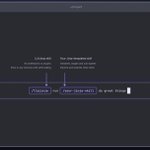
LLAJinja now supports Jev and decision models (including Ollama) in Jinja-templated Skills, without plugins or extensions, in any harness that supports Skill loading:
1
2
264
Jev + Jinja Skills turned out to be a great combination for tasks where you need simple, non-deterministic answers across many items.
You can run Jev in the middle of a Claude session and pass data without loading it into the context, saving tokens, time, and cost.
I ran some benchmarks with LLAJinja triggering Jev from Opus session 🧵:
I was exploring how to detect such confusions based the reasoning trace of the open models.
There a lot of interesting things you can find there, but fixing such confusions is not easy.
Lately I've been exploring reasoning traces from local models like Qwen3.8, and found they can expose the exact phrases in a prompt or skill that make the model argue with the prompt instead of solving the task.
I'm collecting such cases into a so-called "confusion-table", each case pinned to the phrase that caused it and explaining the mechanics of prompt/skill confusions.
With those phrases repaired, the model spends its reasoning on the task instead of the prompt — and follows the intent more reliably across runs.
Tested on two popular skills and inside GEPA. Thread:
olegivye.com/twitter/confusi…
4,025
Founders are also tend to live in their own bubble and focus on none important things (context drift) 🫣
For some context isolution (verifiers/reviewers, experiments, testing) it is nice to separate them, but PRDs indeed feels like a bad idea, unless you have unlimited compute.
1
72
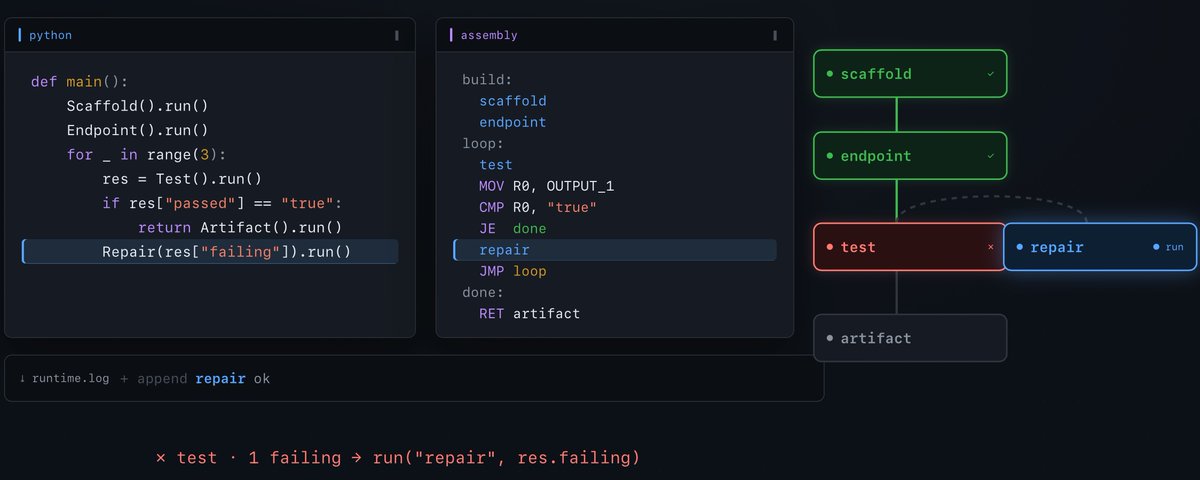
Plan as a code or workflows (driven by a pre-generated code) are more deterministic and this is essential for longer horizon work as different signals and context drift has less influence on the agent
103
And some more cool features: github.com/electronick1/LLAJ…

20
Composing Skills:
With the power of Jinja templates, you can compose multiple Skills, or parts of Skills, together:
1
24
Jinja loops, IFs, and control flow:
You can define the Skill's execution logic as a control flow that depends on the inputs/outputs of each stage of the Skill:
1
38
Variables:
Specify the variables that need to be provided in the prompt/Skill, or the Harness will ask for any that are missing:
1
1
174