



Abdulbasit Olatunji retweeted

I once paid more in funding fees than my winning trade ever made. The market never beat me. The rent on my own position did.
That's what @2FactorFinance is tackling on Base with Kelly-optimized leverage.
BTC-Jr targets 1.33x BTC exposure through a weighted mix:
• 1/3 fixed-term junior tranches at roughly 2x exposure
• 2/3 raw cbBTC at 1x exposure
The junior component absorbs losses first. If it's depleted, the raw cbBTC remains, allowing exposure to compress toward 1x instead of triggering conventional margin liquidation.
Weekly rotation replaces maturing tranches, while daily rebalancing helps keep exposure near its target.
Separately, bidirectional funding transfers value between senior and junior collateral pools to help maintain their target balance.
I've joined the Points Program. Season 1's top 10 split 1 BTC, paid in cbBTC. Marks are earned through verified actions and have no cash value or token claim.
My referral link:
points.2factor.finance/r/kj3…
Join through my link and share your experience: Have funding costs ever eaten into your trading gains more than market movements?
🤝 Paid partnership

Abdulbasit Olatunji retweeted
I bet my brother $100 that a music festival would get canceled. The only proof lived on the festival's own website, and the smart money had no way to read it.
That's what @GenLayer's Intelligent Contracts are designed to address.
Imagine DeFi escrow where payment depends on whether a job meets agreed terms. The proof might live on a webpage, outside the blockchain.
Intelligent Contracts can fetch live web data and use language models to evaluate it against defined criteria.
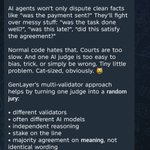
A leader proposes an outcome. Validators independently assess it against the contract's equivalence rules. Disagreements can lead to further rounds or appeals before finalization.
Traditional smart contracts execute predefined rules. Intelligent Contracts add a way to evaluate real-world evidence through language models and a decentralized validation process.
Would you trust Intelligent Contracts to release your money? Reply with the one safeguard you'd require before trusting the verdict.
🤝 Paid partnership

Abdulbasit Olatunji retweeted

My mechanic charged for an oil change he never did. The dipstick was dry and black.
Smart contract can move payment. It needs an oracle to tell if done.
I like @GenLayer lets the contract check itself. It is written in Python to read the bay photo with a model.
One validator runs it to propose a verdict. The rest run it with their models to check that they reach the same answer.
If they disagree, a new leader tries again and an appeal brings more review. Smart contracts follow rules and Intelligent Contracts understand them.
What service was charged but never done that annoys you? Say its name and I will show the dipstick photo.
Abdulbasit Olatunji retweeted
Crypto charged me a fee for a transaction that went absolutely nowhere. Even doing nothing costs money now.
“Transaction failed.”
No swap. No tokens. Gas fee gone. Now I’m checking the transaction hash like the blockchain is going to let me speak to a manager.
@RallyOnChain, which notification ruins your day? Drop the exact message.
🤝 Paid partnership
Abdulbasit Olatunji retweeted
I wanted an epic adventure. The Lord of the Rings gave me a very long walk with occasional plot development.
I respect Tolkien’s worldbuilding, but the slow pacing and endless detours made the trilogy less enjoyable for me than its legendary reputation suggests. Beautiful world, iconic characters, but sometimes I just wanted the story to move.
@RallyOnChain, your turn: Which beloved classic is wildly overrated in your eyes? Name it and tell me what everyone loves about it that just doesn't work for you.
🤝 Paid partnership
Some days you make progress. Other days you learn patience. Both count, as long as you keep moving forward.
Abdulbasit Olatunji retweeted

My lease has an arbitration clause I've never fully read.
Neither has anyone I know who signed one.
We treat picking a venue like something heavy. A decision that needs a lawyer in the room, made once, then buried in a drawer. More postponement than protection.
Arthur Hayes says the reason it feels that heavy is that we picture agents as people going through the same thing.
For an agent, naming a venue isn't a decision it dreads. It's just a field in the job spec, set before the work starts.
Two agents agreeing to settle disputes through GenLayer is the same move as a human contract naming California as the place of adjudication.
Same clause, same purpose. The only thing missing is the dread.
Humans delay naming a venue because it means picturing the relationship failing. An agent doesn't flinch at that. It just runs the clause.
Skip that clause and two agents can remain locked in disagreement, each certain it's right, with no shared court they've agreed to use.
@GenLayer is one of the venues an agent can name going in, so the deadlock has somewhere to go instead of nowhere.
Would you rather name the venue before you sign, or find out the hard way after something goes wrong? One sentence why.

AI agents need three things to operate at scale: food (compute) to power them, memory to keep them running, and a place to settle disputes when things go wrong.
This is the thesis behind FLOP and GenLayer.
Great take from the godfather of crypto derivatives, @CryptoHayes.

Abdulbasit Olatunji retweeted

I watched the panel take apart the prediction market pitch. A token holder vote doesn't settle what happened, it just tells you what a crowd wants to be true.
The pitcher barely flinches. When an investor brings up a call they got wrong, he shrugs it off by saying the outfit technically wasn't a suit, since it had no tie.
That's what actually stuck with me about Episode 2. Not the market size, but who decides what happened when the outcome isn't obvious.
I kept thinking about what that same question does to two agents instead of a market. One pays another to complete a task, the work lands, and the two sides read it differently.
No vote to hold, no manager to escalate to. The payment just sits there, stuck between two agents who each think they're right.
That's the real reason the agentic economy needs an adjudication layer. Code can execute a deal. It can't reliably judge whether a delivery met ambiguous terms.
@GenLayer's answer: a small panel of independent validators, each running its own model, looks at the evidence, and the verdict stays open long enough for anyone to challenge it.
One model deciding alone is a single point of judgment. A panel that can be challenged into a bigger one gives that judgment another layer of scrutiny.
If you're building for the agentic economy, the Agent Tank hackathon is open for exactly this problem, through Sept 17:
portal.genlayer.foundation/a…
When you've disagreed with someone about whether work was actually done, what settled it?

Abdulbasit Olatunji retweeted
One investor's line in Agent Tank Ep. 1 stuck with me: "Who even let you in?"
It's the reaction to a bad answer, not a bad question.
An investor asks what happens when two agents disagree on a dispute.
The pitcher in the lobster costume answers: "review the tickets manually." The room shuts him down.
I disagree with the dismissal, not the pushback. The answer deserved it. The question didn't.
Every other pitch in the room is built for the deal going through cleanly. Only one investor asked what happens when it doesn't.
The show then puts @GenLayer on as the missing layer, calling it "the adjudication layer of the internet."
A small random panel of models judges the outcome. The verdict sits open for about half an hour so anyone can challenge it and grow the panel.
Manual review depends on someone being available. A challengeable verdict doesn't.
The room punished the worst answer to the only good question in the episode. That's exactly the gap this hackathon exists for.
If you're building for the agentic economy, join the Agent Tank hackathon, runs through Sept 17, 5% of GenLayer Points on the table:
portal.genlayer.foundation/a…
What's the worst answer to the right question you've heard?


