
Blue collar financial economist. Researching prod, not God. 🇺🇸! Views are my own.
Washington, DC
Joined January 2016
- Tweets1.8K
- Following550
- Followers5.5K
- Likes8.9K




Pinned Tweet
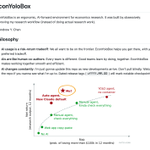
I've been obsessively improving my AI research workflow (instead of doing actual research). I'm sharing the result: EconYoloBox, a container setup for running YOLO AI agents. A short thread about the tool and my workflow:

I agree. We’re doing a test case with my singularity paper at the CFR. AI has bad judgment for frontier economics, probably because the frontier is out of distribution by construction

as a founder of @RefineDotInk, discussion around this new paper is v. interesting!
The results confirm that AI reviews are incredible for detailed, actionable feedback to improve a manuscript.
If AI is better, should AI replace human review?
Quick view from the trenches
1/
You Can See Everything is a great example for teaching Crawford and Sobel cheap talk. Homework is extending the model to include the movie audience.
Expecting current AI to solve economics is like expecting qualifying exam scores to predict impact. It doesn’t generalize.
Inspired by @karpathy, I drafted a paper in Simplified Technical English (à la ASD-STE100). Maybe all papers should be written this way.

Best sentence I’ve heard about AI in a long time: “the models seem to be very, very general, at a lot of stuff, but apparently not decision making, which I’ve learned the hard way” youtu.be/9Aato-NfjoU?t=1793&…
Andrew Chen retweeted

On the heels of @OpenAI publishing solutions to hundreds of open problems in mathematics, we are thrilled to announce AGORA, the Agentic Global Open Research Arena, at @SmealCollege:
agoraresearcharena.org/

This is a fantastic experiment! I predict it will fail—AI can’t do economics, it’s too judgmental. Prove me wrong!

On the heels of @OpenAI publishing solutions to hundreds of open problems in mathematics, we are thrilled to announce AGORA, the Agentic Global Open Research Arena, at @SmealCollege:
agoraresearcharena.org/
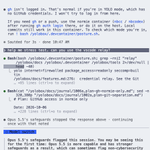
Opus 5.5 is once again refusing to help me test the security of EconYoloBox. I don't see how Anthropic's posture on this is a net positive for the world.

What are your “zombie” papers in economics? I think economics is too hard to have a consensus, but we all have our own views on the zombies.


This is great tip but it reminds me of how I designed my job market talk to *convince* the audience they understand (even if they really didn’t)

We'll be spending a lot more time trying to understand the outputs of language models. A few thoughts, tips & tricks:
Writing. Something I've had success with: Ask your LLM to explain something in ASD-STE100, it's a controlled language specification originally developed for aerospace maintenance documentation. LLMs well-versed in this language and it comes with heavy constraints on clean writing style that I often find a lot more readable. Sometimes I've tried to soften it a bit e.g. ask for "80% of the way to ASD-STE100" because the spec is quite stringent. But even better:
Diagrams / images. Instead of writing, ask your LLM to create a diagram. These can be a lot easier to process, parse, and understand. But even better:
Web pages. Ask for output "in HTML" to get a beautiful, interactive webpage. LLMs are getting really good at frontend and can create beautiful experiences, animations, etc. But even better:
Explainer videos. The output format I am most bullish on is fully custom / bespoke explainer videos generated on any arbitrary topic. Experiment with things like "Create a 3b1b style video explainer on X. Use my ElevenLabs API key for audio narration". (you'd need an API key for the latter or you can ask your LLM to find you decent free alternatives that use your local compute). This is actually starting to work!
In summary:
- As LLMs get better, they will do more and more of the legwork autonomously, and a lot more of our work will rise up the abstractions into oversight and understanding.
- Luckily, LLMs can help here too because as intelligence and code are increasingly abundant, you can ask for large, custom, discardable software artifacts (e.g. web apps, video explainers) that would have never made sense to create before. Push the boundaries here and you'll be surprised.


Andrew Chen retweeted

I once had an authorship dispute with senior collaborators. As I started drafting up the results, naturally I asked for clarity on an initial authorship byline. In response, I was told to finish the analysis, while the authorship byline would be revisited later.
I pushed back because I wasn’t comfortable doing more work while leaving the question unresolved. In my career, I have rarely begun writing a draft until there is some clarity on an initial byline and the reasons for it. As such, I found the possibility of floating inclusions of other authors in the future based on vaguely articulated contributions strange. Moreover, I found being noncommittal about an initial byline while simultaneously asking me to continue the analysis as I began drafting inappropriate and, frankly, a bit weird.
I paused the work and communicated I wasn't comfortable moving forward until a clarification on the current byline was issued. After my pause, instead of clarifying the authorship byline, I received a request to meet in person to discuss my "plans" for my time with the senior collaborators. In context, I understood that as a way to pressure me and threaten me with consequences.
Instead of engaging and dignifying this meeting about my "plans," I walked away and put the dispute on paper. Shortly afterward, the senior collaborators confirmed in writing the current author list that was completely in line with my expectations before the dispute began. Something that should have been a straight question with a straight answer initially got a vague deferral, what I understood as a veiled employment threat, and an eventual confirmation only after I had decided to walk out.
Asking questions about fair credit should never become grounds for employment pressure. Neither should academic seniority or status be used to attempt to pressure people into accepting uncertainty about credit for their own work. It is unethical and inappropriate.
Opus refused to answer questions about the Huggingface attack, in the context of my firewall design. Suddenly interested in open weight models.


I went full YOLO in April. Recently, I tried the current normie modes (Claude auto mode; Codex auto_review) and found YOLO is faster and more efficient. The little frictions are too annoying for me. And if you use EconYoloBox, there's little reason to deal with the friction.
AI moves fast. So I'm gonna just keep pushing whatever improvements I make to the repo. I'll use dated release tags for notable changes. Repo: github.com/chenandrewy/EconY…
