

Economics faculty @isbedu. Dabble in a bit of microeconomic theory. वसुधैव कुटुम्बकम्। Ambedkarite. History, Indology. सोऽहं
Joined June 2021
- Tweets1.3K
- Following188
- Followers1.5K
- Likes1.7K



Wonderful news! EU-India collaboration will permeate all disciplines, from sciences to defence, art, and culture. It could be the most consequential partnership of the 21st century.

Happy Dhanteras to all of India from Europe. A €93.5 billion Dhanteras gift from Europe to India: Indian researchers will now be able to access Europe’s Horizon programme and lead funded projects.
Today, India and the European Commission concluded negotiations on India’s association with Horizon Europe, the EU’s flagship science and technology programme.
Indian researchers and organisations will be able to receive funding directly from Horizon Europe and lead collaborative projects, not merely join them as junior partners.
Association is beginning in January 2027.
Europe says these were its fastest-ever Horizon Europe association negotiations. And this is not a small research grant or a friendly statement about future cooperation.
Horizon Europe is a €93.5 billion programme. Its Pillar II, the part Indian organisations will be able to lead projects under, funds multinational research into health, digital technology, industry, space, climate, energy and the bioeconomy.
Indian scientists will work alongside European institutions on the problems both regions need to solve.
Indian startups and businesses will gain access to deeper research partnerships across Europe.
Indian organisations will be able to compete for funding and coordinate projects on substantially the same terms as their EU counterparts in the covered parts of the programme.
That last point matters. India is not being invited to sit outside Europe’s innovation system and watch. It is being brought inside the room.
Europe has some of the world’s finest universities, laboratories and industrial companies. India has extraordinary scientific talent, a huge engineering base, fast-growing startups and the ability to test new technology at enormous scale.
Put those strengths together and the partnership becomes much bigger than trade.
Europe and India can develop new medicines together. Build cleaner energy systems. Advance artificial intelligence, semiconductors and high-performance computing. Work on space, digital infrastructure and next-generation communications.
This is the closest form of research cooperation the EU offers to countries outside the union. And it comes at exactly the right moment.
Mercedes-Benz and other European companies are expanding Indian engineering and manufacturing. European companies are sourcing more technology and components from India. India and Europe are also moving toward a much larger trade relationship.
But this is no longer a one-way street. Tata is acquiring Italy’s Iveco in an approximately €3.8 billion deal, and Adani Ports has agreed to acquire Europe’s Evos for an enterprise value of €2.56 billion. Indian companies are now buying European industrial champions and energy infrastructure.
Now the research layer is being connected too. That is how a real technology partnership is built: scientific collaboration at the start, engineering and manufacturing in the middle, and globally competitive products at the end.
Not Europe using India only as a source of talent. Not India buying European technology off the shelf. Both regions funding research, sharing expertise and developing technologies together.
So this Dhanteras, I am celebrating something more valuable than gold. I am celebrating good health, innovation and knowledge. After all, you can take the boy out of Pune, but you cannot take Pune out of the man.
The knowledge inside India’s laboratories. The ambition of its researchers. The companies that will emerge from their discoveries. And a Europe willing to build the future with India rather than merely sell to it.
European research strength. Indian scientific talent. Shared innovation. That is the real wealth being created today.
Happy Dhanteras, India. Europe is ready to build with you.
Promises to be an absolute cracker. And perhaps the best time to be writing this given the global developments. Best wishes @harshmadhusudan!

During this auspicious weekend of Dhanteras, Diwali and Lakshmi Puja, and with the blessings of the gods, elders and loved ones..
I am very happy and proud to announce that my third book is now available for pre-order in India:
"LONG INDIA:
The World's Greatest Investment Opportunity"
Here is the pre-order link:
amazon.in/Long-India-Greates…
#LongIndia will be globally released around 23 November 2026. More soon..

Aditya Kuvalekar retweeted

Efficiency fails when both sides join after learning their types in bilateral trading. If the seller instead commits before learning his, efficiency is always attainable under private values. With interdependent values, we show exactly when it fails econometricsociety.org/publi…


The Indian origin of the so-called Arabic numerals is truly hidden only from the illiterates.
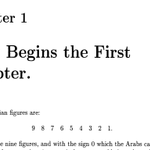
Even as late as the thirteenth century, the Indian origin was beyond doubt. When Fibonacci introduced the system to Latin Europe in Liber Abaci (1202), he began his first chapter: “The nine figures of the Indians are these: 9 8 7 6 5 4 3 2 1. With these nine figures, and with this sign 0, which in Arabic is called zephirum, any number is written.”
He had learned the method as a boy in Bugia, in North Africa, where his father ran the customs house for Pisan merchants. He later studied the arithmetic taught in Egypt, Syria, Greece, Sicily and Provence, and judged all of it, “even algorism and the arcs of Pythagoras,” almost an error compared with the method of the Indians.
His wording is careful. The digits are Indian, and only the name for zero is Arabic.
The Arab mathematicians themselves said the same thing. Al-Khwarizmi’s ninth-century treatise on the system was about calculating “by the Indian reckoning” (ḥisāb al-Hind). Its Latin translation was titled Algoritmi de numero Indorum, al-Khwarizmi on Indian numbers. Al-Uqlidisi’s tenth-century book on the same subject was called Kitāb al-fuṣūl fī al-ḥisāb al-hindī, the Book of Chapters on Indian Arithmetic. Arabic still calls these digits al-arqām al-hindiyya, Indian numerals.
Earlier still, in 662, the Syrian bishop Severus Sebokht praised the Indians’ method of calculating “by means of nine signs,” a few decades after the Arab conquests began.
Europeans called the digits “Arabic” because they got them from Arabs. The Arabs, and Fibonacci, knew better.


Trump, Netanyahu, India’s Socialist Party, and India’s Congress Party, share several common traits. One of them is they all cry about “stolen elections.” ft.com/content/f66a684c-4073…

Aditya Kuvalekar retweeted

भांडारकर प्राच्यविद्या संशोधन मंदिर सादर करत आहे - "परिचय भारतीय ज्ञान परंपरांचा"
एकूण २६ तासांच्या या ऑनलाईन व्याख्यानमालिकेमध्ये वेद, महाकाव्ये, आयुर्वेद, योग, विज्ञान, शेती, स्थापत्यशास्त्र, प्राचीन राजवंश इत्यादी एकूण २१ विषय समाविष्ट आहेत.
"When I first came to India, there was a particular kind of diffidence, which almost felt like there was not enough realisation of its own potential. Today, there is a different feeling. Indians today think bigger and compete harder. They expect more from themselves and from their country", writes @KP24
Like Naipaul, it again takes an outsider to point out the enormity of change in the mindset that India has gone through in the past few years. Economic progress, much like any other progress, first starts in the mind. One must believe in its possibility before one can achieve it.
As India braces for the next wave of conflicts, disguised as resistance, it must keep in mind that mutinies are not to be wished away. But those are minor obstacles in the journey that began somewhere around 1990.
hindustantimes.com/opinion/a…

Wrote a longish essay exploring whether a university education is worth it in today's time.
One of the arguments people often invoke is that much of the knowledge is now freely available online.
However, the track record of people learning online—and finishing courses—is rather poor. Scholars at the world's best universities have made their lectures freely available for nearly two decades now. Gilbert Strang's first lecture on linear algebra has 4.9 million views; by the last lecture, we are down to about 200,000. Across such courses, the fraction of people who make it to the end is anywhere from 1 in 20 to 1 in 100.
There are several problems with today's universities. But, I reckon that the alternatives are vastly inferior.
timesofindia.indiatimes.com/…

Aditya Kuvalekar retweeted

Avg commute time one-way: US 26 minutes, Canada 27m. Australia 31m, Germany 26m, France 26m, Spain 25m, UK 30m, Switzerland 26m, Sweden 26m, Netherlands 27m...
(This is one of my favorite "think in equilibrium" results in all of economics!)
Aditya Kuvalekar retweeted

Imagine this logic applied to public debt.
California defaults on its debt, just this once, and promises never to do it again. Proponents say it will keep borrowing at the same rate as before.
Rauh would say: "No. Lenders won't believe you, so you'll pay a higher rate on everything you borrow from now on. That will cost us dearly in the long run."
Zucman would reply: "Fallacy. Why would lenders charge more unless you default again? And if you default again, you save money again... by virtue of, well, defaulting."

The key problem is this:
Why would billionaires permanently leave California in response to a one-time tax owed if they lived there on January 1, 2026?
It would only make sense for them to leave if the tax becomes annual.
But if the tax becomes annual, it would also generate revenue annually — by virtue of, well, being annual.
Aditya Kuvalekar retweeted

Why are French university students lining up for lunch at 11am when the cafeteria opens at noon?
I took this picture on my way to work this morning because it is a good lesson in “shadow prices.”
In May, France extended €1 university meals to all students. Previously, those not eligible for assistance paid €3.30.
The result was not cheaper meals, but shortages.
Demand surged, and students now queue an hour or more in advance to secure their lunch. What they used to pay with money, they now pay with time.
And this is a lesson in shadow prices. It tells us that students are willing to sacrifice an additional hour to save €2.30, so they are implicitly valuing their time at €2.30 an hour or less.
That's awful. 11 am is one of the best times to study. You are alert, but not yet tired. Even if a fraction of them studied at this time, there could be more value than the one saved by the “cheaper” meal.
While the government did provide €50 million in additional funding for 2026, for a system serving more than 3 million higher-education students (about 8 cents per student per day), the problem illustrates something deeper about France.
Don't get me wrong. I love living here, and I work hard every day to contribute to this country. But too many French institutions operate as though people's time were free.
It is a system where enormous resources flow through the state, and simple transactions are replaced by forms, permissions, and waiting. People grow accustomed to this dependency, sometimes even demanding more of it.
The implicit message of the system is that your time is cheap, your initiative is unwelcome, and your ability to decide for yourself is something to be managed.
It is a sad situation because I genuinely believe France can be one of the best places in the world to live.
But people are tired. And I'm not talking about those who looted sporting goods stores and vandalized public buildings over the weekend. I'm talking about the butchers, bakers, and produce sellers I meet every week at the market. The small antique dealers who worry that a mob could destroy the little capital they have. I talked to many of them yesterday. They are scared and they know there is nothing for them to do other than hide.
A country that values its people should value their time.
Vive la France!

Aditya Kuvalekar retweeted

There are two reasons we did this in Sanskrit. One, because it can be done. 😎
Two, because it opens up some interesting shastric perspectives on the topic beyond regular points of discussion.

Aditya Kuvalekar retweeted

The models in Codex are fine, but even Astra Max in Codex is (by a big margin) not as strong as Astra Pro in the browser.
Many mistaken impressions come from using a coding agent like Codex and seeing it make mistakes. Codex is cute, good for coding and spell-checking, but not for serious academic work.
Really, you haven't seen half of it if you haven't pushed Astra Pro with a few "continue" and "take another pass over your writing".
Aditya Kuvalekar retweeted

You can hate or love Elon Musk, but there’s something undeniably inspirational about the way he takes on extraordinarily difficult problems and solves them through technology, first principles thinking, and relentless execution with his teams.


Aditya Kuvalekar retweeted

Temple freedom is often discussed as important for the organisation of Hindu society. Yet there is little research to inform this debate, largely because few such institutions in India can be studied at scale.
I took this up in my PhD in Economics at the University of Cambridge. I examined how Hindu mutts, among the few Hindu institutions to have retained significant institutional autonomy at scale, have contributed to human capital formation and driven positive structural transformation in the communities they serve.
In this podcast, I discuss my research with @srajagopalan of the Mercatus Center at George Mason University on @IdeasofIndia. Thank you, Shruti, for being a fantastic host and for a wonderful conversation.
We also discuss interesting examples of autonomous religious institutions around the world. I share how Hindu mutts, being outside state control, have served as engines of social and economic progress.

The latest episode of the job market series of @IdeasofIndia @mercatus features @kskishen Shastry
@Cambridge_Uni. We talked about the the role of long standing monastic institutions in India and their impact on education, structural transformation, and political competition in India, and much more.
