

The compliance standard for AI-generated content. Blockchain-anchored. Built for the autonomous AI economy. 🇪🇺 EU AI Act Art. 50 ready.
Joined April 2026
- Tweets66
- Following2
- Followers7
- Likes0




Pinned Tweet
The 4 layers required by the AI Office for AI Act compliance:
L1 — Invisible watermark (survives compression)
L2 — C2PA (verifiable standard credentials)
L3 — Blockchain log (immutable)
L4 — Public detection API
Not optional.
Start now → aiact50.com
#AIAct50

2
57
1/ The EU didn't pick a watermarking standard for Article 50. It said the quiet part instead: no single marking method is robust enough on its own. That one finding reshapes how you build.
#C2PA #AIAct50 #EUAIAct #AICompliance

1
13
3/ Notice who already agrees: OpenAI + Google now ship C2PA metadata and SynthID watermarks together. Meta auto-labels on Instagram. The largest labs converged on layered provenance before the deadline forced anyone's hand.
1
11

3/ C2PA’s own commentators say it plainly: missing or stripped credentials prove nothing, and provenance is verification-first, not detection. The hard part isn’t marking. It’s reading the mark, at scale, when it’s absent or contested.
1
4
4/ That read side — independent, queryable verification anchored so it can’t be quietly rewritten — is the layer Article 50 actually rewards. It’s what we build.
aiact50.com
1
1/ Two dates now define EU AI content compliance. Most teams know one of them.
22 July — deadline to become an initial signatory of the Code of Practice.
2 August — Article 50 transparency obligations begin to apply.
#EUArticle50 #AIAct50 #AICompliance

1
1
14
3/ No vendor is named. But “signed, time-stamped, tamper-evident” describes C2PA today. And the watermark sits alongside the metadata—not instead of it.
The regulator’s posture is clear: layered verification, not a single control.
1
11

4/ Commitment 2 adds another requirement:
a free public detection mechanism.
A standard, software tool, or API that allows anyone to verify whether content originated from your system.
Verification is part of compliance.
1
8
5/ Signed metadata.
Watermarking.
Durable logging.
Public verification.
Four layers.
That is the architecture the Code converges on.
Open.
Verifiable.
Deployable today.
Take Measure 1.1 and compare it against your current generation pipeline this week.
aiact50.com
2
While many organisations still see transparency as a future compliance task, Spain is already building enforcement capacity.
The market may look to Spain for the first practical answers.
#EUAIAct #AIAct50 #AICompliance

48

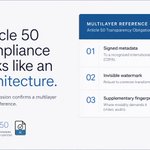
Signed metadata. Invisible watermark. Supplementary fingerprinting.
Three primitives. One architecture. One 3 June deadline to react.
digital-strategy.ec.europa.e…
#AIAct50

10