

imaging neuroscience | brain structure-function-pathology interplay | Alzheimer’s disease | https://xitter.cf/t.co/2T1rtaI2fb
Lund
Joined May 2011
- Tweets801
- Following494
- Followers601
- Likes1.7K




Pinned Tweet
does 🧠 connectivity drive spread of pathological proteins in Alzheimer’s disease?
if this question intrigues you, please check out our new preprint: biorxiv.org/content/10.1101/…
and/or read on.. 🧵⤵️

harry h behjat retweeted

I'll have two computational postdoc positions opening up soon in the @POND_UCL team. One on Alzheimer's clinical trials (data-driven disease models and digital twins). The other on Early Detection via digital/wearable tools. Hit me up for a chat if you're interested.
harry h behjat retweeted

New publication out in Brain! 📢
We found that reference proteins Aβ40 and np-tau consistently helped already high-performing fluid biomarkers (e.g., MTBR-tau243 and p-tau variants) to more reliably represent brain Aβ and tau pathology measured by PET.
🔗 academic.oup.com/brain/advan…

harry h behjat retweeted

Going to ADPD? Come see our work! We would love to share it with you and chat about it if you are interested. See below for a schedule of our sessions, which cover fMRI, proteomics, transcriptomics and AI

harry h behjat retweeted

Inter-individual variability of neurotransmitter receptor and transporter density in the human brain | doi.org/10.1007/s00429-025-0…
How do neuroreceptor distributions vary across people?

harry h behjat retweeted

Are you working with diffusion MRI? Have a look at this analysis-ready and quality controlled dataset of 2,747 participants aged 5–21 years. I was one of the researchers who performed quality control for at least 3000 images.
nature.com/articles/s41597-0…

harry h behjat retweeted

Why do brain 🧠 networks vary? Do these differences shape behavior? If every 🧠 is unique, how can we detect common features of brain organization?
@RodBraga and I explore these questions in our new piece in @AnnualReviews (ahead of print):
go.illinois.edu/Gratton2025-…
🧵👇

harry h behjat retweeted

💥New connectomics paper, now out in @braincomms
We show that indirect “multi-step” connectivity changes to the entorhinal cortex in #Alzheimers unfold along the major axes of 🧠 organization, aka the connectome gradients🌈
➡️ academic.oup.com/braincomms/…

harry h behjat retweeted

PUMBA: A skull-stripping model trained using purely synthetic data, no real brains or labels required. It generalizes across species, modalities, and pathologies out-of-the-box without additional fine-tuning.
Preprint by Jong Sung Park @get_user_data: arxiv.org/abs/2505.07159


harry h behjat retweeted
🚨New publication in Brain Communications!
In this study, we show that microglial cells play a key role in Alzheimer's disease, particularly in regulating changes in soluble tau, based on cell-type-specific genetic evidence.
🔗Full paper: academic.oup.com/braincomms/…

harry h behjat retweeted

Don't miss out! We are still offering FREE access to an IEEE EMBS Membership for all non-members from October 5th - 18th in honor of IEEE Day, a global celebration of technology and innovation.
👉 Learn more here: ieeeday.org/special-activiti…

harry h behjat retweeted

My last PhD paper is out: link.springer.com/article/10…
Thank you to all co-authors and the amazing journey to your side @Neuropresage @SilverSanteEU @Inserm @Universite_Caen @Cyceron14
Now ready for new adventures!

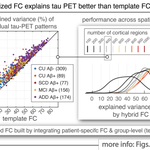
[🧵11] altogether, our findings provide strong evidence that individual functional brain architecture shapes tau propagation in humans, supporting the network-spread hypothesis by showing that variability in connectivity translates into heterogeneity in tau distribution 🧠
[🧵12] this work rests on the foundational guidance of my advisory team @_JakeVogel_ @OskarHansson9 @RikOssenkoppele + decisive inputs from Ruben Smith & @dvdevill + contributions of other brilliant minds at @biofinder_study & demonlab.org —thank you all 🙌